A $12 million book is not the only reason there’s nothing like this Australian library anywhere else
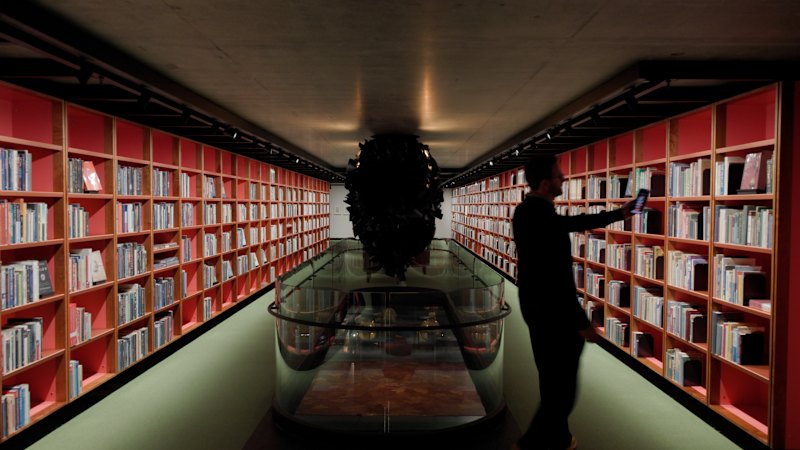
It took 10 years to plan and four years to build, and the budget blew out from $11 million to more than $100 million. But when the Museum of Old and New Art opened its two-level, subterranean Phrontisterion in June, the Hobart library became the only one of its kind in the world.
Thirty-thousand books line the shelves, but there is no Dewey Decimal System organising them. In fact, visitors don’t even need to return them to the spot they found them; if they want to put the book on a different shelf at the opposite end of another floor, they are more than welcome to.
The O, a custom app informed by cameras across the wing, will track down the book. It will also light up the spines of books related to whichever one you’re touching at that moment.
Watch the video below for a full tour of MONA’s Phrontisterion, where librarian Mary Lijnzaad explains how they allow visitors to flick through the pages of a rare, 403-year-old book that nobody is allowed to touch. You can also see the kids’ section, engulfed in a plywood design that makes you feel as though you’re sitting inside a book.
“It’s more about come in, explore, make that leap from looking, to touching, to reading, to enjoying, to thinking,” says Lijnzaad. She calls the Phrontisterion the “end game” of MONA owner David Walsh’s passion for subverting institutional authority and barriers.
Some rules, however, exist for a reason. Lijnzaad got “goosebumps” when she received a text from Walsh informing her he had acquired a rare copy of William Shakespeare’s First Folio, which must sit underneath glass.
First printed in 1623, seven years after the Bard’s death, it preserves 36 of his plays and is widely considered one of the most influential books ever published.
MONA’s copy is one of two in Australia, and the only one in Tasmania. It’s worth about $US6 million to US$8 million ($8.7 million to $11.6 million) and is vulnerable to irreversible damage when handled.
So how does the Phrontisterion make it accessible to the public when MONA staff barely touch it a few times a year? Find out in video above.
Want more book content? We’ve got you covered
- What if Oscar Wilde had lived to 90? Plus nine other books to read
- Six books are vying for the Booker Prize. One stands above the rest
- The frenzy over this new book proves Australians like their literature with a side of spice
The Morning Edition newsletter is our guide to the day’s most important and interesting stories, analysis and insights. Sign up here.
KioskNews shows a cleaned-up reading view extracted from the publisher’s page — the original always lives on their site, not ours.