Malaysia Hindu rites row: live stream of Muslim youth’s repentance fuels fury

A young Malaysian Muslim who took part in Hindu rituals to pray for his ailing mother publicly repented on Thursday in a ceremony live-streamed by state religious authorities, a day after a sharia court ordered him to undergo three months of faith rehabilitation.
The spectacle has raised questions about the enforcement of Islamic orthodoxy in Muslim-majority Malaysia, where state religious departments wield significant influence to police the personal conduct and religious beliefs of Muslims.
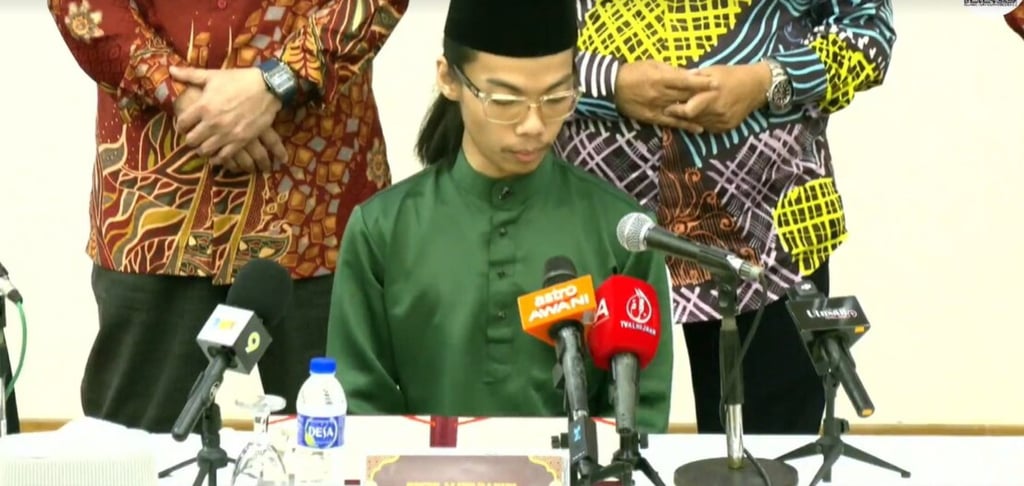
Wearing emerald-green traditional Malay attire, 21-year-old Aliff Daniel Adli read his declaration before senior Islamic officials at the Sultan Salahuddin Abdul Aziz Shah Mosque in Selangor, the state surrounding Kuala Lumpur. The proceedings were broadcast on the official Facebook page of the Selangor Islamic Religious Department.
“I make this declaration sincerely, full of remorse and without any pressure or coercion,” Aliff said during the broadcast, acknowledging that his actions had caused widespread public unease. “I deeply regret my actions and promise that I will never repeat them. I repent and return to the right path.”
The controversy erupted in October after photos and videos circulated widely on social media showing Aliff taking part in Thaipusam rituals at the Batu Caves temple in 2024. The online backlash prompted religious authorities to launch an investigation, resulting in the arrest of Aliff and his mother on October 13.
Thaipusam is a major annual festival observed by Tamil Hindus honouring Lord Murugan, during which devotees perform acts of penance, including bodily piercings and carrying ornate devotional offerings known as kavadi.
Aliff said he had fasted on water and vegetables for a week before joining the rituals in January 2024. Describing his participation, he said he wore a white dhoti and flower garlands, pierced his cheek and tongue and carried both a kavadi and a milk offering up the temple steps to pray for his mother’s health, family happiness and spiritual purification.
His mother, Rohizayanti Ramli, wept as she delivered her own public apology for what she described as her failure to guide her son.
“I acknowledge my negligence and failure in fulfilling my responsibility as a mother,” she said. Aliff’s younger sister also took part in the ceremony, expressing regret for not offering him better advice.
Their declarations were signed and endorsed by senior Islamic officials, including the Mufti of Selangor, along with two other witnesses.
Faith on trial
Islam is Malaysia’s official religion, adhered to by nearly two-thirds of the population. Under the country’s dual legal system, state-level sharia courts hold jurisdiction over Muslims in personal, family and religious matters. While the nation’s sizeable Buddhist, Christian and Hindu minorities freely practise their faiths, ethnic Malays – defined under the federal constitution as Muslim – face strict restrictions on acts deemed contrary to Islamic teachings.
The ceremony followed a ruling on Wednesday by the Gombak Barat Sharia Lower Court, which sentenced Aliff to three months at a religious rehabilitation centre in Hulu Yam after he pleaded guilty to improper worship.
The charge carries a maximum penalty of two years’ imprisonment, a fine of up to 3,000 ringgit (US$730), or both. Prosecutors sought rehabilitation rather than a custodial prison sentence, state news agency Bernama reported.
During sentencing, presiding judge Mohd Faizal Habib reminded Aliff that his actions bordered on syirik – the sin of polytheism or associating partners with God. “This repentance is a matter between you and Allah,” the judge said.
The court scheduled a review hearing for February 25 next year to assess his progress. Aliff told the court that while the images had only recently gone viral, they were taken when he was 18 years old.
Speaking at Thursday’s broadcast, Selangor Islamic Religious Council chairman Salehuddin Saidin defended the proceedings as part of an effort to restore proper religious understanding.
“Every individual deserves to be treated respectfully and their dignity preserved,” Salehuddin said, adding that repentance required more than words spoken in public.
But the decision to broadcast the family’s apology drew sharp criticism from some observers.
Ahmad Fauzi Abdul Hamid, a political scientist at Universiti Sains Malaysia, questioned both the necessity and intent behind publicising the case.
“Religiously, what good is there in humiliating a 21-year-old who just happened to deviate?” he said, contrasting the event with the 1994 televised repentance by members of Darul Arqam, a banned Islamic movement with thousands of followers, whose broadcast was pre-recorded rather than aired live.
“It’s simply a show of power by the religious authorities,” Ahmad Fauzi said. “It serves no theological purpose.”
KioskNews shows a cleaned-up reading view extracted from the publisher’s page — the original always lives on their site, not ours.