Chris Bowen faces a titanic task at Cop31. What will it take for the world to make the climate crisis its top priority? | Adam Morton
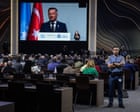
Australian politics could have looked markedly different this week if the Albanese government had succeeded in its longstanding bid to host a major UN climate summit in Adelaide.
Tens of thousands of people, including ministers and diplomats representing 200 countries, would have descended on the city of the toxic algal bloom to meet, lobby and negotiate over how to tackle the climate crisis, and wander the halls of a massive green trade fair that runs alongside the formal talks.
For two weeks, it would have been the biggest news story in the country. It would have blocked out the sun. Instead, an estimated 100,000 people are flooding the streets of Antalya, a Turkish resort city on the Mediterranean, for the summit known as Cop31.
Some senior members of the Albanese cabinet are not sorry they are so far away and lost enthusiasm for hosting the event before the final decision was made. Aside from the climate change and energy minister, Chris Bowen, the government has shown a diminishing appetite to make the case that fighting global heating is a top priority.
It still has the policies it brought in after the 2022 election – to underwrite large-scale renewable energy, make electric vehicles more available and affordable, and put a limit on industrial pollution – and last year added a generous household battery subsidy scheme. But meeting its emissions reduction targets will require significantly more. So far, those steps are MIA.
Meanwhile, the government continues to approve new coal and gas extraction, mostly for export. Since its election, 38 developments have been given the green light.
It continued a long-term trend. Since 2005 – the year against which Australia measures its emissions reduction targets – annual domestic emissions are estimated to have fallen by 25%. But, according to analysis by Naru Research, emissions from burning Australian fossil fuels after they are exported overseas have roughly doubled. Australia is one of the world’s top-three fossil fuel exporters. It sends a lot more climate pollution overseas than it releases at home.
Whatever justification is made for this – and the Albanese government does have a position – behaving like this while arguing the world needs to cut emissions is understandably going to lead to accusations of hypocrisy.
On the other hand, an incestuous club of science-denying rightwing MPs and News Corp publications relentlessly attack the idea that anything should be done about climate pollution. The result was that some senior government figures ended up not wanting to spend two weeks and hundreds of millions of dollars in Adelaide while defending themselves from attacks on two flanks.
The government could have chosen to get on the front foot, Usman Khawaja-style, and taken on its critics by making an evidence-based case that there is no greater threat to living costs than failing to address the climate crisis while developing a roadmap to get off fossil fuels. That would have been electorally brave, but it’s not the climate universe we currently live in.
It also may not have worked. Australia hung in for years attempting to win the rights to host Cop31, but Turkey would not yield. The compromise deal is that Bowen is the president of negotiations – a specially created role that gives him the unenviable task of attempting to wrangle an international consensus on what needs to be done (or near international consensus – the US under Donald Trump is an official non-starter).
It’s a huge job. And it does matter, even if climate talks no longer carry the profile or expectation they did in 2015, when the landmark Paris climate agreement was signed.
As my colleague Fiona Harvey explained, the world has missed a key goal of the Paris agreement – aiming to keep global heating to 1.5C above preindustrial levels – and progress that has been achieved has been slow and partial. It took until Cop28 in 2023 for there to be a UN consensus agreement that the world needed to “transition away from fossil fuels”.
But the agreement did help drive an increase in renewable energy investment by sending a signal to big money that this was where the world was heading. It showed some sort of global momentum on the issue was possible, with caveats. Projections of future temperature increase remain bad, but not quite as catastrophically bad as a decade ago.
Despite the sharp cynicism about Australia’s love affair with coal, Bowen is well regarded within the UN climate negotiations, winning praise for the role he has played in trying to advance the negotiations since 2022. He played a central role alongside Pacific leaders in the compromise deal in Dubai that led countries to agree that a transition away from fossil fuels was necessary.
That, to put it mildly, is not a claim heard often from many of his cabinet colleagues. Anthony Albanese has given some recent speeches on the climate crisis on the international stage – at New York Climate Week in September and the pre-Cop meeting on Pacific islands in October – but he didn’t mention fossil fuels, or the need to limit Australia’s still-expanding coal and gas industries. He is scheduled to speak during the high-level leaders’ summit segment in Antalya later this week.
Whether the global community can bring itself to name fossil fuels as the problem will be at the centre of debate over the next fortnight. There will also be focus on an alternative path: a potential agreement that 35% of the world’s energy should come from electricity by 2035.
An analysis for the Australian government suggested reaching this target could lead to a significant reduction in fossil fuel use across industry, transport, heating and cooking, and spur investment in clean energy. The global energy crisis triggered by Donald Trump and Benjamin Netanyahu’s attack on Iran has underlined why it is necessary.
Other goals nominated by Bowen in an interview with the Guardian include mobilising climate finance for island states, including in the Pacific, that currently receive just 0.2% of what has been committed globally to help countries cope with the crisis despite being some of the nations most at risk.
He also emphasised the need to limit “overshoot” – that is, how much the world goes past 1.5C heating so that it has a chance to get back there by drawing carbon dioxide from the atmosphere. This is what is meant when Cop31 is described as an implementation summit: that national commitments to cut pollution and help the world’s most vulnerable people are put into action.
That may be too much to hope for. It may be that the best result possible in Antalya is just keeping the UN climate progress together until, maybe, the US returns under a Democrat president and the world meets in a historic climate summit in China in two years.
Either way, it will be a hard slog, and we should be willing them to succeed.
KioskNews shows a cleaned-up reading view extracted from the publisher’s page — the original always lives on their site, not ours.