Germany does not want China decoupling but must defend its interests, president warns
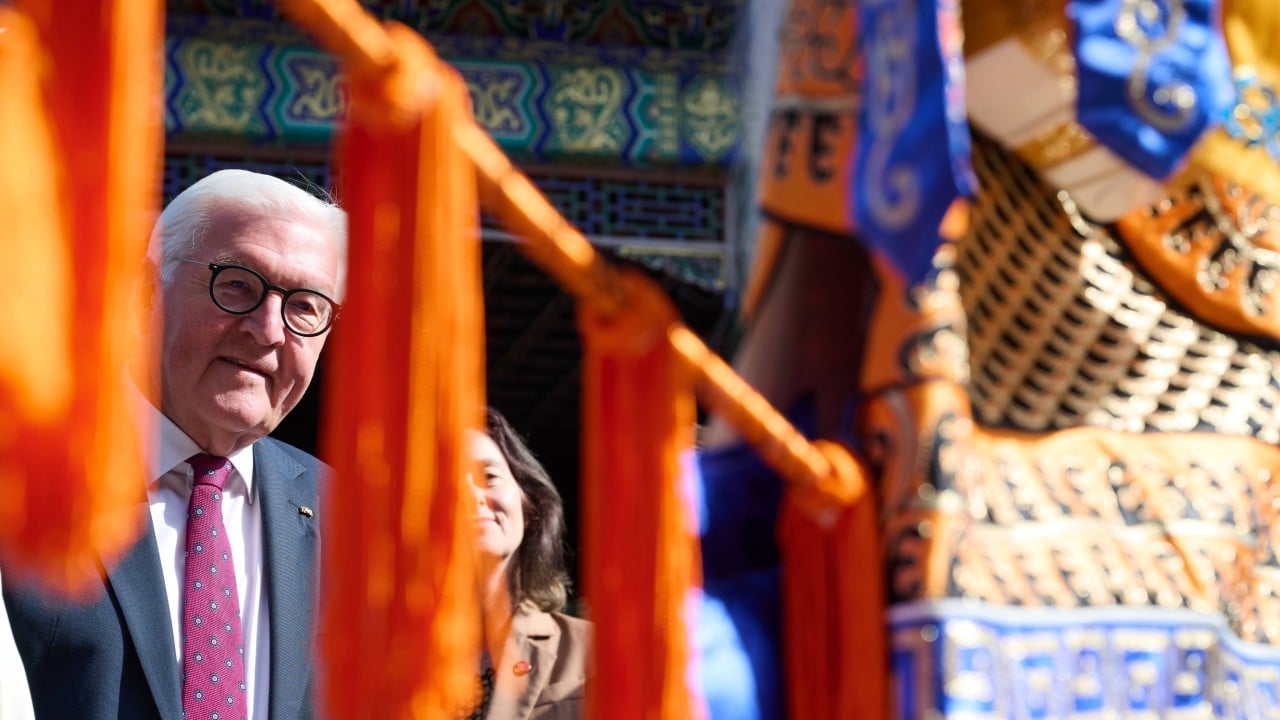
Germany is not seeking to decouple from China, but must defend its economic interests, visiting German President Frank-Walter Steinmeier said in Beijing on Thursday, echoing the line taken by Chancellor Friedrich Merz during his tour of neighbouring countries.
Speaking at Peking University, Steinmeier insisted that Europe’s goal was not to sever ties with the world’s second-largest economy, but to reset the relationship on a fairer footing.
“Our goal as Europeans is clear. We do not want decoupling from China,” he told students and academic staff.
“We want to shape trade so that it continues to bring benefits to both sides. In short, win-win must not turn into win-lose. Partnership works only when both sides have something to gain.”
His comments followed a warning from Merz on Tuesday, who said in Singapore that economic decoupling from Beijing would be a “big mistake” that would not make Europe “safe” or “more prosperous”.
Instead, he said, Germany was adopting a realistic approach centred on de-risking and diversification to reduce “unhealthy, one-sided dependencies” in areas such as energy, supply chains and critical raw materials.
Two years ago, the European Union imposed tariffs on Chinese electric vehicles because of concerns about state subsidies. Since then, Beijing has responded with tariffs on European brandy, pork and dairy products and restricted exports of critical minerals.
An agreement reached earlier this month between Beijing and Brussels, which could cut Chinese exports of hybrid cars by more than half, was described by European officials as a crucial first step in rebalancing trade relations.
Steinmeier expressed confidence that dialogue could help ease tensions, adding that the agreement proved “solutions are possible”.
02:05
Emboldened EU readies China company ‘kill switch’ as Beijing warns Brussels not to ‘fantasise’
He also stressed that Germany would act in concert with the rest of the EU.
Faced with a ballooning trade deficit with China, Germany – Europe’s largest economy – appears to have shifted its position.
Two years ago, it voted against the tariffs on Chinese EVs to protect its carmakers’ extensive investments and market share in China.
But the EU’s goods trade deficit with China swelled to over €370 billion (US$412 billion) last year and is on track to surpass €400 billion this year – a figure European Commission President Ursula von der Leyen has branded “unsustainable.”
Steinmeier said that Europe could not allow its industrial base to be lost, adding that China, whose own rise was built on industrialisation, should understand this.
The push for firmer measures is gaining momentum across Europe. Last Friday, EU ministers called for further limits on Chinese imports while exploring additional trade defence mechanisms, such as import quotas on plastics.
On Thursday, Steinmeier said: “We Germans do not want the world to fracture into blocks. We do not want a new block confrontation.”
He added that Europeans had “no fear of China rising,” but “the rise of one does not mean the decline of another”.
Beyond trade, Steinmeier urged Beijing to use its diplomatic weight and work with other countries to get Russia to halt its attacks on Ukraine and enter serious peace negotiations.
The push comes ahead of next month’s Asia-Pacific Economic Cooperation summit in Shenzhen next month, which could see three-way talks involving China, Russia and the United States about the wars in Ukraine and the Middle East.
On Thursday, Russian state news agency Tass reported that the Kremlin had said such a meeting was possible, but no final agreement had been reached.
KioskNews shows a cleaned-up reading view extracted from the publisher’s page — the original always lives on their site, not ours.