LOCAL ELECTIONS 2026: Slovo Park could be a Joburg success, but residents have lost hope in elections
Tshediso Moses Poshodi was 35-years-old in 2016 when he sat in the Johannesburg High Court, nervously awaiting the fate of Slovo Park, the informal settlement he had called home for more than 15 years. The air was thick with anticipation. Seated with bated breath, Poshodi and his fellow Slovo representatives listened tensely to the judge’s verdict.
“We were from squatter camps and we were fighting with the City of Joburg,” he says, explaining how the City had previously rejected their pleas for development and was planning on evicting them to the city’s outskirts.
“We were fighting with the people that have money and are capable of hiring expensive lawyers to fight against us, so we didn’t expect anything good coming from the judge.”
However, contrary to the community’s fears, a historic turning point was made on April 6, 2016. Rather than being relocated outside the city, residents won a monumental order for in-situ upgrading to develop their settlement right where it stood.

Finally, Slovo Park was on the path to transformation. Poshodi remembers how the courtroom erupted into joy. People were cheering, others were crying, some were praying.
“We didn’t even know how to celebrate,” Poshodi recounts, a flicker of joy still lingering in his voice. “It was a miracle.”
10 years later
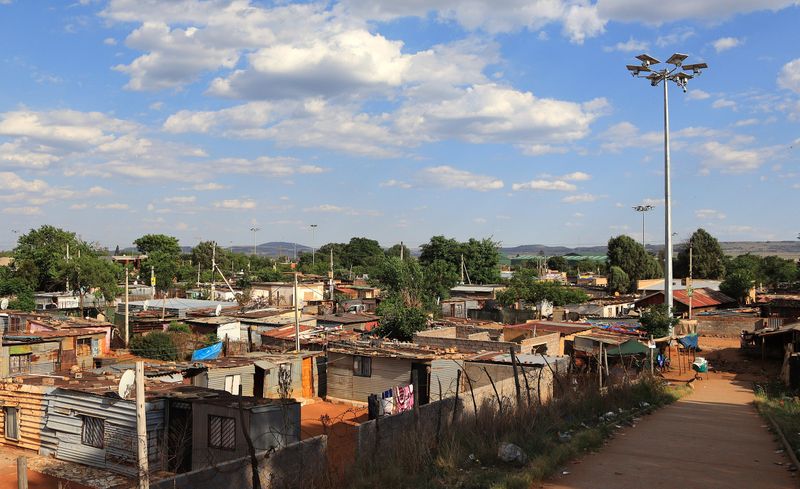
Poshodi is now 45-years-old. He lives right on the border of Slovo Park, south of Soweto, near Nancefield and Olifantsvlei, where mountains of rubbish are the only thing separating his home from the N12 highway.
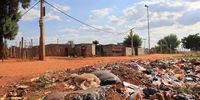
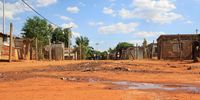
The roads are long stretches of dusty, red craters and children play alongside open sewer pits. Countless corrugated iron shacks rust, waiting for the upgrading that was promised all those years ago.
A decade has passed since the monumental 2016 ruling, yet Slovo Park remains a forgotten corner of the city. The community has seen little progress beyond the installation of electricity and non-functional smart poles that fail to provide Wi-Fi.
The legal victory never translated into reality. With every new election season come and gone, the promises flood in, but the community stays the same.
As the 4 November local elections loom closer, Poshodi feels completely divided. In the beginning, like many residents in Slovo Park, he was a proud ANC loyalist. He was even a member of the party at one point.
But after countless broken promises, Poshodi decided to change his party affiliation.
“I wanted to punish the ANC,” he admits.
Little did he know, switching political allegiances would only reveal a more troubling landscape.
“All the political parties are the same,” he states, with a painful chuckle.
“Even if I go to EFF, Mayibuye or Inkatha, they are the same. They are going to do the same thing. They are going to delay, sit down and eat the money, thinking about their families rather than thinking about the communities.”
Poshodi’s disillusionment reflects a broader trend among many Slovo Park residents who have lost faith in political parties bringing any change to their community.
Cecilia Hlongwane is a 58-year-old pensioner who has lived in Slovo Park for 26 years.
“We were very excited,” she says, recalling the day their community won the Melani case.
“Lawyers also came. They made a meeting for us. They told us they’re going to build our houses. They told us they’re going to make a rail this side. We’re going to have a train,” she chuckled
“Everything was going to be alright.”
She pauses for a moment and looks down. “But they only came that day, those people. After that, we never saw them again.”
Hlongwane remarks on the worsening conditions in Slovo Park.
“We’ve got a lot of rats here,” she says. “You can clean your place, but sometimes you’ll find a small rat because the place is dirty.”
She motions to the surrounding land piled high with waste and rubbish. “And the people are dumping everywhere.”
“And also the toilet,” she grimaces, gesturing to the pit latrine outside.
“They said it was temporary for four to five years, but I think this toilet is going for 15 years. The flies go inside there. When it’s raining, the toilet gets full and floods out on to the land.”

Hlongwane has supported the ANC since 1994. However, the upcoming November elections will mark the first time she changes her vote.
“I still have hope, but in my mind I see what’s going on in South Africa,” she says. “I think we must also change. The government must change. They had a lot of time to do things for us, but they didn’t do it.”
The youth disconnect
For 20-year-old Kgopotso Moloi, the November elections will mark her first opportunity to vote.
“I feel excited. Confused at the same time, because I don’t know which one I will vote for,” she says.
“Voting, it brings change. As youth, we are promised if we vote, we will get jobs. That’s what we’re also hoping will happen.”
However, Moloi’s decision to vote stands out as uncommon. As much as political cynicism appears to be the trend among the older generation living within Slovo Park, much of the settlement’s youth are alienated from politics altogether.
Regina Shomang is 19 years old and finds voting meaningless.
“I would say most of my peers don’t believe in voting,” Shomang admits. “Each and every year, the parties always promise us stuff, but then there’s still no change, so there isn’t any use [in] believing in them any more.”
For others, matters of politics are secondary to their immediate survival. In the absence of formal economic pathways and institutional support, socioeconomic pressures have driven many of the youth into substance abuse, gangsterism and petty crime.
Vuyo Tsatsi (18) attests to this, observing how substance abuse and crime have swallowed up most of his peers. Yet, rather than viewing this purely as reckless behaviour, he sees it as a tragic coping mechanism for young people who feel entirely trapped by systemic neglect.
“I feel like as a young person, you choose to dwell in those challenges,” he states, pointing to how lack of opportunity leaves the youth with little else to turn to.
Fighting to be heard
Slovo Park’s decades-long struggle for basic dignity has not had any success. Since the 2016 high court ruling, the community has routinely blockaded the N12 highway with burning tyres and rubble, a message to the government not to forget about the promises made to Slovo Park.
“Instead of helping us, they send the police to come and shoot us,” Poshodi remarks.
“Every time we try to close the freeway and say: ‘City of Joburg, please help us’, they send the police.”
During a strike in 2023, the confrontation turned deadly. Karabo Chaka (16) was shot and killed by police. “After the strike, Slovo Park was in red blood,” Poshodi recalls.
The fact that even bloodshed wasn’t enough to make the City act has left Poshodi defeated.
“There’s no hope that we’re going to get any development here in Slovo Park,” he states solemnly. “There is no hope.”
However, for some residents, change is still possible.

Fezeka Kobo has lived in the settlement since 1994 and refuses to give up on the future of Slovo Park.
“Some people say: ‘Why must I vote? Because I voted previously, but I see no difference,’” she says. “But I’m voting because that’s where I feel I’m gonna get an opportunity for my vote to count. There’s still hope.”
“It seems as if we are the forgotten place,” Kobo adds. “I just hope Slovo Park can become a developed area just like Freedom Park. Our hearts are so painful because we were here first, but then Freedom Park got developed before us. So my wish and my prayers [are] that Slovo Park gets proper housing, proper sanitation, proper schooling. Proper everything, like any other place.” DM
KioskNews shows a cleaned-up reading view extracted from the publisher’s page — the original always lives on their site, not ours.