[Column] A glimmer of hope for inter-Korean dialogue from Kim Yo-jong
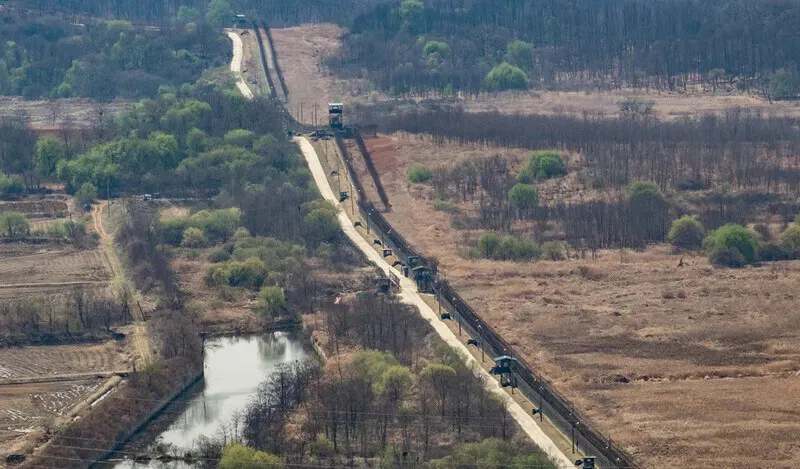
The DMZ, which divides North and South Korea. (Getty Images Bank)

By Gil Yun-hyung, editorial writer
What initially overcame me when I read Kim Yo-jong’s statement Tuesday denying North Korea’s responsibility for the mine explosions that severely injured South Korean soldiers at the border was not rage, but an odd sense of relief.
Much like how the National Intelligence Service described that statement as an “extremely low-level response,” I was able to recognize that the North was taking this current crisis incredibly seriously.
The most important first step toward resolving an issue is acknowledging that there is a problem. The North’s statement offers at least a glimpse of acknowledgement, making it hard not to hope that the possibility of restarting inter-Korean dialogue, which came to a halt in late 2018, has risen from 0% to 2%-3%.
The statement can be divided into three sections.
The first section is focused on justifying North Korea’s efforts to fortify the border, which began in spring of 2024.
Kim noted how the entire world was aware of how North Korea’s army began building barriers along the southern border as part of its effort to strengthen the border two years ago. She described the effort as a “thorough exercise of sovereignty unrelated with any military purpose.”
In the same vein, North Korean leader Kim Jong-un abandoned the goal of territorial integrity, which had been passed on from his grandfather Kim Il-sung, in late 2023. Instead, he opted to define inter-Korean relations as being one between two separate and hostile states.
Following this shift, a new territory clause was added in March to the North’s constitution, while the previous clause on reunification was deleted.
With no reason for the North to fraternize with strangers, it embarked on a massive construction project to physically disconnect the two Koreas from one another. This included installing tactical roads and barbed wire fencing, as well as planting mines.
The second section concerns itself with arguing that the North was not complicit in the mine explosion incident. Kim slammed South Korean “military warmongers” for groundlessly caviling at the North’s alleged attempt to cross the border, stating that “our soldiers have never crossed the border.”
Since North Korea insists that its soldiers have never crossed the line, Kim is labeling this incident as a “clear farce” orchestrated by the South.
However, on Monday, South Korea’s Joint Chiefs of Staff announced that the mine exploded “around 10 meters south of the Military Demarcation Line.” This was followed up on Wednesday, when the Joint Chiefs stated that North Korean crossings across the MDL were about 20 in August and about 30 in September.
The UN Command also stated on the same day that it discovered one North Korean anti-personnel mine south of the MDL.
If we accept that both the North and the South are basing their claims on their respective understandings of the facts, it becomes clear that the two countries are operating with drastically different reference points for the MDL.
According to a 2019 journal article by Kye Yong-ho, a military expert and former Marine, the current MDL was drawn on a 1:50,000-scale paper map with pencils, ballpoint pens, and oil fountain pens by representatives from the UNC, North Korea, and China during armistice talks in July 1953. If we assume that the thickness of a pencil line is 1 millimeter, a single pencil stroke would represent a margin of error of 50 meters.
Since the North began fortifying the border, the accurate demarcation of the MDL —which had been largely neglected for the 70 years following the armistice — has become a key variable threatening peace on the Korean Peninsula.
Aware of this risk, the South Korean Defense Ministry reached out to the North in November 2025 to suggest talks over the demarcation of the MDL, but the North remained silent. It did not acknowledge that a serious problem requiring swift resolution by both Koreas had emerged.
Over time, however, North Korea has adopted a different approach. The third section of the statement is rife with recognition that the tense military situation is exceedingly perilous.
“The ROK military warmongers are [. . .] teasing our personnel mobilized for building the border barriers about the groundless ‘crossing of the border,’” Kim said, protesting how the South was “seriously threatening the personal safety of our soldiers through warning broadcasting and warning shots.”
“It is clear that if the frequency of malicious accusation and provocation against us in the border region are frequent and lead to an encroachment on our actual territory and military sovereignty,” Kim warned, “the rogue group will [. . .] only face a miserable and catastrophic position.”
Basically, North Korea is arguing that it is engaging in legitimate construction work. As such, it will not accept responsibility for the mine explosion when the South claims that its soldiers have crossed the border and has also fired warning shots.
What we need to focus on is that Kim clearly recognizes the risk posed by “the frequency of malicious accusation and provocation.”
If the North continues to push ahead with construction without establishing an MDL that both sides can agree on, this will lead to a bigger and more complicated fiasco.
Both Koreas must immediately engage in dialogue to resolve the issue. What is more important than the lives of young soldiers?
KioskNews shows a cleaned-up reading view extracted from the publisher’s page — the original always lives on their site, not ours.