Arson attacks now so ‘routine’ that firefighters are being warned before a flame is lit
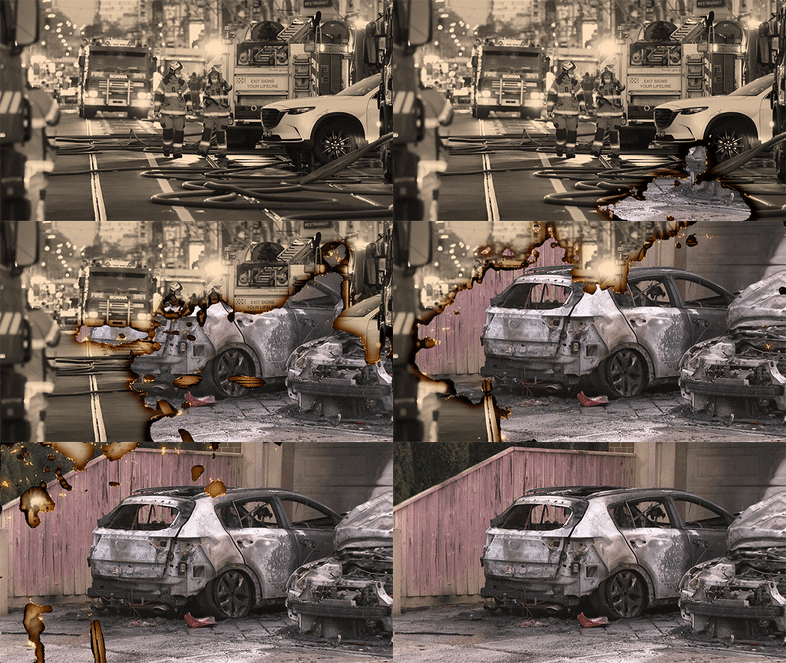
Arson attacks have surged by up to 380 per cent in five Victorian council areas over the past decade, and the crime has becomes so common that police are issuing alerts to firefighters in advance of targets being hit.
The unprecedented rise of firebombings as an everyday weapon of intimidation and revenge means that, on average, nearly 10 fires are being deliberately lit every day, leaving police and fire services scrambling.
More than 23 businesses, homes and cars have been targeted in just over a fortnight in October as teenagers are being used to unleash Victoria’s latest crime wave.
Organised crime gangs’ methods of recruitment are rudimentary but effective – police intelligence suggests one recently arrested middle man had access to up to 2000 foot soldiers.
The pace of incidents is now nearly as bad as the darkest days of Victoria’s “tobacco war” from 2023 to 2025, although fire as an instrument of terror and intimidation is now being used widely against homes, cars, retailers and restaurants.
A firefighting source, who cannot be identified publicly, said police were now sometimes issuing alerts to firefighters in advance – called a “pre-warning” – that a target somewhere in their service area could soon be hit.
New data obtained by this masthead from the Crime Statistics Agency shows arson offences have soared nearly 75 per cent since a decade low in 2021.
“This is how fights are waged now, how messages get sent,” said an organised crime detective, who cannot be publicly identified. “It can cost next to nothing to send someone out to stage a firebombing – there’s that many kids willing to do it.
“Doesn’t matter how dangerous it might be, that’s not a consideration for these people. And finding out whose responsible is getting very, very difficult.”
The new surge in targeted arson attacks ignited from embers first struck in 2022, which fuelled a “tobacco war” that claimed five businesses a week during its 2025 height, before the tactic was more widely adopted by criminals across the state.
Analysis of more than 29,000 arson offences between June 2017 and June 2026 emphasises just how targeted and calculating arsonists have been. While overall arson offences have only increased by 11 per cent in Victoria over the past decade, attacks on retailers have soared by almost 140 per cent.
Clear geographical hotspots have also emerged. Arson attacks have more than doubled in the Melbourne, Port Phillip, Monash and Stonnington local government areas, while rates have also spiralled in Wellington, Maribyrnong and Darebin.
Stonnington recorded a 385 per cent increase in arson attacks over the decade to June 2026, with 34 incidents in that year alone as criminal gangs turned their attention on nightspots as part of the so-called bar wars.
In 2016, only one in 56 arson offences involved the type of business typically involved in the tobacco trade, including shopping complexes, convenience stores and small retailers. But in the decade that followed, the rate of businesses being targeted has increased, now accounting for one in every 15 arson offences.
The “tobacco war” ignited in March 2023 after rising gangland figure Kazem “Kaz” Hamad began to form a “cartel” to control the illicit cigarette market, with rivals and resisters attacked in waves of fire bombings that compelled operators to pay an extortion “tax” to operate and stock the syndicate’s smuggled product.
The Australian Criminal Intelligence Commission said it identified more than 200 arson attacks nationwide linked to the illicit tobacco trade between 2023 and early 2026.
Some estimates are significantly higher. The vape advocacy group ALIVE puts the figure at nearly 300, based on an analysis of nationwide media reports.
Crime Statistics Agency data reveals that the conflict inside the illicit tobacco market began even earlier than most estimates, in 2022, when fires at tobacco-related businesses more than doubled.
They rose from 47 in 2021, to 102 in 2022, despite there being no simultaneous increase in arson at other types of businesses or locations.
In these early days, more than a half dozen crime gangs – including a number of prominent Middle Eastern organised figures, outlaw motorcycle gangs, and ambitious start-up players – were beginning to use violence to corner parts of the state’s rapidly expanding market.
They were also turning to vulnerable kids to do their dirty work, increasingly using encrypted messaging and online recruitment to groom an ever-expanding network of troubled, and then cleanskin, teens to light their fires.
Victoria’s Commission for Children and Young People had already warned in 2021 of growing concerns over the criminal exploitation of children. It had recommended the government and Victoria Police commit to a specialist joint, targeted and statewide response to stop young people in residential care being groomed, but the request went nowhere.
There were more than 1600 illicit tobacco retailers jostling for market share in suburban shopping strips and regional towns by this time, according to police intelligence.
The first notable arson hotspots were Frankston and Kingston, in Melbourne’s south-east.
Despite Kingston not recording a single arson at tobacco retailers in the previous five years, 19 businesses in the area were suddenly hit in 2022.
The rate of tobacco-type retailers being targeted remained high throughout 2023, before surging by almost 50 per cent in 2024.
In July, the firebombing of a tobacco shop in Richmond destroyed nearly a dozen neighbouring shops along Victoria Street in what has been one of the most damaging attacks to property of the more than three-year-old “tobacco war”. Containing the blaze took 80 firefighters and 25 trucks.
Retailers in Melbourne, Merri-bek, Whittlesea and Brimbank bore the brunt, with each of the local government areas suffering at least a doubling or tripling of businesses being targeted that year.
When the war spread to restaurants in 2025, attacks in central Melbourne doubled again. During 2025, 23 Melbourne tobacco-connected businesses and restaurants were torched – up from just three in 2023.
Arson attacks on businesses in Hume, Dandenong, Geelong, Maribyrnong, Whitehorse and Melton also surged, as 263 tobacco-type retailers and restaurants were razed in 12 months.
The “tobacco war” accelerated a trend that was already becoming embedded in the wider criminal milieu that had come to regard arson as a cheaper and simpler method of warning, intimidation and retaliation than gun violence.
A jerrycan costs as little as $20 to buy and its contents less than $10.
As a result, criminal flames have spread well beyond illegal tobacco stores.
Deliberately lit house fires doubled between 2017 and 2026, though the increase is focused on the Monash, Darebin, Greater Dandenong and Yarra Ranges local government areas.
Even police stations have become a target. Sixty have been set on fire in the past decade – including 13 during the COVID-plagued 2021. In both central Melbourne and Geelong, stations were hit five times.
At the other end of the spectrum, only three brothels or sexual services, eight second-hand shops and 16 gaming venues have been torched in the past 10 years.
Firebugs have increasingly struck Victoria’s public transport network, despite arson at other public areas including streets, open spaces, schools, and on agricultural land, decreasing.
However, not all incidents are connected to organised criminal activity.
In 2025, a mentally ill man allegedly set eight separate fires in just over 30 minutes in the small regional town of Portland, torching a portaloo, laundry trolleys and rubbish bins.
Numerous arsonists have been convicted, in part, by CCTV evidence of them filling up jerrycans at suburban petrol stations before “jobs”.
Contracts to do firebombings, often by teenagers, cost as little as $200. More “professional” operators can charge up to $20,000.
A criminal cottage industry has also arisen for providing full jerry cans and stolen cars to order, delivered to a planned location for contract arsonists to collect and use.
There has also been an innocent casualty – Katie Tangey died along with a family dog when arsonists, believed to have been sent by Kaz Hamad, targeted the wrong house in January 2025.
No one has been arrested for that crime.
Arsonists lighting themselves on fire has also become a common sight in this latest wave of violence.
In January, a 52-year-old man died of his injuries after setting himself alight during a tobacco shop burn job in Chapel Street.
In the string of fires set this month, a 13-year-old suffered burns to 90 per cent of his body after a botched arson attack on a home in Taylors Hill where he was promised a $3000 payment.
The police, increasingly frustrated by the recklessness of the arson attacks, have sworn to hold accomplices to account for the injuries sustained by their co-offenders. This call out began when a 22-year-old was left for dead after setting a fire at a western suburbs tobacco shop in September.
“This individual will have life-changing injuries,” arson squad Detective Inspector Chris Murray said at a press conference. “His mate, when we catch him, will be charged with the offending that comes with [this crime].”
Start the day with a summary of the day’s most important and interesting stories, analysis and insights. Sign up for our Morning Edition newsletter.
KioskNews shows a cleaned-up reading view extracted from the publisher’s page — the original always lives on their site, not ours.