One thing must now be clear to Andy Burnham. The rightwing press is on a war footing – and he’s the enemy | Jane Martinson

While the merits of a so-called Britannia shield to protect Britain from missiles and drones are debatable, the Conservatives’ proposal did achieve one thing last week: the very idea of the shield was used to anoint a political leader.
In a significant development, little observed amid the hullaballoo of news events, Kemi Badenoch’s uncosted, pie-in-the-sky plans to build a £10bn anti-missile system were enthusiastically heralded by the rightwing press. It was not just a matter of the plans themselves being lauded, even by outlets that must know them to be ridiculous. More significant is what it said about the champion chosen by these media organisations in their offensive against the Labour government and Andy Burnham.
The Sun splashed a smiling Badenoch across its front page with a banner headline calling her the “Iron Dome Lady”; the Express paraded her in a power suit and a union jack. The Daily Mail, meanwhile, hailed the Tories for seeking to “protect the nation’s skies” and sealed the plans with its “Don’t Leave Britain Defenceless” campaign stamp. Even wartime leaders could not hope for better, unquestioning coverage from battle-aligned, nation-rallying propaganda sheets.
The slavish Badenoch coverage is significant so soon after Burnham’s first conference speech as prime minister. It marks the moment when much of the rightwing press has returned to its traditional Tory-supporting ways after years of flirting with – and outright eulogising – Nigel Farage and his now scandal-hit Reform UK party. It also suggests a back-to-basics return to the economy as the chief battleground for this fight, and not the madder excesses of the war on woke that has recently consumed them.
The praise for Badenoch, who was also recently treated to an all-expenses paid trip to Greece to meet Rupert Murdoch and executives from the Sun and Times-owning News Corp, suggests that she has cemented a position as the rightwing press’s best political hope of beating Burnham.
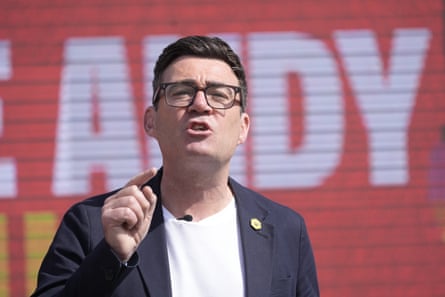
The search for a suitable champion has assumed a growing urgency because the prime minister has so far proved hard to leave a mark on. “Red Andy”, the early attack line, has not been widely used since the June byelection in Makerfield. The Mail may have dubbed Burnham’s first conference speech “the most Left-wing speech delivered by a modern British prime minister”, but in recent weeks only the Telegraph’s Allister Heath has fired the “Red Andy” missile in a column that called plans for pension reform, a social care system and all talk of a return to the European Union, “mad, nasty and shockingly extreme”.
This coverage reminds Alastair Campbell of his early years advising Tony Blair when he was depicted either as a “useless Bambi or Stalin”, he tells me. “They can’t decide if [Burnham] is a useless Paddington Bear or red in tooth and claw,” says Campbell. “They just can’t work him out yet.” A member of the loathed liberal elite or outright Trot?
There are a few factors that are making it difficult for the rightwing press to get the full measure of their enemy – including Burnham’s trajectory from New Labour luvvy to working-class champion, the King of the North. Labour advisers also cite the fact that Burnham’s inner circle, in contrast to his predecessors, has also been relatively leak- and conflict-free, leaving rightwing combatants with fewer vulnerabilities to exploit.
This is the calm before the storm, of course, with Burnham’s opponents gearing up for the budget and the inevitable controversies on 28 October. “The press are probing his defences,” Tom Baldwin, a former Labour party adviser, tells me. “They’ll keep trying, of course, and the chances are that one of their missiles will eventually hit a target.”
Amid rising fuel prices, geopolitical uncertainty and concerns over jobs, the back-to-the-future nature of this debate – indeed the back-to-the-Tory-future nature of it – is hardly surprising. Burnham has assaulted shibboleths. He has vowed to reverse “40 years of failure” with his pledge to repeal Margaret Thatcher’s ban on public ownership of water companies, to abolish the Tory version of the right-to-buy housing scheme, and to restore a sense of common good to Britain. To the right, this is unconscionable. Dan Hodges in the Mail, praising Badenoch’s “best speech yet”, wrote that the country faces a choice between Burnham’s “unashamed 1970s-style socialism” and the Tory leaders’ “bold attempt to reappropriate and recondition Margaret Thatcher’s radical conservatism”.
Although the rightwing outlets fight a similar battle against Labour, they do so for varying reasons. Some of those are ideological, but commercial imperatives also fuel their fervour. The 1970s and 80s marked a golden age for newspapers, when millions of loyal readers gave them heft and profits. With sales and readership figures now at a fraction of their peak in the late 80s, the Sun (which claimed sales of 3.8m per day in 1987) and several other titles no longer publish their numbers, focusing instead on online reach. In dwindling markets, the strategy is to stay competitive by aligning with, or perhaps exacerbating, the prevailing wave of political populism.
after newsletter promotion
The Sun has struggled more than the Mail with the shift online. It has also struggled more with Burnham because of its coverage of the 1989 Hillsborough disaster, in which it falsely blamed Liverpool supporters for a crush that killed 97 people. According to Baldwin, citing well-placed sources, Burnham may become the first prime minister since the Labour leader Jim Callaghan to refuse requests for exclusive interviews and articles in Rupert Murdoch’s biggest tabloid.
The right’s battle-camp has the additional problem that Burnham himself is proving quite a wily opponent. The prime minister spends 10 minutes a day with his social media team before posting to his nearly 1m followers on Instagram and more than 700,000 on TikTok. His short-form videos on fuel prices and the triple lock don’t seem to target younger voters, but they are a way of bypassing a negative narrative – or what Campbell calls “the madness of the rightwing press”.
Burnham could opt to go his own way, to ignore the hostile rightwing outlets altogether. But in a democracy, that would be no more ethical for Labour than it is for Reform UK, which has barred press critics. David Yelland, the editor of the Sun when it put Tony Blair on its front page with the headline “Is THIS the most dangerous man in Britain?”, tells me it would also be unwise. The power of the rightwing press is diminished, he says; they are “toothless tigers in a jungle full of new dangers – dangers as lethal for them as the rest of us, by which I mean AI and what comes next”. But, “the truth is the Tory press still has influence over the political and media classes … it can still set the weather”. D
And as we know from famous battles past, the weather can be a decisive factor. The side that copes with it best usually wins.
-
Jane Martinson is an academic and Guardian columnist. She is a board member of the Scott Trust, which owns the Guardian Media Group, and writes in a personal capacity
KioskNews shows a cleaned-up reading view extracted from the publisher’s page — the original always lives on their site, not ours.