'Wicker' Cast and Directors Break Down the Fantasy Romance's Most Pivotal Scenes

Carly Lane is an Atlanta-based writer and critic who has been with Collider in some form or fashion since 2021. She considers herself a television nerd, diehard romance/sci-fi/fantasy reader, and nascent horror lover. Her fondness of books is only eclipsed by the towering TBR that her shelves can't possibly contain.
She is the author of A REGENCY GUIDE TO MODERN LIFE: 1800s ADVICE ON 21ST CENTURY LOVE, FRIENDS, FUN AND MORE, published through DK Books (an imprint of Penguin Random House) and currently available wherever books are sold.
Editor's note: The below interview contains spoilers for Wicker.Even if you haven't seen Wicker yet, chances are you've seen Wicker in some form or another already. Although the fantasy romance film from writer-directors Alex Huston Fischer and Eleanor Wilson (adapted from the short story by Ursula Wills) originally dropped at Sundance in January, it's slowly taken on a life of its own. Seven months after its initial festival run, the movie's first trailer premiered, turning Wicker into the type of phenomenon that no one ever could have anticipated.
At a glance, though, it's not surprising why audiences have come out in droves to support this film. The fairytale-esque story follows an ostracized Fisherwoman (Olivia Colman) who, in a burst of desperation and immense loneliness, commissions the village's Basket Weaver (Peter Dinklage) to make her a Wicker Husband (Alexander Skarsgård). One month later, the two have been hitched; cue lots of enthusiastic consummation and subsequent bed-breaking. Yet even while the Wicker Husband's mere existence earns a lot of raised eyebrows — particularly from the deeply unhappy Tailor's Wife (Elizabeth Debicki) — his clear romantic devotion to the Fisherwoman is what ultimately causes more of a stir, as the other husbands in the village are suddenly made all too aware of their own marital shortcomings.
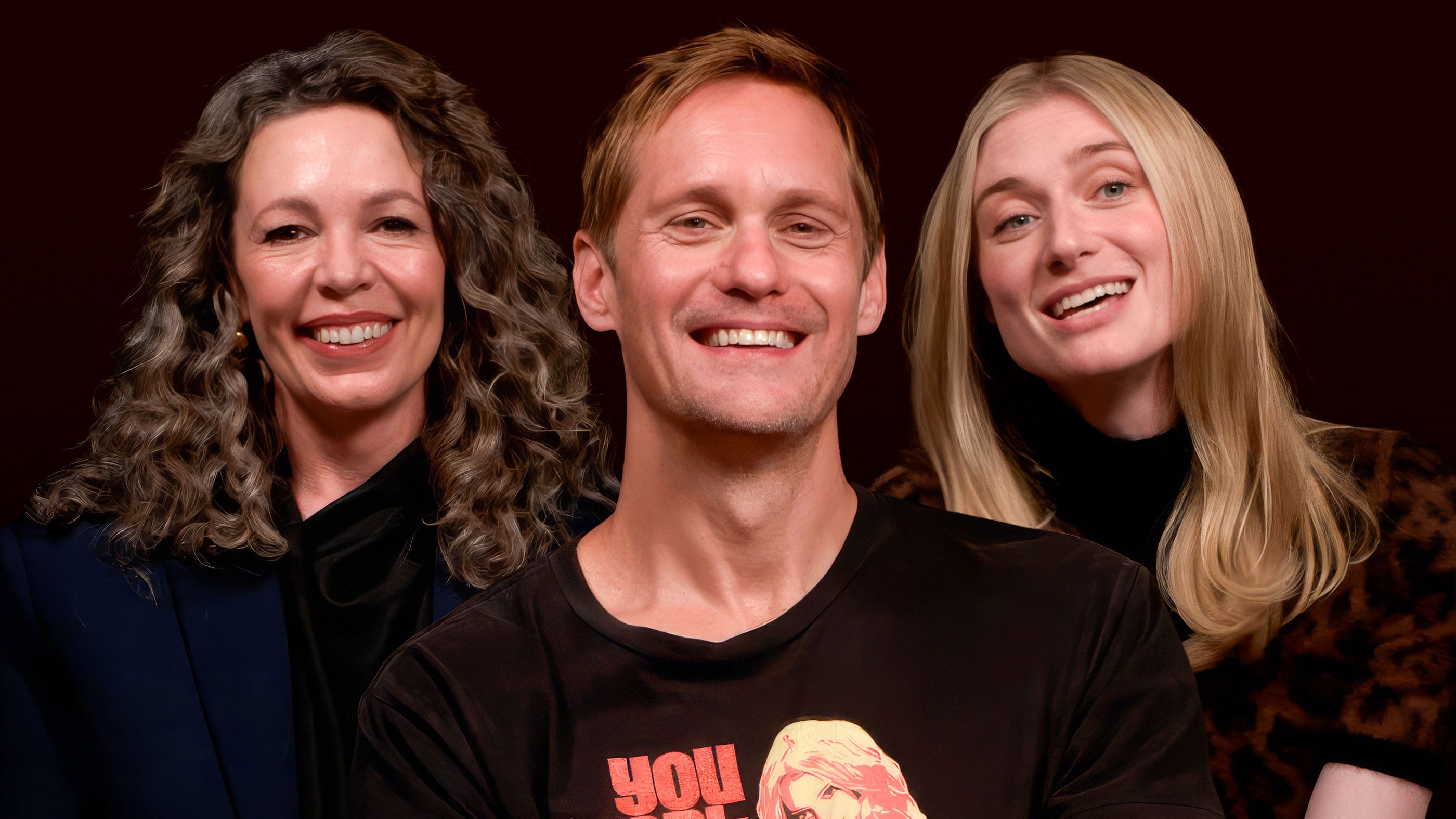
Below, Colman, Skarsgård, Debicki, Fischer, and Wilson discuss some of Wicker's most pivotal moments — including striking the right tone between fable and comedy, which scene gives new dimension to the film's most polarizing character, and the difficulty of nailing the story's emotional third-act reconciliation.
'Wicker' Always Had the Bones of a (Steamy) Romantic Comedy

Before Wicker was a movie, it was a short story. Reading Wills' "The Wicker Husband" makes it clear that Fischer and Wilson preserved the narrative's basic bones in adaptation, but while the source material reads more closely to a classic fairytale, Wicker infuses the story with the kind of bawdy humor and wit that feels akin to a Yorgos Lanthimos period piece. Speaking with Collider ahead of the film's premiere, Wicker's writing-directing duo admitted that the comedy emerged naturally while they were fleshing out "The Wicker Husband" into a scripted format.
"Anytime we come on to a movie or think about a movie, the first question is: can it be funny?" Fischer muses. "Is it okay if it's funny? The short story was such a gift to have this five-act structure of this perfect fable, and then we basically just tried to think about how each of these characters would actually behave, given the context that they're in. Then it became much more idiosyncratic." Taking certain character decisions into account, he added, provided specific narrative threads to pull on: "What kind of person would ask for a husband, and what's her life like?" If Wills' original fable was more about exploring certain archetypes, Fischer says that the ultimate goal was to make their adaptation "as human and tangible as possible."
Wilson makes a point of emphasizing that the clues for more humor were already baked into Wicker's source material. "There's a little line saying that, after their first night of marriage, the Wicker Husband turned to his wife and said, 'The bed is broken.' And we were like, excuse me? What happened? Nothing was said of the night before."
"If you read it too fast," Fischer adds, "you might just think, 'Oh, the bed just broke.'" Finding those opportunities for narrative expansion became part of the duo's early creative process, but Wilson says that their overall approach to drafting the script "was very 'yes and.'"
Fischer chimes in with an anecdote that provides the opportunity for the perfect segue into the fact that Wicker not only refuses to water down the most romantic aspects of the story, but also its love scenes. "We'd ask each other, 'Do you think we should write the scene where the bed breaks?'" While there could have been a decision to fade to black rather than depict all the beats of the Fisherwoman and Wicker Husband's wedding night — "It would certainly be very easy to just have them kiss and head to the next morning, but where's the fun in that?" Wilson ponders — the two confess that their initial attempt to embrace more humor took an unplanned turn once their lead actors were more directly involved on set.
"The comedy comes from a character not expecting to have a whole night of sex, and then that surprises. It was very specifically written almost like a shot list. But then, when we worked with Ita O'Brien, the intimacy coordinator, and with Olivia and Alex, we all found that it was like getting sexy as we were working on it," Fischer admits. "When we were shooting it, we were blushing, and were like, 'Wow, it’s really taking on this other dimension that we hadn't thought about.' The scene written is pretty short, and the scene as depicted in the movie is longer."
Wilson adds that the unexpected steaminess of Wicker's love scenes is something the two have found themselves reflecting on more and more in the wake of the film's production—and maybe also because yours truly, a self-professed romance fan, is banging the drum about the importance of their inclusion. Yet, as she emphasizes, perhaps the reason that the movie's sexiness is partly resonating so much with viewers is because it doesn't shy away from those messier human aspects too. "I do think that there's a real honesty in having a funny sex scene, because sex is kind of funny and strange and awkward and surprising. I felt that was, in a way, a really interesting feminine perspective on sex, that it wasn't just all skin. In fact, in the first sex scene, there's no music, and it was kind of shocking and joyous."
"But it's all in her face," Fischer points out. "It's surprising to her. It’s Olivia Colman; she’s the best actress there is, so you get all of that, and the whole thing works because she just embodies the character and feels exactly as they would feel."
How Alexander Skarsgård Became the "Perfect" Wicker Husband

Arguably, Wicker wouldn't land quite as successfully without a performer who could bring the right kind of vulnerability and soulfulness to a being created by seemingly magical means, even behind an intricate layer of makeup and prosthetics. You might be surprised to learn, especially after watching the finished product, that Skarsgård wasn't the first name publicly attached to the role. When Colman was initially announced as Wicker's lead and executive producer — involvement that proved crucial in getting the film off the ground, per Fischer — Dev Patel was actually attached to play the Wicker Husband before Skarsgård stepped in as a replacement, with his casting ultimately announced alongside co-stars Debicki and Dinklage after the film had already wrapped production in Budapest.
Once Skarsgård was involved, and long before any piece of the practical costume was donned, Fischer and Wilson say the conversation quickly turned to honing in on an even more crucial aspect of the Wicker Husband. "We spoke a lot about the voice," Wilson admits, to which Fischer tacks on: "What does a new man sound like?"
In a separate interview in the lead-up to the movie's release, Skarsgård reveals that he always wanted the audience to be able to track the Wicker Husband's development through a series of small performance choices. "I wanted a little bit of an evolution, a progression from the first moment you see the Wicker Husband to the end of the film without ever forgetting that he's made out of wicker."
One can't help but think that he's seen some of the memes circulating in the wake of the film's rising internet popularity, though, when he quickly adds: "I wanted it to be kind of like an old piece of furniture. In the beginning, it's like there's a stiffness to it, and then it warms up in a way, both in terms of physicality, but also vocal quality — the cadence, these pregnant pauses at the beginning. I wanted to kind of never lose that completely, but again, have a bit of an evolution there that it's like as he's growing in terms of his personality, I also wanted it to kind of become a bit more human-like in a way, in terms of both movements and the voice."
Fischer and Wilson specifically call back to a moment before shooting on Wicker even began as an example of Skarsgård's choices for the character being even more surprising than what they anticipated or even scripted. "We had gathered most of our ensemble cast, and we did a Zoom read-through, and honestly, I don't even truly know how to put into words what he was doing," Wilson marvels. "I think we all came off that call really in shock because he was bringing something to his character, even without having prosthetics on, that was so profound and simple.
'You always hope that the lines that you've written speak the way that you imagine them, and it was that, but there was this other layer to it that I truly can't even describe. He tapped into something that felt..."
"Very pure," Fischer supplies.
That decision to keep the performance "simple and restrained," despite what Wilson describes as "a very short amount of rehearsal time" with Skarsgård, made the entire pre-production process feel like... well, something out of a fairytale.
"There was no us figuring out the character with him," Fischer emphasizes.
"He had a plan," Wilson agrees. "Yeah," Fischer adds. "He's perfect."
'Wicker's Elizabeth Debicki on Her Most "Heartbreaking" Scene With Olivia Colman

As the film itself quickly reveals, the Wicker Husband's arrival in the village is met with what could be described as mixed reactions at best. Much of the hostility aimed in his direction comes courtesy of the men convinced that the Wicker Husband's open dedication to satisfying his wife — and repairing their bed after repeated breakings — is making them look bad at home. Yet the biggest threat to the Fisherwoman's happiness actually emerges when one of the community's most unsung leaders is unwilling to face her own discontentment.
At first, the Tailor's Wife, played by Debicki, subtly expresses her disdain through backhanded remarks about the Fisherwoman's spinster status, but over time, it becomes more and more evident that her attempts to sabotage the Fisherwoman and Wicker Husband's marriage are rooted in unhappiness with her own. Dismissed by her husband, the Tailor (Nabhaan Rizwan), and frequently overlooked for her own contributions in not just their household but within the entire village, the Tailor's Wife projects her frustrations elsewhere — and begins to spread vicious rumors about the Wicker Husband's fidelity.
Things partly come to a head between the two women in a berry-picking scene that Debicki says she "loved shooting," despite the evolving onscreen tension between her and Colman's characters. It's not just a personal confrontation between two women who have known each other since they were children, as the exchange reveals, but also a bigger commentary on the "patriarchal system" that exists within this outwardly modest village. (The fact that every married female character in the film, apart from Colman's Fisherwoman, is named as a wife, rather than having a title independent of their own husbands, doesn't feel coincidental.)
"You've been with these characters for probably about half the film by then, maybe even longer," Debicki explains, "and then it's very moving to suddenly have a scene that starts with the system we've learned to expect, where the Tailor’s Wife presents herself as this kind of matriarch of the village, and just here to give some friendly advice, but the Fisherwoman being this lens of truth on this system of patriarchy. She's giving us this alternate vantage point for the whole world that we're in."
Debicki says she was struck by how "heartbreaking" the scene actually was when she read it in the script, and while she's not sure how it will resonate with audiences — up to and including the moment where the Fisherwoman hits the Tailor's Wife with her basket — she points out that the conversation is a means of emphasizing the roles that these two women have been playing for their entire lives, "surviving in their own way." While the Tailor's Wife later attempts to free herself from her stifling circumstances after Dinklage's Basket Weaver commissions a Wicker Woman intended to be married off to the village's highest bidder, Debicki's hope is that viewers see the deeper layers that all build up to the climactic moment that Colman labels a "scream of frustration."
"It's just a beautiful thing that [Alex and Eleanor] wrote into the script, this moment where you get to sort of see the making of these people, and that they were once totally innocent, and then they were formed by a system that is repressing women, so they just kind of crack into these people," Debicki adds. "They didn't really have any choice. I find that really beautiful, actually, as a king of character. Very helpful for me, because I want you to have a little bit of empathy for her."
"I think you do have empathy for her," Colman insists. "Yeah, a tremendous amount," Skarsgard echoes.
'Wicker's Most Iconic Line Was in the Script's Earliest Drafts
Meanwhile, try as the Fisherwoman might to ignore the increasingly nasty (and untrue) rumors being spread about her husband's loyalty, it becomes harder and harder for her to remain steadfast. When the Tailor's Wife's Sister (Marli Siu) loses her own husband, the Bottlewasher (Gustav Lindh), after his well-meaning efforts to fix their roof go tragically awry, she seeks out the Basket Weaver to make her a wicker baby she can care for.
The child's very existence is innocent, but his wicker makeup — paired with a previous consoling embrace from the Wicker Husband at the Bottlewasher's funeral — initially seems like irrefutable evidence that the Fisherwoman's husband has been unfaithful. The Wicker Husband denies fathering the child, but feels compelled to care for it given their shared origin, and in a moment of anger and self-doubt, the Fisherwoman throws a lantern on him, leading him to flee, still burning, into the woods. It's undeniably the film's lowest moment for its leading romance, and when spring arrives, the couple hasn't yet reunited, but the Basket Weaver encourages the Fisherwoman to reconcile with her husband, having repaired his charred body with stronger, darker materials.
It's an emotional reunion — not just because the Fisherwoman has immense guilt about her actions, but because she's not sure whether the Wicker Husband will forgive her. Fischer and Wilson now admit that the scene itself was very tricky to nail down, mostly out of a desire to get all the exchange's most complicated feelings right.
"A lot of the scenes are sort of as they were written in the first draft; they came out funny and spontaneous, and it just felt right," Fischer reveals. "That scene we rewrote a lot, and it was only ever going to be five to nine lines of dialogue. It had to be short and concise, and so it was kind of like working on a poem for a couple of years."
Amidst the shuffling and moving around of various pieces of dialogue, the scene's most iconic — and arguably most romantic — line always existed within the script in some form or another. After the Fisherwoman apologizes for her hand in the Wicker Husband's current state and promises to never lash out at him like that again, his response is simple yet poetic.
"That line, 'My love does not require a promise,' Eleanor wrote in the first draft," Fischer says, "and we just moved it around a little. Other things came before and after, but that was always the center of the movie."
When it came time to perform the scene itself, which was actually filmed toward the end of production in Budapest, Colman says she didn't actually get to see the repaired version of Skarsgård's suit ahead of time, which provided an advantage in preparing to tackle the emotional layers at play in the reunion between husband and wife. "It's really heartbreaking to see what he's been through. It was written so nicely, and you could just imagine it." Skarsgård, meanwhile, had to keep his own feelings locked down for more practical reasons.
"I was struggling not to cry in that scene because it was also emotional because, again, it was towards the end of the shoot, and it had been such an extraordinary experience, and it was a beautiful scene. That reunion, it would have been weird if the Wicker Husband was like [ugly sobs]."
"Snot pouring out of the wicker nose," Debicki quips. "Yeah, wicker snot," Skarsgård jokes. "I was fighting to kind of keep it together."
Over a year after bringing the story to life, and in the wake of an online virality that has given way to its own devoted audience, even Wicker's stars don't hesitate to effusively express their own admiration for a character who has arguably become one of the year's most romantic figures. "'My love doesn't require a promise.' I love that line," Debicki says. "That hits me so hard. We could all learn a lot from him. We really could."
KioskNews shows a cleaned-up reading view extracted from the publisher’s page — the original always lives on their site, not ours.