Albanese apologizes for misinterpreting Nazi camp term away from original meaning of Jews
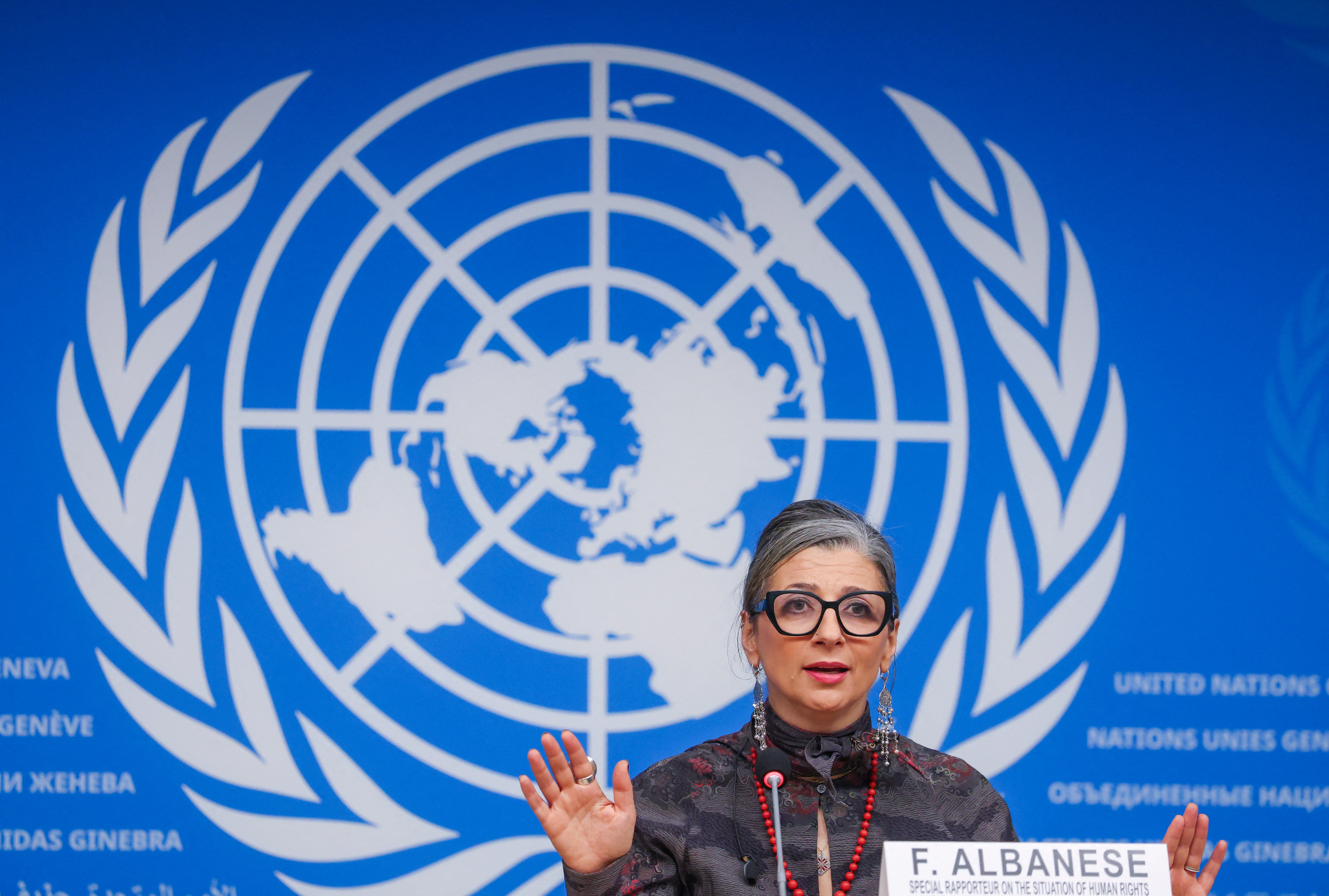
In her original statement, she said, “In fact, when they were being taken to the gas chambers, there are some accounts of life in the concentration camps saying that Jews were called ‘the Muslims.’”

UN Special Rapporteur on the Palestinian territories Francesca Albanese issued an apology on X/Twitter on Monday, retracting a statement she made during an interview with the Latin American and Caribbean Confederation of State Workers (CLATE), in which she claimed that Jews were referred to as Muslims.
Albanese's original assertion was that “Jews were called ‘the Muslims,’” which she made as part of a broader argument that antisemitism originally encompassed discrimination against the broader category of “Semitic peoples,” rather than Jews specifically.
"I misread the term "Muselmann" (Muslim) used in Nazi camps for prisoners at the brink of death, wrongly inferring that the term antisemitism originally meant hatred of all Semitic peoples. In fact, it was coined specifically to denote hatred of Jews," she wrote.
In her original statement, she said, “In fact, when they were being taken to the gas chambers, there are some accounts of life in the concentration camps saying that Jews were called ‘the Muslims.’”
“When the word ‘antisemitism’ was coined, it referred to anyone who was not European and who came from the Middle East,” she continued. “So there was a racist hatred of the non-white, of the non-pure, of the non-Christian, which then crystallized into antisemitism as hatred of Jews,” she said.

Auschwitz victims labeled 'Muselmann' marked for death, execution
According to the International Holocaust Remembrance Alliance, the term was coined in 1879 by German journalist Wilhelm Marr “to designate anti-Jewish campaigns [and] was spread through use by anti-Jewish political movements and the general public.” The IHRA notes that the term has “since its inception referred to prejudice against Jews alone.”
The term "Muselmann," German for “Muslim,” was used at Auschwitz and other Nazi concentration camps to refer to prisoners in a state of extreme exhaustion or suffering severe symptoms of starvation, according to the Auschwitz-Birkenau Memorial. The term, whose etymology “has not been definitively explained,” referred to prisoners in this physical state and was not a Nazi racial classification identifying Jews as Muslims.
According to the Memorial, prisoners categorized as Muselmänner often died soon afterward or were chosen to be executed.
Yad Vashem released a statement, saying: "Her use of the term “Muselmann” is also historically inaccurate. "Muselmann" was not a term specifically for Jews and it does not prove that Nazi antisemitism connected Jews and Muslims. The term developed among the concentration camp inmates, not the Nazis, to describe prisoners, Jews and non-Jews, who were near death and appeared as walking skeletons.
"By misusing this term as evidence of a racial category, Albanese fundamentally distorts its historical meaning."
KioskNews shows a cleaned-up reading view extracted from the publisher’s page — the original always lives on their site, not ours.