Commentary: Anthony Loke resignation offer matters little to DAP’s fate
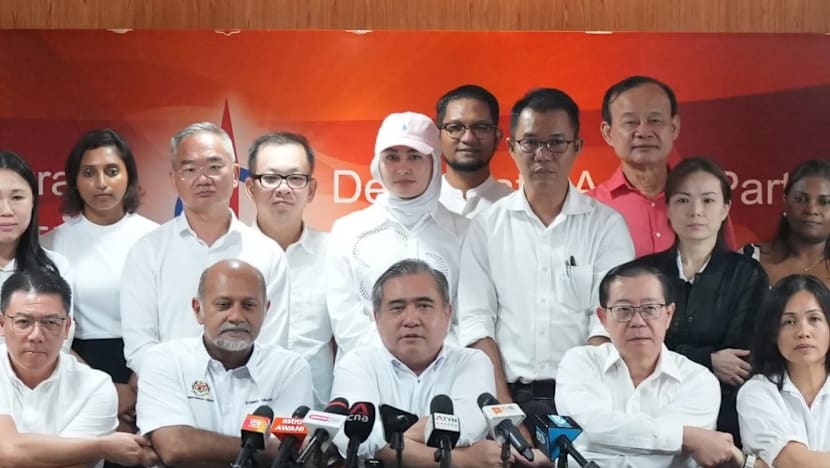
The Democratic Action Party chief's decision to resign as Malaysia's transport minister in protest over Najib Razak’s conditional pardon is symptomatic of a deeper crisis for his party that won’t be fixed by a single gesture, writes CNA’s Leslie Lopez.
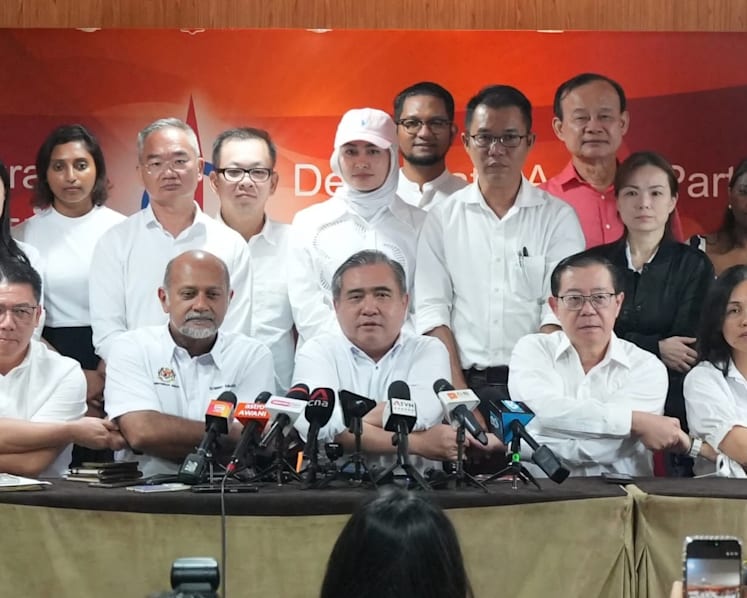
Democratic Action Party (DAP) Secretary-General Anthony Loke (centre front) addresses the press. Loke has resigned in protest against the conditional royal pardon granted to jailed former prime minister Najib Razak. (Photo: Facebook/Ng Sze Han)
New: You can now listen to articles.

This audio is generated by an AI tool.

26 Sep 2026 06:00AM
KUALA LUMPUR: When the strongest party in a coalition – in terms of the number of parliamentary seats it holds – is the weakest in power, something has to give. In Malaysia, that moment may be arriving for the Democratic Action Party (DAP).
On Sep 19, Transport Minister and DAP supremo Anthony Loke told his top party lieutenants that he would be giving up his Cabinet position.
But that protest decision, over the Pardons Board's move to allow former prime minister Najib Razak to serve out his corruption sentence under house arrest, is now up in the air.
In recent days, Prime Minister Anwar Ibrahim, who was travelling with Mr Loke on an official investment mission to China, called on his Cabinet colleague to reconsider, offering the DAP secretary-general an off-ramp.
AWKWARD PREDICAMENT
But this episode tells a far bigger story: DAP’s awkward predicament.
DAP is the largest political institution in the ruling coalition, holding 40 of the 77 seats in the Pakatan Harapan (PH) alliance. Yet, it remains structurally junior in terms of power, compared to the 28 seats held by Mr Anwar's own Parti Keadilan Rakyat (PKR). Within the broader unity government, the United Malays National Organisation (UMNO) holds 26 seats.
Despite having the largest number of seats, DAP only has five ministerial posts while PKR and UMNO have nine and seven respectively in the Anwar government.
It is a political asymmetry that DAP – Malaysia's longest-established opposition force – has accepted in recent years for the sake of being in government.
But this passive political stance and the compromise-heavy role have come at a stiff electoral price.
Even before the decision by the Pardons Board on Najib's house arrest, voters had begun to punish the DAP. In the November 2025 Sabah state elections, the party lost all eight seats it contested. It shed support in Johor this July, and in August it watched Mr Loke himself lose his state assembly seat in the Negeri Sembilan polls.
The pattern is unmistakable: DAP's urban, largely Chinese voters are not defecting – they are abstaining, in protest at the snail's-pace reforms promised by the Anwar government.
There is also widespread unhappiness over the compromises the party has been forced to make by having UMNO, a party the DAP has long fought against, in government.
Najib's conviction for misappropriating RM42 million (US$10.3 million) from SRC International – a scandal linked to 1MDB – was a cause DAP and Pakatan Harapan championed for years. The Najib corruption campaign were central planks on which PH won the 2018 and 2022 general elections.
PH REFORM BRAND QUIETLY DILUTED
But since coming to power, the PH reform brand has been quietly diluted in favour of what is widely being branded as Mr Anwar’s politics of survival through what his critics argue are compromises with UMNO at DAP’s expense.
The case of Najib, who was UMNO chief between 2008 and 2018, perhaps epitomises this.
Although Mr Anwar has said he had flagged concerns about a pardon for Najib to Malaysia’s King Sultan Ibrahim Sultan Iskandar, it was the last straw for Mr Loke.
At the press conference announcing his decision to resign, Mr Loke reiterated his party’s stance that Najib’s involvement in the 1MDB scandal represents the “kleptocracy” that has plagued Malaysia for a decade, and a “major crisis” that DAP has consistently fought against.

The conditional pardon Najib received last week to serve the remainder of his sentence under house arrest is the second clemency.
In early 2024, Najib received the first clemency from Malaysia’s then-King over his sentence of 12 years in prison and a fine of RM210 million. His prison sentence was halved and the fine reduced to RM50 million, which he must now settle before being allowed house arrest.
The first clemency Najib received was followed by an acquittal for Najib’s wife Rosmah Mansor. Deputy Prime Minister and UMNO president Ahmad Zahid Hamidi had also earlier recieved a Discharge Not Amounting to Acquittal (DNAA).
To be sure, apart from Mr Loke, no other PH component party or politician has offered a protest resignation so far. However, Mr Loke's gambit may not be enough to halt the erosion of DAP's support. Here is why.
Critics argue that DAP has been less strident on positions over corruption since joining the federal government and also become more passive in championing its long-stated multiracial platform.
That accommodation began in 2018 when DAP joined forces with former primer minister Mahathir Mohamad, a politician it had spent decades denouncing in opposition, to oust Najib and the Barisan Nasional coalition.
The gamble paid off: DAP entered the federal government for the first time and secured key portfolios such as finance, transport, communications and human resources. But that government was short-lived.
The opposition narrative, pushed by UMNO and Parti Islam Se-Malaysia (PAS), that the Mahathir administration was effectively led by DAP found fertile ground among Malay voters. The government collapsed, and Malaysia was plunged into years of political instability until Mr Anwar came to power in the November 2022 general election – with the help of DAP's 40 seats.
Yet the largest party in government was shut out of any serious portfolio that could shape the country's fiscal direction – not even the law ministry, which would have given it leverage over issues like corruption. Instead, it was UMNO, with only 26 parliamentary seats, that Mr Anwar rewarded with rural development, international trade and industry, and the law portfolio, together with the deputy prime ministership for Mr Zahid.
PERHAPS DAP BELONGS IN THE OPPOSITION
Mr Loke's offer to resign over the Pardons Board's decision may have bought him some authority within DAP. But ordinary Malaysians, fatigued by years of political compromises, are likely to dismiss it as a half-measure.
The walls, in short, are closing in.
With just over a year before Malaysia's 16th general election is due to be called, DAP faces hard choices if it is to regain electoral ground: Extract reform demands with strict milestones and enforce them; exit the executive by giving up all Cabinet positions; or leave Pakatan Harapan entirely.
One thing is clear. The push for multiracial reform – the cause at the core of DAP's identity – is floundering within Malaysia's communal political system. Perhaps it can only thrive in opposition.
KioskNews shows a cleaned-up reading view extracted from the publisher’s page — the original always lives on their site, not ours.