[Vantage Point] Maya’s IPO meets the accounting test
Manuel V. Pangilinan has planted the flag for Maya’s 2027 market debut, insisting on a Philippine listing even if offshore partners pursue Wall Street. The target confirms what inside sources shared with Vantage Point—that Maya was preparing its listing long before the exchange nudged it to follow GCash. Fresh audited financial statements filed with the SEC reveal what public investors will buy: a core payments turnaround earning P493 million, but carrying a P30.9-billion legacy deficit and an earnings base still dwarfed by GCash.
Tycoon Manuel V. Pangilinan has ended market guesswork, setting a 2027 stock market debut for Maya following GCash’s historic listing.
Speaking on Wednesday, October 28, the PLDT and Maya chairman made his stance clear: while foreign partners may eye Wall Street, a domestic listing remains non-negotiable.
“I’ve made known my preference to the other shareholders that if they want to have a Nasdaq listing, we have no objection, but I think there should be a listing here in the Philippines,” Pangilinan said.
Pointing to the massive demand behind GCash operator Mynt, he added: “You’ve seen the success of Mynt. Proven that a quality company like Mynt, they can attract a great deal of demand in their shares.” (READ: [Vantage Point] Holiday dividend or market coal? What GCash could deliver by Christmas)
Pangilinan’s target corroborates what inside sources earlier shared with Vantage Point—that Maya was methodically preparing for an IPO well before the Philippine Stock Exchange courted it. Centering a domestic listing ensures local depositors and merchants who fueled Maya’s rise are not shut out.
The pivotal question for investors is simple: what are they buying, and at what valuation? The picture sharpens with Maya Philippines, Inc.’s Audited Financial Statements.
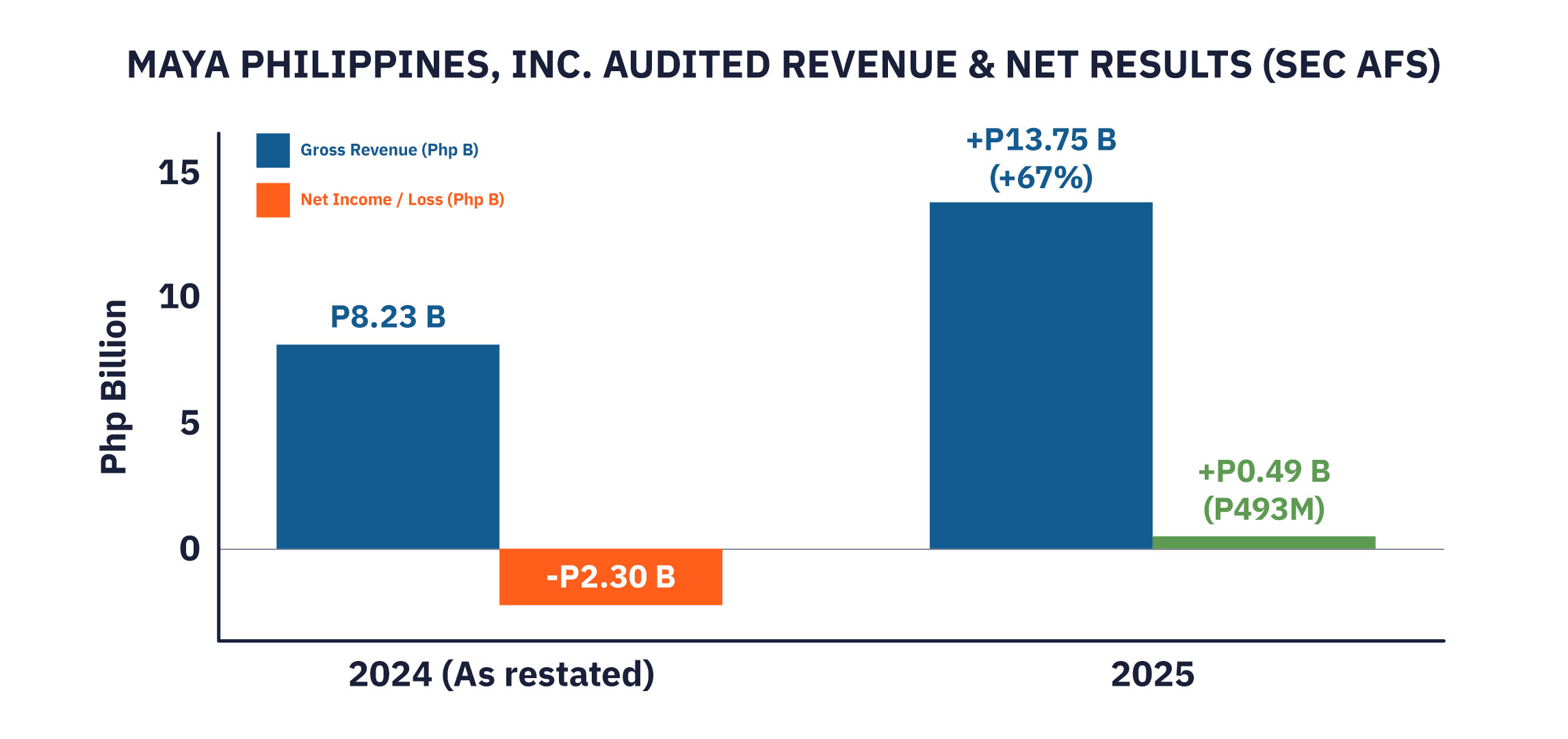
The filings confirm an operational pivot: the standalone payments and wallet company earned P492.97 million in 2025, reversing a restated P2.30-billion loss in 2024. Gross revenues jumped 67% to P13.75 billion, driven by a 74% surge in merchant service fees to P9.27 billion.
Across the wider group, consolidated profit reached P1.7 billion.
Maya Philippines, Inc. Audited Gross Revenue & Net Income Turnaround (2024–2025).
Yet the audited balance sheet reveals the steep cost of scale. Maya Philippines carries an accumulated deficit of P30.92 billion as of end-2025. While capital infusions totaling P32.83 billion in paid-up equity keep the company solvent—leaving net equity at P2.23 billion—investors will examine how this legacy deficit impacts post-listing dividend capacity.
Corporate identity is a critical disclosure. Maya Philippines, Inc. operates e-money issuance, merchant acquiring, and payments infrastructure under Singapore-based parent Voyager Innovations.
Maya Bank operates under a separate digital banking charter. Each arm runs on different margins, assumes distinct credit risks, and answers to separate regulators. The listing vehicle must define precisely which assets, liabilities, and earnings streams public shareholders acquire.
Maya’s ownership provides a clear baseline. First Pacific’s investor disclosures show a formidable register: PLDT anchors the group with roughly 38%, private equity firm KKR holds 30%, Tencent carries 15%, and the International Finance Corporation accounts for 10%. First Pacific holds 1.6% directly, leaving 5.4% with other investors.
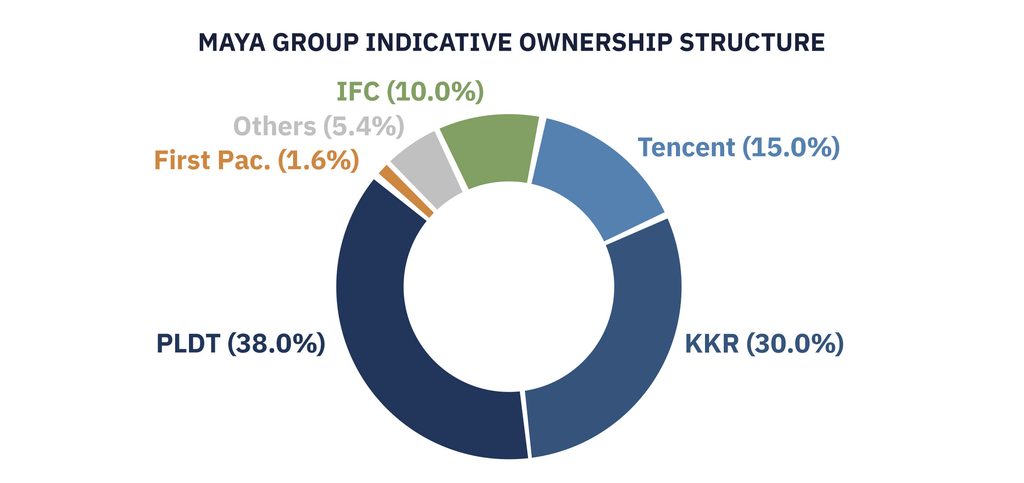
Maya Group Shareholding Structure based on First Pacific investor presentation.
While PLDT provides domestic anchor strength, foreign institutions supply capital, technology, and governance expertise. Yet diverse shareholders bring differing horizons, valuation metrics, and liquidity expectations. When a prospectus appears, distinguishing direct holdings from indirect chains, like First Pacific’s stake via PLDT, will be essential to establish voting control.
Operating momentum is undeniable. Liabilities to wallet users—active e-money on the platform—jumped 57% to P12.04 billion in 2025, backed by P6.14 billion in trust deposits and P6.72 billion in cash.
On retail counters, Maya commands 53% of registered point-of-sale terminals. On the banking side, deposits surged 71% to roughly P86 billion by June 2026, while loan receivables climbed 56% to P39 billion.
Yet rapid expansion consumes capital. Maya Bank’s capital adequacy ratio narrowed from 14.93% in March 2026 to 14.13% in June. This frames a core offering question: how much capital will be primary funding plowed into the bank, and how much will provide secondary liquidity to earlier shareholders? Asset quality also warrants scrutiny: PLDT cited a 4.8% gross NPL ratio, versus BSP’s 4.02%, a gap likely explained by repo receivables.
Then comes the inevitable benchmark: Mynt. The GCash parent posted P17.23 billion in net profit in 2025—roughly ten times Maya Group’s consolidated profit and thirty-five times Maya Philippines’ standalone net earnings—pulling in another P10.82 billion in first-half 2026.
Pangilinan conceded that Maya “may not be the same scale as Mynt,” but argued it can deliver a successful issue tailored to its size.

(Charts and graphs are based on Vantage Point computations prompt, generated by Gemini nano banana)
FFY 2025 Net Income Comparison (Maya Group vs. Mynt/GCash).
Maya cannot simply copy GCash’s playbook; it must prove how its digital banking charter and merchant relationships generate superior returns from a tighter base. Comparing user numbers requires discipline: Mynt’s 41.5 million monthly active users and Maya’s 10.7 million bank customers measure different populations. The true test will be transaction velocity and customer retention costs. (READ: [Vantage Point] GCash at P6.60: Did investors finally get their price?)
Moreover, institutional backing differs. While Maya enjoys established private equity and developmental capital, Mynt secured commitments from over 20 global and local cornerstone investors. Venture ownership demonstrates confidence at an earlier stage, but cornerstone commitments prove an immediate willingness to absorb equity at market clearing prices.
Maya’s turnaround, under the microscope: Revenue catches up with expenses. Maya Philippines Inc., the wallet and payments company, not Maya Bank or consolidated Maya Group.

Revenue rose 67%; net profit margin was 3.6%. Service income compensates work for Maya bank; associated costs remain in expenses. Intragroup normally eliminates on consolidation. The first bridge bar is our substraction, not a company-designated operating profit metric. Values rounded; other net balance includes interest and FX.
Ultimately, execution hinges on deal structure and pricing discipline. Maya has built a credible enterprise with substantial deposits and reach. But as the runway toward 2027 opens, the market’s verdict will not turn on fintech hype.
The decisive test will be whether its valuation reflects sustainable earnings after credit losses and funding costs—leaving enough room for public shareholders to share in the growth they finance. – Rappler.com
This analysis draws from Maya Philippines Inc.’s audited financial statements for 2025, including restated 2024 comparatives; First Pacific’s October 7, 2026, investor presentation; PLDT’s financial disclosures; Mynt’s IPO financial information and cornerstone-investor announcement; and Pangilinan’s reported October 28 remarks. Calculations and interpretations are Vantage Point’s.
KioskNews shows a cleaned-up reading view extracted from the publisher’s page — the original always lives on their site, not ours.