Could Indonesia’s ‘content governor’ rival Prabowo for the presidency in 2029?
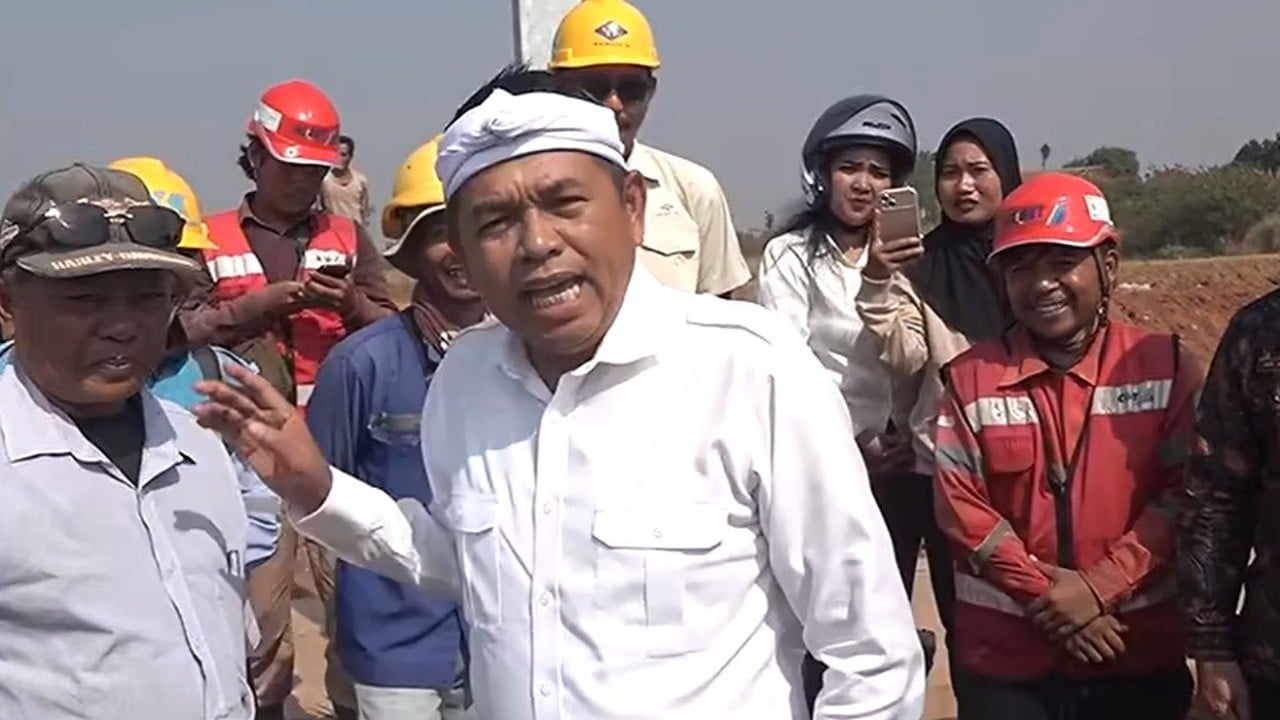
KUNJUNGI CISANTI | INI LANGKAH KDM HADAPI KRISIS HULU CITARUM
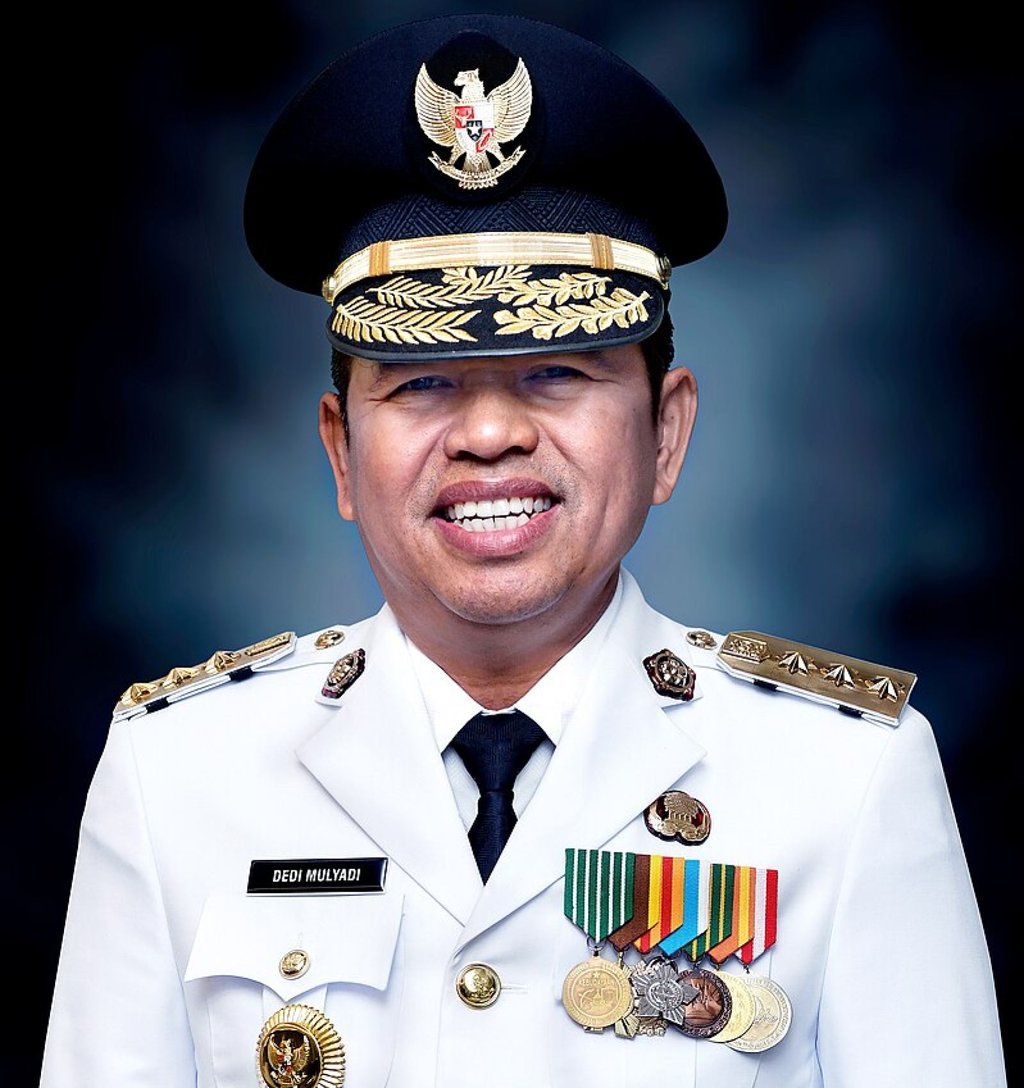
Having won a landslide gubernatorial election in late 2024 as a member of President Prabowo Subianto’s Gerindra party to lead Indonesia’s most populous province, Dedi’s massive online following and recent strong poll numbers have ignited speculation that he could mount a serious bid for the presidency in 2029.
A July simulation by pollster Saiful Mujani Research and Consulting (SMRC) placed Dedi at 35 per cent in a multi-candidate presidential preference test, leaving Prabowo trailing far behind at 14.5 per cent. A subsequent August survey by Tempo Data Science produced similar results, placing Dedi above 40 per cent and Prabowo around 15 per cent.
The 2029 presidential election is some time away, but analysts say Dedi’s poll numbers have raised an awkward question for Gerindra: could the governor who rose to prominence under its banner eventually become its chairman’s rival for the presidency?
Strength in ‘authenticity’
Dedi’s ascent has been propelled by his mastery of social media. His primary YouTube channel has 9.2 million subscribers and generates tens of millions of views every month, earning him the nickname “Gubernor Konten”, or “content governor”.
Rather than broadcasting dry policy speeches, his feed operates more like a populist reality show: he intervenes in neighbourhood disputes, hands out cash to the elderly and recently made headlines by offering a 50-million-rupiah (US$3,200) personal bounty to anyone who could catch pickpockets or muggers.
In a July survey conducted by Lembaga Survei Indonesia (LSI), public satisfaction with Dedi’s performance across West Java reached a staggering 95.4 per cent.
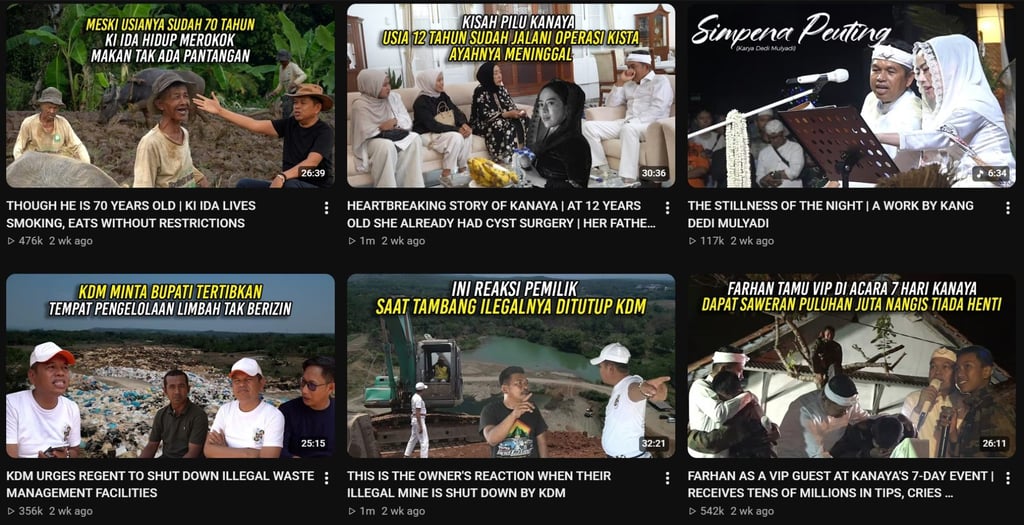
Djayadi Hanan, executive director of LSI, observed that Dedi’s grass roots appeal combined political cultivation spanning a quarter-century, as he climbed from local councillor and two-term regent of Purwakarta to national lawmaker, with an instinctive command of social media that starkly contrasted with the archaic outreach methods of his older peers in the political circle.
Dedi’s “main strength is authenticity”, Djayadi said, a trait he shared with Prabowo’s predecessor, former president Joko Widodo, who also rose from humble origins to national fame by branding himself a man of the people.
“By contrast, you cannot imagine President Prabowo Subianto making social media content hugging a taxi driver or eating at a street vendor without people viewing it as staged,” Djayadi added.
According to Burhanuddin Muhtadi, a visiting senior fellow at the ISEAS–Yusof Ishak Institute, Dedi’s surging profile outside his home province is not merely a product of his social media activities. His poll numbers also reflected a growing public weariness with the central government, Burhanuddin said.
He added that Dedi’s huge popularity should not be attributed to just his political strengths.
“Part of his rise also reflects negative sentiment towards the Prabowo government. Dedi projects a more down-to-earth, accessible image, whereas Prabowo has a much more high-profile presidential persona.”
Going ‘offside’
With the surge in Dedi’s online presence, his content creation has begun to raise eyebrows within Jakarta’s establishment.
In August, in the wake of a magnitude-7.7 earthquake, Dedi travelled to East Nusa Tenggara to personally deliver relief assistance. While framed as an act of humanitarian solidarity, his excursion beyond West Java’s borders drew intense chatter, with critics questioning why he was leveraging a distant crisis to elevate his national profile.
For some analysts, Dedi’s manoeuvres risk crossing an unwritten line in a political system where institutional loyalty is prized above personal popularity.
While Dedi has earned a reputation as an on-the-spot problem solver, venturing beyond his provincial boundaries risks overstepping his mandate, said Aditya Perdana, a political science lecturer at Universitas Indonesia.
By attempting to intervene in crises outside West Java, Aditya argued, the governor was increasingly playing “offside” in the eyes of party elites by projecting influence where he had no jurisdiction.
His widening ground engagement has likely not gone unnoticed inside Prabowo’s party, which Dedi joined only in 2023 after decamping from Golkar, according to analysts.
“The potential main friction lies in Prabowo’s inner circle in Gerindra, who may perceive Dedi’s activities outside of West Java as his political warm-up agenda for the 2029 election,” said Wasisto Raharjo Jati, a political researcher at the National Research and Innovation Agency (BRIN).
Gerindra’s bind
Publicly, Gerindra has dismissed the polling disparity between the two men. After the release of the SMRC report, the party’s daily executive chairman, Sufmi Dasco Ahmad, brushed off pollster’s figures, saying surveys could “fluctuate” from one cycle to the next.
Djayadi has noted Dedi’s “strategic ambiguity” by routinely deflecting questions about his national ambitions and insisting he remains focused on his present position.
“I am currently just thinking about how to be a successful governor,” Dedi told reporters last month when pressed on his 2029 prospects. “Now is not the time for that.”
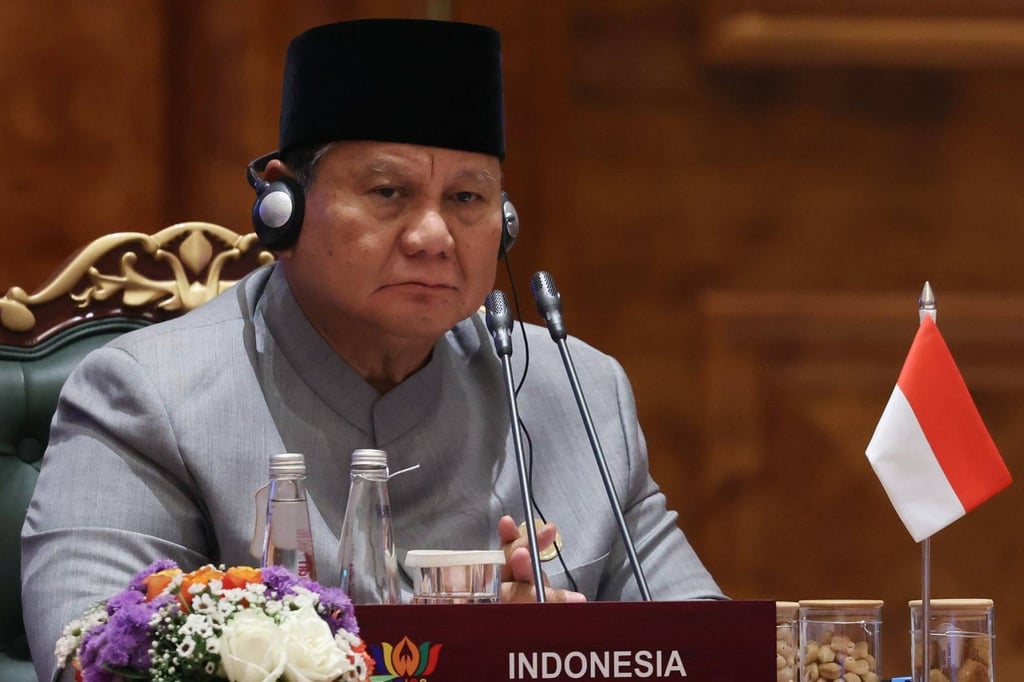
As for Prabowo, while Gerindra elites have already publicly pushed him to run for a second term, the 75-year-old incumbent has so far refused to commit, stating repeatedly earlier this year that he would not run in 2029 if he felt his administration had underperformed.
Should Prabowo decide to run, Dedi has been touted by some observers as the president’s running mate. But Burhannudin said voter data suggested that such an alliance could fail.
“One complication is the emerging ‘anyone but Prabowo’ sentiment,” Burhanuddin explained.
“If Dedi becomes the running mate of an incumbent whose popularity has been declining significantly ... some voters who currently support Dedi could instead move towards Anies or Gibran,” he added, referring to former Jakarta governor Anies Baswedan and Vice-President Gibran Rakabuming Raka, both of whom are also seen as potential 2029 contenders.
“We should not assume that all Dedi supporters would automatically follow him into a Prabowo-Dedi ticket. Some may prefer Dedi precisely because they see him as an alternative to the incumbent.”
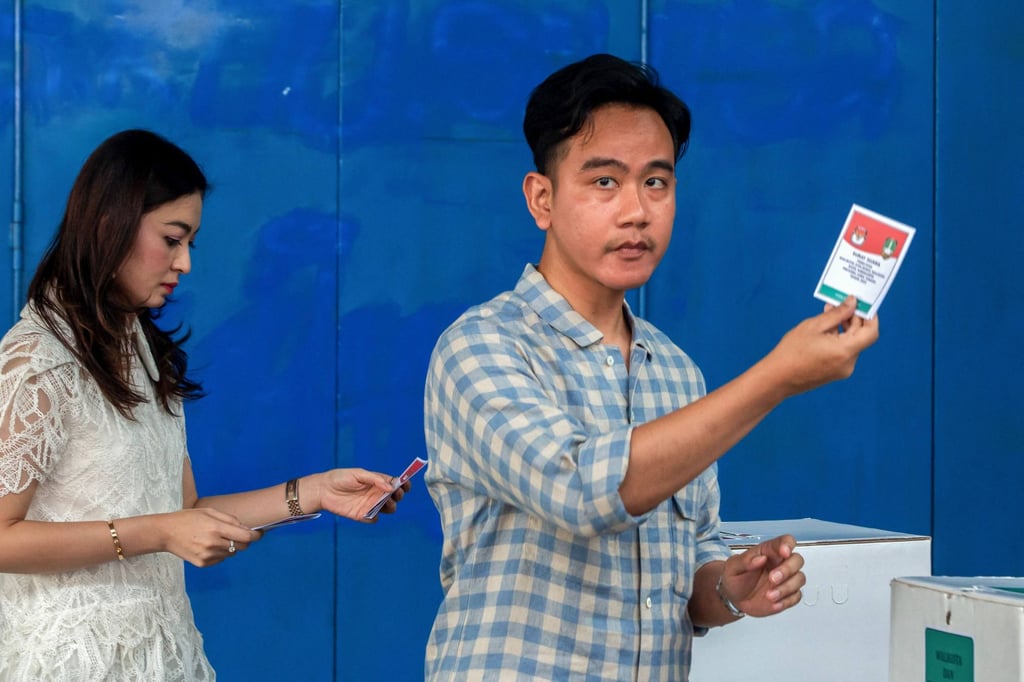
Nor can Gerindra sideline Dedi and order him to remain an obedient campaigner on Prabowo’s behalf without consequence, Burhanuddin said.
“The publicly available survey data suggest that, if Dedi is removed from the presidential-choice simulation, Anies and Gibran benefit more than Prabowo,” he added.
Another possibility is that Dedi could leave Gerindra to seek a ticket elsewhere.
This prospect has become plausible following a landmark Constitutional Court ruling last year that abolished the minimum requirement of 20 per cent of the vote for a political party before it could nominate a presidential candidate, which has opened a back door for popular independents to contest in an election for the top job.
“This significantly changes the strategic environment,” Burhanuddin said. “Other parties that lack a sufficiently popular presidential figure of their own may be interested in nominating Dedi for president.”
Long road to 2029
Dedi, however, faces the daunting task of sustaining his populist aura given the relentless public scrutiny. While his personal approval rating remains sky-high, his governance record is not without blemishes.
In June, the turbulent rollout of West Java’s public school admissions system left thousands of parents frustrated after their children failed to secure places at state schools, prompting Dedi to issue a public apology.
With West Java facing a projected 3.4-trillion-rupiah deficit, Dedi announced last month that he was halting all new provincial projects to avoid taking on massive debt.
The polling landscape, however, remains far from uniform. A nationwide survey conducted in late August by pollster Median offered a counterweight to earlier findings, placing Prabowo in the lead with 32.4 per cent support, followed by Dedi at 20.6 per cent and Anies at 20.5 per cent.
Three years is a long time in Indonesian politics, Burhanuddin warned, and early regional momentum can easily evaporate as the stakes rise.
“His current popularity is real, but sustaining it until 2029 will depend on whether his personal appeal can survive the much harder tests of governing performance, greater national scrutiny and the changing political environment.”
KioskNews shows a cleaned-up reading view extracted from the publisher’s page — the original always lives on their site, not ours.