Journalism icon, Inquirer founder Eugenia Apostol writes 30
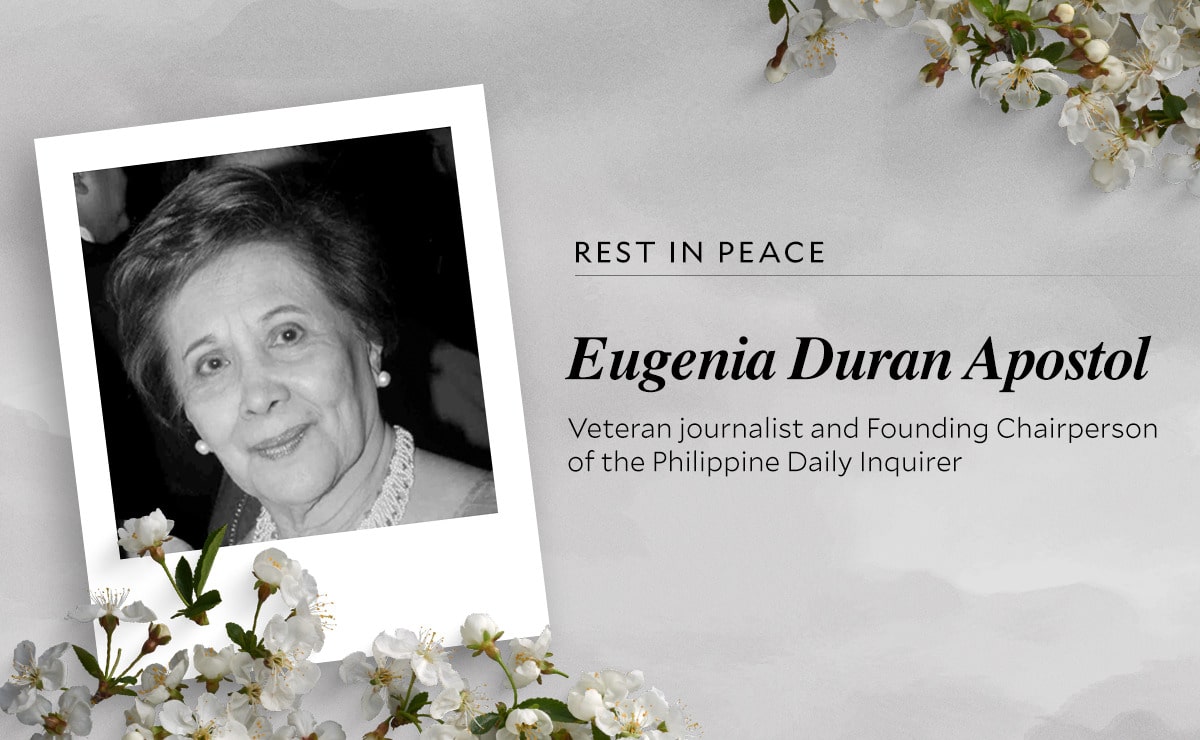
MANILA, Philippines — Eugenia “Eggie” Apostol, a veteran journalist and founding chairperson of the Philippine Daily Inquirer, has died at the age of 100.
Her death was announced by the Ramon Magsaysay Award Foundation (RMAF), which honored Apostol in 2006 for her contributions to journalism and press freedom.
Apostol’s family has requested for privacy as they mourn her passing.
Article continues after this advertisement
“The Ramon Magsaysay Award Foundation joins the journalistic community in mourning the passing of 2006 Ramon Magsaysay Awardee Eugenia Duran Apostol, journalist, publisher, and fearless champion of truth and press freedom,” the foundation said.
FEATURED STORIES
NEWSINFO
NEWSINFO
NEWSINFO
“Through her journalism, she gave Filipinos the information and voice they needed in a defining chapter of her nation’s history,” it added.
Apostol, who hailed from Sorsogon, graduated from the University of Santo Tomas and went on to edit the women’s pages of The Manila Times and The Manila Chronicle.
In what was then often regarded as the “lipstick beat,” Apostol brought a fresh approach by producing content that appealed to intelligent and civic-minded women readers.
Her role in Philippine journalism became even more significant during the martial law era.
Article continues after this advertisement
In 1981, Apostol joined a small group of journalists in the so-called “mosquito press,” publications that challenged government-controlled media, and began publishing articles openly critical of the dictatorship of former President Ferdinand Marcos Sr.
Through Mr. & Ms. magazine, which she founded, Apostol helped provide a platform for stories and commentary that challenged the Marcos regime at a time when press freedom was severely restricted.
Article continues after this advertisement
READ: A new chapter for the Inquirer
Birth of the Inquirer
In 1985, two years after the assassination of opposition leader Sen. Benigno “Ninoy” Aquino Jr., Apostol set out to establish what she envisioned as a “broadsheet like no other.”
She wanted a publication that would closely and independently cover the Sandiganbayan trial of the Aquino-Galman double murder case, which sought to determine whether Rolando Galman — who was also killed at the Manila airport — was indeed Aquino’s assassin, as claimed by the Marcos administration.
By then, Apostol had already been publishing the weekly Mr. & Ms. Special Edition to chronicle developments following Aquino’s assassination.
“The newspaper would be fearless in the face of repression…unflinching in its commitment to the truth,” Apostol later recalled in the Inquirer commemorative book From Ninoy to Noynoy.
With a small group of Mr. & Ms. staff, Apostol launched the Philippine Weekly Inquirer. Its name was inspired by The Philadelphia Inquirer, as proposed by the late editor-in-chief of Inquirer, Letty Jimenez-Magsanoc, who had lived in Philadelphia.
Apostol initially planned to shut down the weekly after the Aquino-Galman trial.
But when Marcos called for a snap presidential election, she saw the need for a daily newspaper.
“Which is why, with fire in the veins, heart pounding, fist clenched, eyes closed and armed only with the courage of our doubt, we said ‘Let’s do it!’” Apostol recalled.
On Dec. 9, 1985, the first issue of the Philippine Daily Inquirer rolled off the press with the banner headline, “It’s Cory-Doy,” referring to the presidential and vice presidential tandem of Corazon Aquino and Salvador Laurel.
The newspaper did not yet have a slogan. Instead, above its masthead was an invitation to readers: “A slogan? Help us write one and win a prize.”
All 30,000 copies of the maiden issue, priced at P2 each, were sold.
As the political crisis deepened, the Inquirer reported extensively on Aquino’s campaign and the events that culminated in the 1986 Edsa People Power Revolution and the fall of the Marcos dictatorship.
The newspaper went on to become one of the country’s leading publications.
READ: From print to multimedia organization: The Inquirer story
Apostol stepped down as its publisher in 1994.
She also established the Foundation for Worldwide People Power in 1996 with fellow trustees, including Fely Arroyo and the late Doreen Fernandez, to help preserve the legacy of the 1986 People Power Revolution.
Journalism honors
Apostol’s contributions to Philippine journalism earned her numerous awards and recognitions.
She was the first recipient of the Knight International Press Fellowship Lifetime Achievement Award from the International Center for Journalists.
In 2004, she became the first recipient of the University of the Philippines’ Gawad Plaridel, its highest recognition for outstanding media practitioners.
Two years later, Apostol received the Ramon Magsaysay Award for Journalism, Literature and Creative Communication Arts.
In honoring her, the RMAF Board of Trustees cited Apostol’s “courageous example in placing the truth-telling press at the center of the struggle for democratic rights and better government in the Philippines.”
“With courage and unwavering integrity, Apostol showed the power of a free press to speak truth, serve the public, and uphold democracy,” the RMAF said.
“Her legacy lives on in every journalist who continues to defend truth, independence, and the people’s right to know.” /dm
Your subscription could not be saved. Please try again.
Your subscription has been successful.
READ: Renowned Inquirer sports journalist Recah Trinidad dies at 83
KioskNews shows a cleaned-up reading view extracted from the publisher’s page — the original always lives on their site, not ours.