Analysis | A 25-Day Clock And A Cash Shortfall: Why Punjab Farmers Burn Stubble
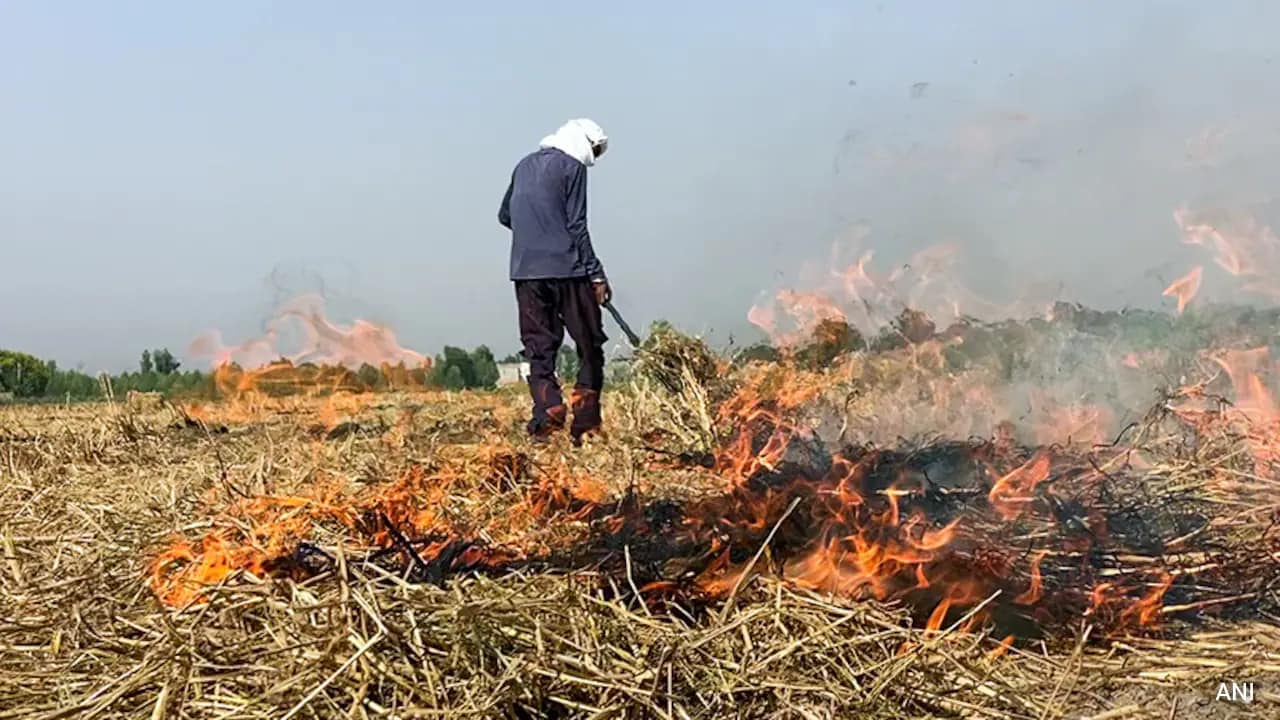
Every October and November, Punjab's fields turn into a race against the calendar. Paddy is harvested, and wheat has to go into the ground almost at once. Most farmers get only a twenty-to-twenty-five-day window to clear the leftover straw, prepare the soil and sow the next crop. Miss that narrow window and germination suffers; the yield drops and the money the family was counting on shrinks with it. Manual labour to cut, gather and haul away the dense residue is simply too expensive for the large number of small and marginal holdings. Machines such as Happy Seeders, Super Seeders and mulchers can chop the straw and mix it back into the soil in one or two passes, yet the cost of buying, maintaining and fueling them remains heavy. Even when government subsidies and Custom Hiring Centres put the equipment within reach, daily rental, diesel, and the need for a reasonably powerful tractor still keep the option out of reach for many farmers.
The government data claims that out of the approximately 20 million metric tonnes of paddy straw generated in Punjab every year, the vast majority is successfully diverted from open burning through two complementary scientific methods. Under in-situ management, roughly 11.4 million tonnes of straw are chopped and mixed directly back into the soil using specialised machinery like Super Seeders and Happy Seeders. Concurrently, under ex-situ management, nearly 7.85 million tonnes of straw are collected and transported off the fields to serve as industrial feedstock for biomass plants, compressed biogas units, and brick kilns. When combined, these on-field and off-field pathways account for roughly 19.25 million tonnes of scientifically managed crop residue annually. The truth is farmers still burn paddy straw openly in day or, in many cases, at night.
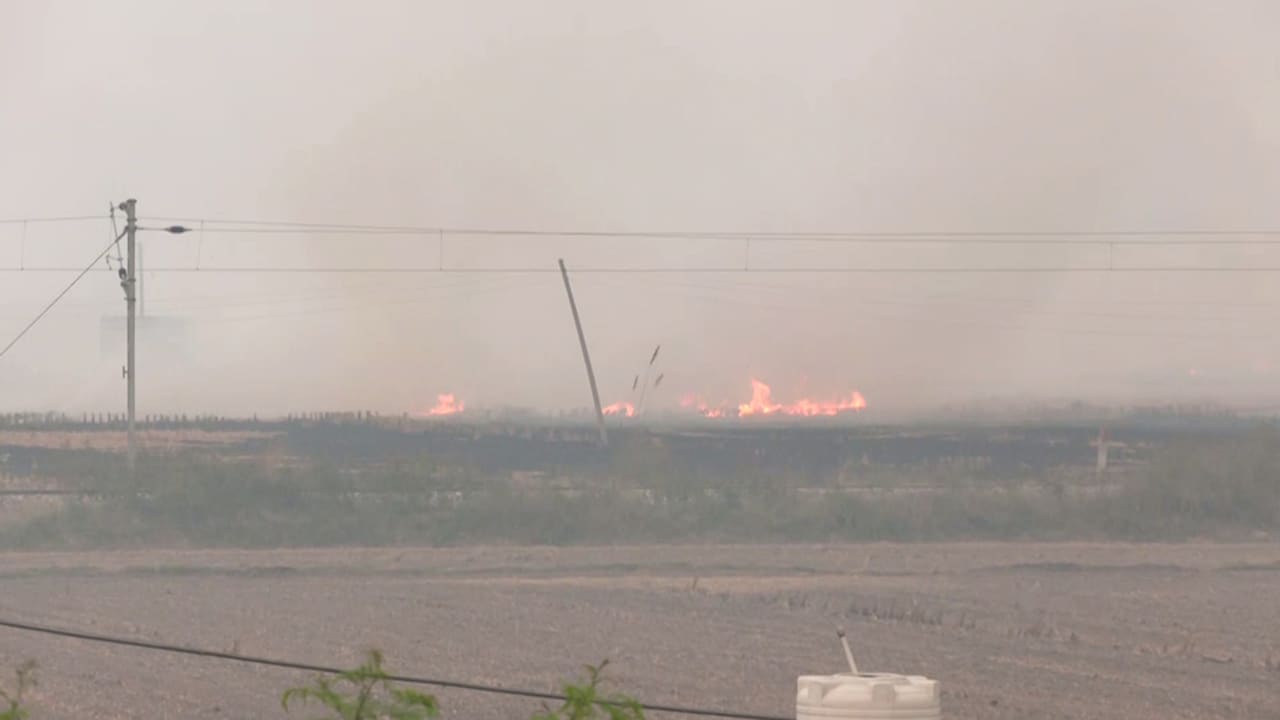
Thick smoke billows from an agricultural field due to stubble burning at a village in Moga on November 9
Photo Credit: ANI
As of this month, Punjab has recorded a cumulative total of 4,459 farm-fire incidents for the current paddy harvesting season. Following a sharp single-day spike of 1,152 new cases reported on Diwali day alone, state authorities have ramped up enforcement measures across heavily affected districts like Tarn Taran, Ferozepur, and Sangrur. To deter violations, the administration has registered 884 First Information Reports (FIRs), marked over 1,000 "red entries" in land revenue records, and levied environmental compensation exceeding Rs 62 lakh.
Moving the straw off the field for use in biomass plants, industrial boilers or compressed-biogas units also looks attractive on paper. In practice, the logistics stay difficult. The material is bulky, collection points are uneven, assured buyers are scarce, and the price offered is rarely high enough or paid quickly enough to justify the effort of baling and transporting. Without a reliable local network that lifts the residue directly from the farm, millions of tonnes of straw are left sitting on the land at the exact moment the next crop must be sown. Burning is still the fastest and cheapest way to clear the ground.
The same farmers are already trapped in a bitter financial squeeze. Over recent years, the cost of diesel, deep-bore irrigation, chemical fertilisers and plant-protection sprays has climbed steadily. Land-lease rates have shot up. Tenant farmers and small owners face higher custom-hiring charges for tractors, harvesters and residue-management tools. At the same time, yields are under pressure from tired soil, micronutrient depletion and erratic weather. Minimum Support Prices rise only in small steps that do not match the real rise in input costs. A single pest attack or patch of crop failure can wipe out the season's margin. Net returns have therefore been shrinking for years, leaving many families deep in debt and unable to absorb extra out-of-pocket expenses.
Caught in that distress, farmers have asked for direct compensation of at least Rs 100 per acre to manage the residue, instead of burning it. They have also asked for some help with the steep machine-rental fees.
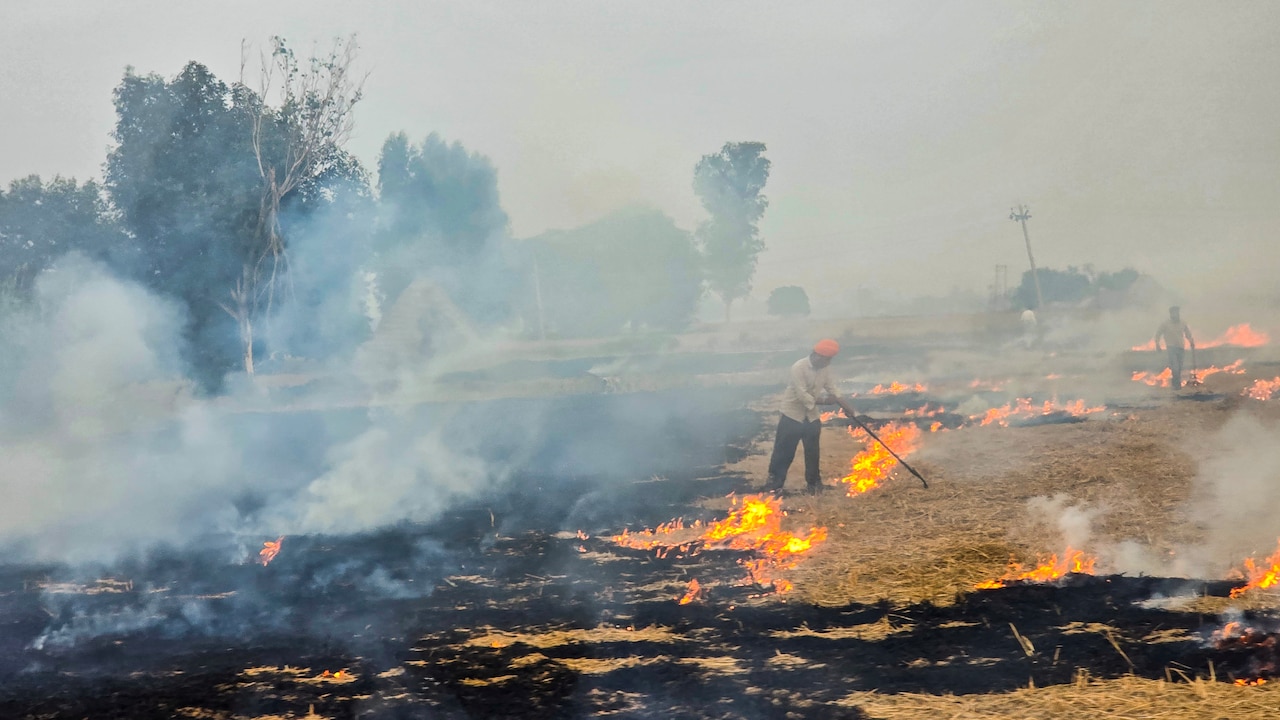
A farmer burns paddy stubble in a field on the outskirts of Patiala on October 24
Photo Credit: ANI
The ruling AAP government in Punjab went further and proposed a joint incentive package of Rs 2,500 per acre, asking the Centre to fund Rs 1,500 of that amount while the state would cover the remaining share. The Union government rejected the idea, arguing that massive subsidies had already been poured into crop-residue management machinery and that Punjab should follow the model used next door.
In Haryana, the BJP-led government runs a straightforward direct payment of Rs 1,000 per acre to farmers who refrain from burning. That scheme has operated for several seasons. In Punjab, the deadlock continues. Without comparable cash relief, farmers remain stuck between mounting debts, unaffordable alternatives and the urgent need to clear fields before the wheat-sowing deadline closes.
The Numbers the States Cite, and the Election-Year Lens
Satellite counts from the CREAMS laboratory at the Indian Agricultural Research Institute (IARI) also show a dramatic decline. Between September 15 and November 3, Punjab recorded 2,196 farm-fire incidents in 2026 compared with 43,994 in the same period of 2020 - a fall of roughly 95 per cent.
Haryana dropped from 2,699 incidents to just 52, about 98 per cent. Officials attribute the change to farm mechanisation, scientific interventions and greater farmer participation in residue management. By 2025-26, a cumulative 3.45 lakh crop-residue machines had been distributed across the country, supported by more than 43,000 Custom Hiring Centres. Punjab alone accounts for roughly 1.48 lakh of those machines and nearly 26,000 centres; Haryana has established 6,775 centres.
In-situ management inside Punjab expanded sharply. Around 11.4 million tonnes of paddy straw were handled directly in the fields during 2025-26, nearly three-fifths of the state's estimated generation. The government says those practices produced cultivation-cost savings exceeding Rs 600 crore and conserved an estimated 571 million cubic metres of groundwater through better soil and moisture retention. On the ex-situ side, nearly 7.85 million tonnes of paddy straw generated in Punjab in 2025 were used in industrial boilers, biomass and thermal power plants, fodder, compressed biogas, brick kilns and bioethanol production. The growing industrial demand is creating some rural employment and the beginnings of a bioeconomy, although assured procurement, remunerative prices and smooth supply chains are still required to keep the system working.
These figures are large, and the long-term direction is clear. Whether they tell the whole story, especially in an election year, is the sharper question. The official counts record detected fire events, not the total area burned or the full volume of straw that still goes up in smoke. Earlier seasons showed steeper year-on-year drops; the latest partial season still records thousands of incidents, and single-day spikes remain possible once the wheat-sowing deadline approaches. Governments that need to demonstrate progress ahead of polls have an incentive to emphasise the cumulative percentage decline and the machines already distributed. Opposition parties have an equal incentive to treat any remaining fires as evidence that the problem is unsolved. The underlying data can support both readings: the multi-year reduction is substantial, yet the absolute numbers that remain are still large enough to matter for regional air quality when weather conditions trap the smoke.
Why Delhi Still Chokes and the Politics
That said, if the fire counts have fallen so far, the seasonal smog in Delhi-NCR continues to produce loud political arguments every autumn. AAP leaders in Punjab stress the multi-year decline, the money spent on machinery and subsidies, and the fact that farm fires are only one contributor among vehicular emissions, industrial activity, construction dust, garbage burning and local firecrackers. They accuse opposition parties, particularly the BJP, of selectively targeting and unfairly maligning Punjab's farmers for political gain. Central and opposition figures reply that seasonal surges in farm fires still severely degrade regional air quality despite the official claims of progress. They argue that the state administration relies more on public relations than on effective ground-level enforcement and results, and that fines, red entries and physical verification have not kept pace with the satellite detections.
The gap between the two accounts is not mainly about whether the satellite numbers moved; it is about how much those numbers should settle the larger pollution problem and who should bear the cost of the remaining residue. Farmers still face the same twenty-five-day clock and the same cash shortfall for machinery or labour. Without a reliable local market that pays for the straw or a direct payment that covers the extra expense, a fraction of the crop residue continues to be burned. When that fraction coincides with calm weather and festival emissions, the air quality in the capital deteriorates, and the political cycle restarts: one side points to the 95 per cent decline and the machines, the other points to the haze outside the window and the farms that still lit up. The structural reasons the farmers give - time, cost and the absence of a better-paying alternative - have not disappeared just because the fire-count graph has bent downward.
KioskNews shows a cleaned-up reading view extracted from the publisher’s page — the original always lives on their site, not ours.