‘Trapped in grief’: wife of Japanese journalist detained by Russia pleads for his release
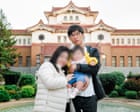
The wife of a Japanese journalist who has been detained in Russia for more than a month on suspicion of spying has issued an emotive appeal for his release.
Yuki Imai, a reporter for the Hokkaido Shimbun, was arrested in mid-October as he was preparing to return to Japan from a two-year assignment at the Japanese newspaper’s bureau in the city of Yuzhno-Sakhalinsk, on the island of Sakhalin in Russia’s far east.
Russian authorities alleged that Imai had been “conducting espionage activities” on the island, collecting information about Russian defence capabilities he intended to pass on to Japanese intelligence. Both the newspaper and Japan’s prime minster, Sanae Takaichi, have denied the claims.
His detention has inflamed tensions between Tokyo and Moscow and prompted Takaichi to request Imai’s release during a meeting with the Russian leader Vladimir Putin at last week’s Apec summit in China.
The arrest comes amid rapidly deteriorating ties between Japan and Russia, triggered by Tokyo’s support for Ukraine and a longstanding dispute over islands in the Kuril chain near Sakhalin that are known in Japan as the Northern Territories. Japan claims the four islands closest to its territory – the nearest is less than 4km from Hokkaido – which Russia has administered since the dying days of the second world war.
In a statement released to media organisations through the Hokkaido Shimbun, Imai’s wife, Nozomi Imai, said her husband’s plight meant his family were “trapped in grief”.
“Since his detention, his parents and I have spent every day worrying about him” she said in the statement, published in Japanese, English and Russian. Recalling the moment she saw TV footage of her husband being taken away by Russian authorities, she said: “I could hardly breathe. It felt as if my heart were being ripped apart.”
She added: “No one could remain calm after seeing a beloved family member with his arms bound behind his back. In the video, I could even see the souvenirs in his suitcase – the gifts he was bringing home for us. I could not sleep even for a moment that night. When morning came, it still did not feel real. I could not even cry.”
Imai, 34, has barely seen his infant daughter, who was born during his posting to Russia. “He had been so looking forward to coming home,” Nozomi Imai wrote. “During his posting, our daughter was born. She is now 21 months old, and he loves her more than words can say. He had even said excitedly that he wanted to be the one to pick her up from daycare on the very day he got home.”
Japanese diplomats have been permitted to visit Imai only twice since he was detained, although he has had several meetings with lawyers appointed by his employer.
Japan’s ambassador to Moscow, Akira Muto, said he had met the journalist at Lefortovo detention centre in Moscow this week and that he appeared to be in good health. Japanese embassy officials were also granted access to Imai at the end of October.
The Hokkaido Shimbun said Imai had been engaged in “ordinary news gathering” on Sakhalin, adding the newspaper did “not conduct reporting or gather information based on government directions”.
Shortly after his arrest, Takaichi denied Imai had been spying. “There is no such fact,” she told reporters, adding that “the protection of Japanese nationals is extremely important right now, and we intend to focus our efforts on that.”
Concerns are growing that Moscow will seek to make an example of Imai in protest at Japan’s support for sanctions imposed after Russia’s full-scale invasion of Ukraine in 2022.
Russia’s Federal Security Service, which is investigating Imai, has not commented publicly since it announced the reporter’s arrest. His detention is scheduled to expire on 12 December but could be extended, the Kyodo news agency said.
The Hokkaido Shimbun said Imai, whose grandfather was born on Sakhalin, was an admirer of Russian culture who had used his position to promote grassroots exchanges.He even hosted Russian visitors at his home in the Hokkaido city of Nemuro.
Nozomi Imai, who said she and her husband had met as students through their shared love of Russian films and novels, said his detention was taking a toll on his ageing parents.
“They worry whether they will ever see their beloved only son again in their lifetime,” she wrote. “Yuki Imai is not only a journalist. He is a beloved son, husband, and father. Please – please return this precious papa to his little daughter.”
Year-end fundraiser
$0 of $2,000,000 goal
A moment full of possibility – and risk
We hope you appreciated this article. Before you close this tab, can we ask you to support the Guardian at this crucial time for democracy in the US? With Black Friday approaching, our most impactful monthly support option is just $7.50 a month for six months.
In the last two years alone, Donald Trump has eroded many of the pillars of US democracy – slashing funds for universities, undermining science, shutting down arts institutions, and attacking the free press as an “enemy of the American people” and “a threat to our national security”. While he and his allies have enriched themselves and spread lies, federal forces have harassed and imprisoned innocent people and violated the constitutional rights of many Americans.
Now, in a sweeping change election, the American people have spoken: Donald Trump, Pete Hegseth, RFK Jr, Elon Musk and the tech oligarchs may finally be held to account. A majority of American voters have demanded an end to the costly and immoral wars, the flagrant profiteering, and the corrosive attacks on communities and democratic institutions.
It’s a moment full of possibility, with more stories than we can possibly cover. New leaders are emerging from Texas and Michigan to Iowa and South Carolina – and heading to Washington to fight for affordability, against wealth inequality, and for human survival in the face of AI and the climate crisis.
These new leaders will be facing a cornered Trump and his hardline chief of staff, Stephen Miller, who have nothing left to lose. The next few years are critical for the future of the country. Journalism that covers the epic clash between these forces has a vital role to play right now.
Investigative journalism provides a fact-based paper trail for an emboldened Congress to follow. Members of Congress – and the American public – often rely on our in-depth reporting to inform the tough questions, to connect the dots and to pursue accountability for wrongdoing.
At the Guardian, our newsroom is devoted to uncovering the truth and conveying it to as many people as possible. We’re not alone in this mission, but this kind of journalism faces unprecedented hurdles: big tech threatening our financial stability and stealing our work for AI, billionaire owners telling journalists what to publish, and a hostile executive branch intent on suppressing our reporting.
The Guardian is free to dig deep without fear because we’re funded by our readers. Our readers hold us to account, and we hold the powerful to account.
However, this only works when enough of our readers contribute. Against the advice of most industry analysts, we’ve refused to put up a paywall – we believe good journalism should be freely available to all people, regardless of ability to pay. If you’re counting on our reporting, and you can’t afford to pay, please stop reading this message and go back to our articles.
If you can afford to contribute, please know that your support is not only helping yourself – from voters in Kansas to immigrants in Minnesota and families in Gaza, your generosity is bringing factual news to people around the globe.
Today is among our most important fundraising days of the year. To sustain our unique financial model, our goal is to raise $2,000,000 before the new Congress is seated on 3 January. More than 19,000 people have contributed already. All gifts are gratefully received, but for the next several days only, our most impactful monthly support option is $7.50 a month for the first six months. If you can afford 37 seconds, please join our ranks – and show your support for the rekindling of democracy in the US and around the world.
KioskNews shows a cleaned-up reading view extracted from the publisher’s page — the original always lives on their site, not ours.