How poor public transport policy is putting the brake on cities | Letters
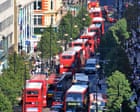
Your analysis of slowing buses in global cities sets out the mechanism exactly, and the remedy follows from it (London buses in decline? Why public transport in global cities is slowing to a crawl – visualised, 23 September).
Transport for London’s own calculation that a 10% fall in speed costs 6% of demand and Imperial College London’s finding of the same decline across 15 cities show what happens to buses as the traffic thickens around them. Retiming the lights will not reverse it, and London is already trying. The phrase to notice in the article is one used by TfL: signals will give more buses priority “where possible”.
There lies the difficulty. On a route running a bus every two minutes, the signals are asked to intervene 30 times an hour in each direction, and the junction cannot recover between calls before the next bus arrives.
Bristol city council’s engineers found precisely this when they reviewed their bus priority: in the most congested parts of the city, priority delivered no journey-time saving at all.
This is a bigger brake on the economy than it looks. What holds a city back is the plain difficulty of getting across it to work, to customers, to the shops. A firm can recruit from a smaller area, a worker can reach fewer jobs, and a high street can be reached by fewer people. Much of the decline of the high street is a decline in how easily people can get to it.
The cure is to carry the same people in fewer vehicles. One tram carries as many people as three or four buses, so it can be given priority junction after junction, and the crossing traffic still gets its turn.
About 30 French cities have put trams through their centres since Nantes started in 1985, and they rebuilt those centres around them. Their central streets are visibly busier for it. Sheffield’s trams share a shopping street with cars and vans, and run to the same timetable in the peak as at midday.
David Andrews
Chair, Light Rail Transit Association; lead author, Bristol Area Bus and Tram Business Case
Your article on London buses in decline highlights poor transport policy in London, which is guided by publicity rather than practicality.
Buses have slowed down as dedicated bus lanes have been largely replaced by a poor choice of cycle lanes. London is an old city with narrow lanes and, with individual cycle transport given priority over mass public transport, it’s no wonder that buses have slowed and become erratic in service.
One only needs to observe the utilisation of cycle lanes that are empty except during the peak hours of 7.30am-9am and 4pm-5pm on weekdays. That is a gross waste of valuable road space that could be used by buses.
Having a dedicated bus lane instead of a cycle lane would speed up buses and make them more reliable. The bus lane could be shared by cycles and during peak times be dedicated to them, while being free for buses rest of the day.
Sadly, politicians rarely look beyond elections, and fail to prioritise buses over bicycles. The authorities have wasted millions on cycle lanes while failing spectacularly to improve mass public transportation.
V Narayanan
London
KioskNews shows a cleaned-up reading view extracted from the publisher’s page — the original always lives on their site, not ours.