Asean wants a single digital economy. Will different state laws hobble its goal?
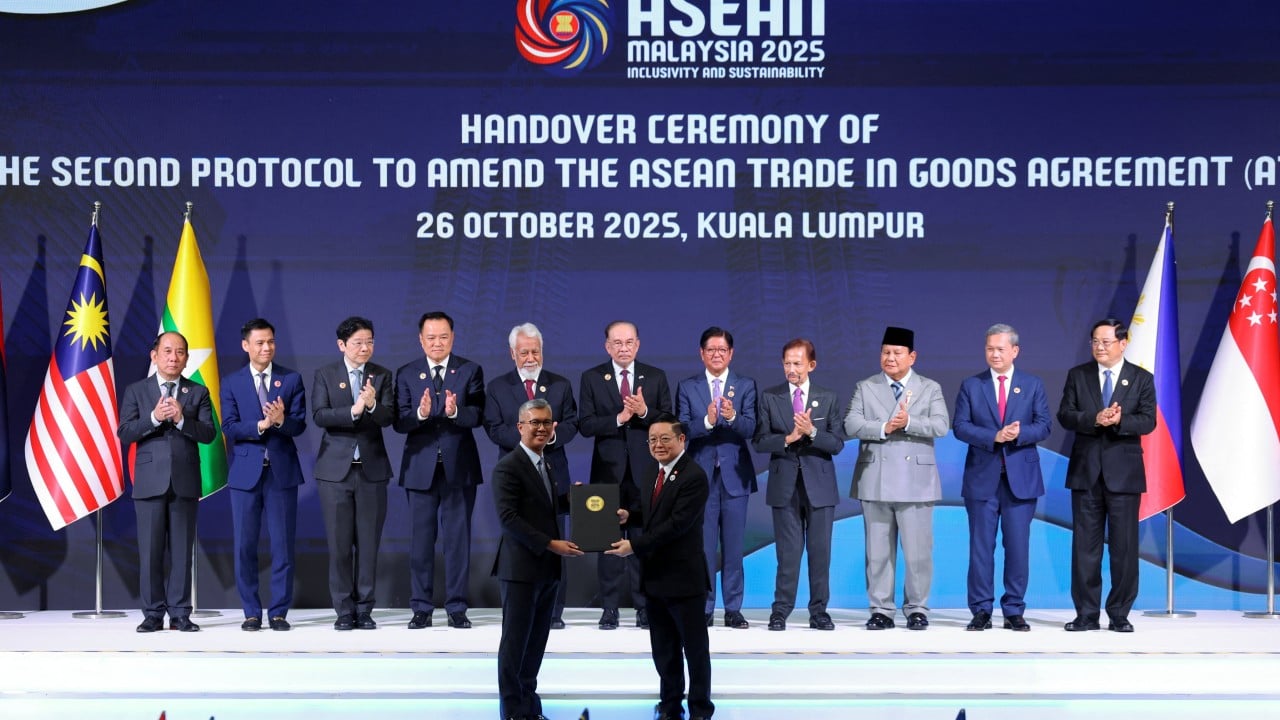
Southeast Asian nations are seeking to make it easier for businesses and consumers to operate across borders in the digital economy, but achieving the goal will depend on whether governments can align their domestic laws under a proposed pact, according to analysts.
Targeted to be signed during the Association of Southeast Asian Nations summit in Manila in November, the Asean Digital Economy Framework Agreement (DEFA) is aimed at improving compatibility between rules and systems governing digital payments, data flows and online commerce across the region. However, its draft text is yet to be published.
In an interview earlier this month, Philippine President and current Asean chairman Ferdinand Marcos Jnr said he hoped Singapore, which will chair the 11-member bloc next year, would help advance the agreement then.
In June, Asean announced that its officials had resolved all outstanding issues arising from a meeting in Manila in May, adding that DEFA was expected to play a transformative role in unlocking the full potential of the region’s digital economy.
Deborah Elms, head of trade policy at the Singapore-based Hinrich Foundation think tank, said the text could be released some time between the coming Asean summit and 2027.
This would depend on how much “legal scrubbing” by the bloc’s members was needed before signing the pact, she said. “We are therefore left to speculate about what might or might not be included in DEFA.”
A 2024 preparatory study on DEFA, prepared by the Boston Consulting Group with support from the Australian government, identified differing payment standards, fragmented digital payment requirements, restrictions on data sharing and transfers, cybersecurity gaps and insufficiently connected trade infrastructure as barriers to increasing digital trade within Asean.
More than 2,000 micro-, small- and medium-sized enterprises (MSMEs) across the 10 Asean members at the time, as well as corporate and government representatives, were interviewed or surveyed for the study.

Elms said a major risk for companies was that governments would pursue different domestic regulatory approaches without coordination at the Asean level to finalise DEFA. Members could, for instance, introduce different privacy requirements for various types of data, leaving businesses to navigate multiple legal regimes, according to Elms.
DEFA was intended to encourage coordination and regulatory alignment, but businesses would need clarity on how interoperability would operate in practice, Elms said.
“They will be required to create interoperable rules. But absent clear criteria for how to make this happen, firms might discover that interoperability on offer is not actually making a difference on the ground,” Elms said.
These difficulties, she suggested, might first emerge in payment systems or rules governing data flows.
To bridge these gaps, Hafidzi Razali, founder and CEO of public affairs advisory firm Strategic Counsel, argued that Asean should adopt a flexible DEFA to accommodate domestic legal amendments by its members.
“At Asean level, a principle-based approach can guide member states to achieve consistency in addressing the different facets of interoperability,” Hafidzi said.
“The challenges presented by the rise of AI present a good case study, where it’s still early but not too late to mitigate the unintended effects.”
Elms predicted that DEFA could entail implementation barriers similar to those encountered by the bloc for its existing Agreement on Electronic Commerce, which was signed in January 2019 and came into force in December 2021.
“It is worth remembering that Asean already has an active E-Commerce Agreement that covers many of the same topics,” she said, adding that much of the earlier agreement had not been implemented or had been implemented unevenly.
“This is not unusual for Asean, as the institution prizes flexibility and implementation is always the challenge,” she said.

The 2024 preparatory study for DEFA recommended staggered timelines and commitments to accommodate member states’ different starting points, alongside mechanisms to help countries move towards higher levels of commitment.
It also called for continued private-sector engagement and updates to policies and standards as business needs and technologies evolved.
Farlina Said, director of cyber and technology policy at Malaysia’s Institute of Strategic and International Studies, said Asean’s ambitions required greater cross-border data flows and transactions, supported by compatible approaches on trusted credentials, privacy and security.
Institutions would also need greater capacity to manage increased digital activities and the accompanying cybersecurity challenges, she said.
“While DEFA advances conversations on cross-border data flows, there can be bottlenecks to implementation,” Farlina said.
While the agreement sought to position Asean as a digital market and encourage its population to participate in the digital economy, constraints on access and connectivity could affect the pace at which its benefits spread across different communities in the region, according to Farlina.
“While some communities may advance quickly, others may just be slightly slower to benefit from the agreement,” she said.
KioskNews shows a cleaned-up reading view extracted from the publisher’s page — the original always lives on their site, not ours.