‘National suicide’: The election issue tearing Israelis apart
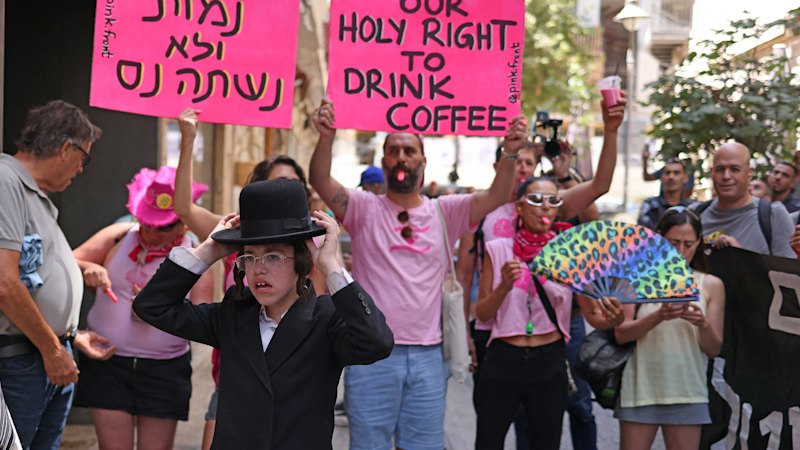
Jerusalem/ Bnei Brak: Almost anywhere else in the world, a cafe opening for business on Saturday would not be an inflammatory act. But in downtown Jerusalem, Cafe Basimta’s decision to sell coffee and pastries on the Sabbath ignited an almighty culture war between the Holy City’s ultra-Orthodox and secular residents.
Soon after the coffee shop opened in a quiet alley in May, dozens of ultra-Orthodox teenage boys wearing black suits and fedoras showed up to block its entrance while chanting “Whoever breaks the Sabbath has no part in the world to come”.
Ultra-Orthodox Jews believe in resting on the Sabbath, the frequent study of religious texts, strict gender segregation and eating kosher, pitting them against the less devout, who favour a more relaxed approach.
As the demonstrations grew each week, so did counter-protests. Hundreds of non-religious activists locked arms to protect the entrance to the café, and prominent politicians from the right and left joined in.
The fact that the cafe’s owners – the messianic and controversial Jews for Jesus organisation – were hardly secular was a wrinkle in the narrative. But it didn’t deter most of the counter-protesters, who believed they were fighting for an important principle.
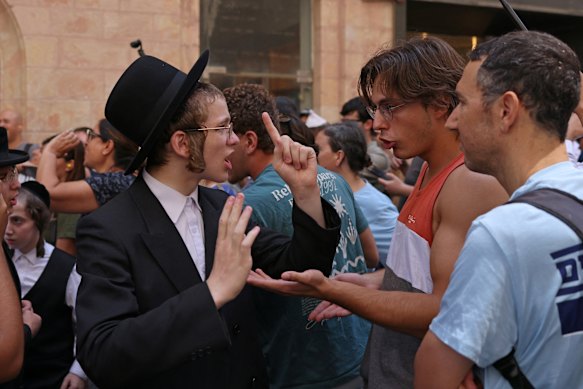
“We see it as our right to be able to drink coffee on the Sabbath in the centre of Jerusalem,” says deputy Jerusalem mayor Adir Schwarz, a champion of the city’s secular population. “Our capital is supposed to unite all Israelis, and if any Jew is being pushed out of Jerusalem, that is a bad forewarning for the rest of the state of Israel.”
While the havoc was a boon for business, the owners ultimately decided it wasn’t worth the pain. In September, the cafe announced it would no longer open on Saturdays. “The cafe has become, over the past several months, a focal point of friction and danger,” Jews for Jesus chief executive Eli Birnbaum said.
Disappointed by the decision, secular activists mostly abandoned the cafe and business plummeted. When we visited last week, the coffee was excellent, but only a handful of customers were there.
Schwarz says the backdown was just the latest blow to secular Jerusalemites, who feel increasingly marginalised and disempowered. Ultra-Orthodox residents are rising in number and moving into secular suburbs, sparking heated battles over resources and cultural norms.
‘We live in separate worlds, and those worlds are getting further apart’
Rabbi Yisrael Goldwasser
“A territorial battle is playing out in certain neighbourhoods as their identity changes and becomes more religious,” Schwarz says.
Schwarz cites strict ultra-Orthodox modesty laws which can expose female pedestrians to harassment and intimidation for wearing jeans. “The fact a secular woman cannot walk in pants through the neighbourhood she grew up in is a big problem,” Schwarz argues.
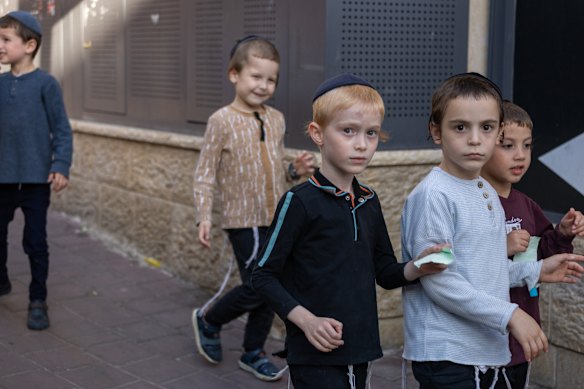
Israel’s ultra-Orthodox community – known as the Haredim – makes up 14 per cent of the national population. That figure is exploding, reflecting the fact that the birth rate for ultra-Orthodox women (6.5 children per woman) is vastly higher than for other Jewish women (2.2 children). By 2065, the Haredim are projected to comprise a third of Israeli society, a figure unimaginable when Israel was founded in 1948. Such rapid growth equals more political power but also greater scrutiny about ultra-Orthodox Jews’ contribution to Israeli society.
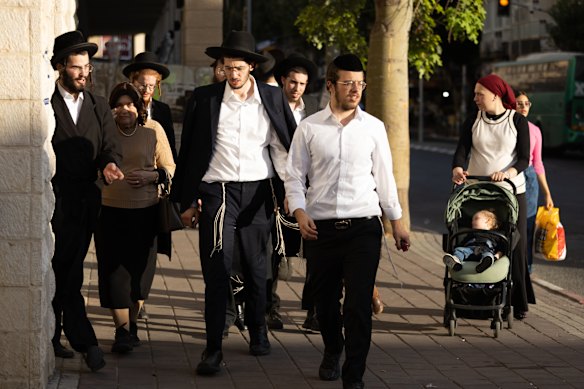
The fight over Cafe Basimta is emblematic of a deeper battle being waged in Israel ahead of national elections on Tuesday. Topics that foreigners may expect to be front-of-centre – like how Israel waged its war on Gaza or the possibility of a two-state solution with the Palestinians – are almost entirely absent from the public discourse. Meanwhile, the concessions provided to ultra-Orthodox Israelis are tearing the nation apart and dominating the campaign.
Bnei Brak is a mere 20-minute drive from the gay bars and non-kosher restaurants of Tel Aviv, but it might as well be on a different planet. “We live in separate worlds, and those worlds are getting further apart,” Rabbi Yisrael Goldwasser says of the two cities, which serve as avatars for Israel’s ultra-Orthodox and secular tribes. Here there is none of the clashing and intermingling you find in more integrated Jerusalem.
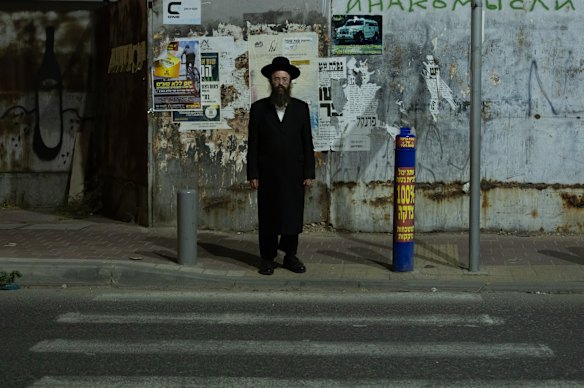
Bnei Brak is one of the world’s most densely populated cities: 230,000 people, almost all of them Haredi, crammed into just seven square kilometres of land. “It’s a terrible city, it’s dirty, it’s more crowded than Gaza,” Goldwasser says as he slurps a bowl of matzo ball soup. His kosher phone, which blocks internet access, sits on the table. On the plus side, he says it is a self-contained society packed with restaurants, yeshivas, shops and medical facilities where the streets remain lively until the early hours of the morning.
In Hebrew, the Haredim means those who tremble before God. To be ultra-Orthodox is to be on edge. But Goldwasser says the community’s naturally high anxiety has spiked to intolerable levels because of an all-out campaign to force them to serve in the military.
The dilemma of ultra-Orthodox army service has existed before the founding of Israel in 1948. To ensure as broad support as possible for the creation of a Jewish state, founding prime minister David Ben-Gurion granted 400 yeshiva students exemptions from compulsory military service. This reflected the ultra-Orthodox community’s fraught relationship with Zionism (many believe establishing a sovereign Jewish state before the arrival of the Messiah violates divine law).
A decade later, with thousands of students now exempt, Ben-Gurion questioned his decision. Today, court filings by Israel’s attorney-general estimate that about 80,000 are avoiding military service. This became a source of fury as Israel fought a multi-front war against its enemies after the October 7 attacks of 2023. The burdens of service – time spent away from family and the risk of dying on the battlefield – have not been distributed evenly across society.
Reflecting the new era Israel entered after October 7, the Supreme Court ruled in 2024 that the longstanding blanket exemption for yeshiva students was unlawful. Fierce resistance has followed. Last year, chief rabbi Yitzhak Yosef used his weekly sermon to warn that the ultra-Orthodox community “will all board planes and leave Israel” if they are forced to serve in the army.
Attempts to force Haredi men to enlist, including through arrests, have sparked riots and blockades of major highways. In June, ultra-Orthodox rioters smashed windows, damaged flowerpots, and vandalised a car parked at the home of the Supreme Court’s deputy president.
“As far as they’re concerned, it’s life or death. Religion comes first,” Wasserman says, explaining why the issue arouses such passion. Bnei Brak yeshiva student Yakov, 20, says he has no intention of enlisting. “Prison, sanctions, nothing can break us,” he declares. His dream is to be a rabbi.
Protests and arrests have accelerated in the lead-up to the October 27 election, raising the temperature. The military arrested 40 ultra-Orthodox men returning from the United States on Tuesday at Tel Aviv airport on suspicion of draft dodging.

Prime Minister Benjamin Netanyahu, whose conservative coalition is reliant on ultra-Orthodox parties, criticised the arrests. “We need to preserve the world of Torah study because it has preserved us,” he said in a radio interview.
On the other side of the debate, the four main Jewish parties running against Netanyahu are all campaigning to end sweeping exemptions from military service. They are convinced they are onto a vote winner. An overwhelming 72 per cent of Israelis want to see the Haredim drafted alongside other Israelis eligible for military service, according to a September poll by the Israel Democracy Institute.
Heightening the anger over draft dodging is the ultra-Orthodox community’s dependence on the Israeli state. The employment rate for Haredi men is only around 50 per cent, and more than half live in poverty, making them reliant on government subsidies. Ultra-Orthodox schools typically devote little time to subjects such as maths and science, leaving graduates poorly equipped for the modern workforce. Critics argue this is a time bomb threatening the viability of Israel’s advanced, high-tech economy.
“There’s a million-and-a-half Haredis; in one generation there is going to be four million,” former prime minister Naftali Bennett, who is running to unseat Netanyahu, told podcast host Eylon Levy last week. “Right now, they don’t serve in the army, they barely work and barely pay taxes, but we have to fund them ... It’s a machine of national suicide.”
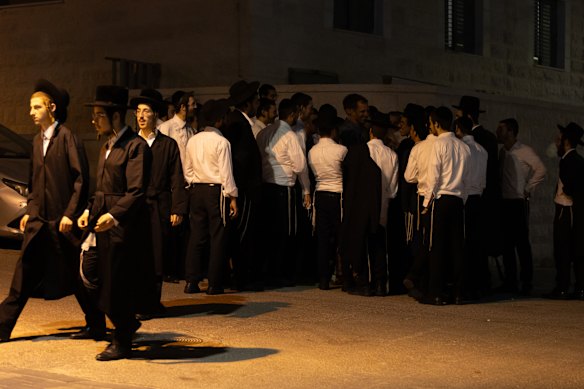
Rabbi Goldwasser says the military enlistment drive is encouraging hatred in a populist bid to win votes. “We take care of the poor, we look after the unfortunate. That’s why it hurts so much,” he says of being labelled shirkers and draft dodgers.
While he believes trying to force resistant Haredis into the army by arresting them will be disastrous, he says making the military a welcoming environment for the ultra-Orthodox could boost recruitment numbers.
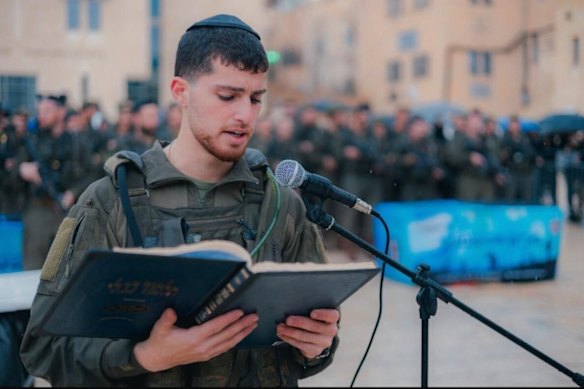
Elchanan Wasserman is on a mission to prove it can be done. At 18, Wasserman did something normal for secular Israelis, but remarkable for a young Haredi man like himself – especially one raised in a fervent anti-Zionist household. He enlisted in the army. A troubled childhood convinced him yeshiva life wasn’t for him, prompting a search for an alternative source of structure and meaning. “I didn’t know what to do with myself,” he says from Syria, where he is currently serving. “I joined the military to help my country, and it saved me.”
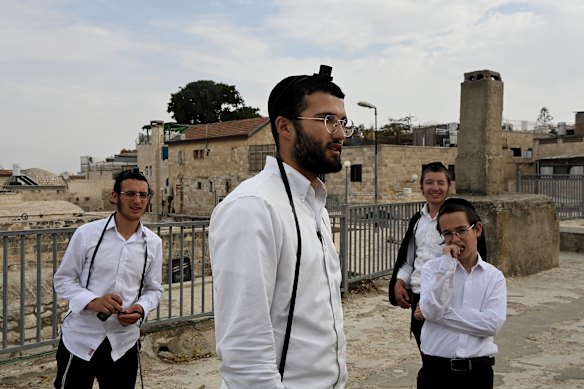
Wasserman, 27, heads recruitment for the newly formed Hasmonean Brigade, created to accommodate ultra-Orthodox soldiers. The soldiers only serve alongside men, are given time to study the Torah, are allowed to wear black-and-white on the Sabbath and eat the highest level of kosher food. Before October 7, 2023, only around 1800 Haredi men enlisted each year. That jumped to 4300 last year, a substantial rise off a small base.
Wasserman’s work has come at a cost: he was cut off from the community he grew up in and had to be evacuated with police protection in January when violent riots broke out at a conference for ultra-Orthodox recruits. But he says he will encourage his children to serve when they turn 18. “If I didn’t enlist, I think I would be in jail or dead,” he says.
Like Goldwasser, Jerusalem deputy mayor Adir Schwarz is alarmed by the sight of ultra-Orthodox men being arrested. He prefers the use of economic incentives, and sanctions, to encourage enlistment. “Everyone knows the current situation of having this society within a society can’t continue,” he says. “People have simply had enough.”
Get a note directly from our foreign correspondents on what’s making headlines around the world. Sign up for our weekly What in the World newsletter.
KioskNews shows a cleaned-up reading view extracted from the publisher’s page — the original always lives on their site, not ours.