‘The Twilight Zone’s Creepiest Episode Is Still an Unforgettable 25 Minutes

Lloyd 'Happy Trails' Farley: the man, the myth, the legend. What can be said about this amazing - and humble - man that hasn't been said before? Or, more accurately, what can be said in public? Born in Calgary, Alberta, Canada, Lloyd is a master of puns and a humorist, who has authored one pun book to date - Pun and Grimeish Mint - and is working on a second. His time with Collider has allowed Lloyd's passion for writing to explode, with nearly 1,000 articles to his name that have been published on the site, with his favorite articles being the ones that allow for his sense of humor to shine. Lloyd also holds fast to the belief that all of life's problems can be answered by The Simpsons, Star Wars, and/or The Lion King. You can read more about Lloyd on his website, or follow his Facebook page and join the Llama Llegion. Happy trails!
Sign in to your Collider account
What defines creepy? Generally speaking, "creepy" is anything, or anyone, that causes unease, nervous fear, or even dread. But on a more specific level, "creepy" is largely subjective. Not everyone gets shivers whenever a spider shows up on a TV screen, for example, with phobias driving that sense of dread for those that do. That said, there are things that most people can agree are creepy. The titular doll from Annabelle? Creepy. Serial killers? Creepy. Fictional dystopian futures in media that aren't all that far-fetched based on where today's society seems to be heading? You bet, and one of The Twilight Zone's creepiest episodes hinges on that very idea, only to change the game over the course of its 25 minutes.
One Man Challenges the Totalitarian State in ‘The Twilight Zone’ Episode “The Obsolete Man”
In a totalitarian state set sometime in the future, Romney Wordsworth (Burgess Meredith) stands before a tribunal, where he awaits judgment from the Chancellor (Fritz Weaver). His only crime is his professed occupation as a librarian, which, because the State has eliminated books, has rendered him obsolete and subject to the death penalty. His faith in God only cements his fate, given the atheist regime has proven that God doesn't exist. Wordsworth protests but to no avail: the Chancellor finds him guilty and sentences him to death within 48 hours.
Collider Exclusive · 8 Questions · 2 Minutes What Is Your Biggest Horror Nightmare? Elm Street · Chucky · Scream · The Conjuring
Four horror franchises. Four completely different ways of scaring you. One waits until you fall asleep. One makes sure nobody believes you. One is already in your group of friends. And one is in the house with your family. Answer eight quick questions about how you actually watch horror, and find out which nightmare was built for you.
😴Elm Street(Freddy Krueger)
🧸Chucky(Child's Play)
📞Scream(Ghostface)
🕯️The Conjuring(The Warren Files)
01
Which horror scene makes you cover your eyes? Four classic images. One of them is worse than the others for you.
02
You are home alone and you hear a noise. First thought? Everybody has one. It arrives before you have decided anything.
03
Which horror movie rule would you break first? Everybody thinks they would survive. Almost nobody actually does.
04
Something genuinely frightening happens. What do you do? Not in a film. In your actual living room, tonight.
05
How do you actually watch a horror film? Be honest about this one. Nobody is checking.
06
Somebody offers you serious money. Which do you still refuse? The amount does not matter. There is one on this list you are not doing.
07
Which feeling stays with you a week after the film? Good horror does not stop when the credits do.
08
Something wakes you at 3am. What is the worst possibility? Eight questions in, this is the one that decides your nightmare.
The Lights Just Went Out Your Nightmare Is…
Four franchises, four completely different ways of getting underneath your skin. This is the one built out of your particular fear, why it works so well on you, and what it would leave behind.
Elm Street
Your nightmare does not wait outside the door. It waits for you to close your eyes, which you are going to have to do eventually, because nobody has ever won that particular argument.
- Freddy is horror's cruellest idea: a threat that lives in the one place you cannot guard, cannot lock, and cannot avoid forever.
- You are the one who is fine during the film and wide awake at two in the morning. Your own head is where this does its damage.
- These films understood exhaustion as a horror engine. The kids on Elm Street do not lose because they are weak. They lose because they are tired.
- You can lock every door in the house. You still have to sleep.
Chucky
Your nightmare is not really the doll. It is the face of the person you tell, and the way they decide, very kindly, that you have imagined all of it.
- Chucky works precisely because he is absurd. That is the trap: the more accurately you describe him, the less anybody is going to believe you.
- You are the one shouting at the screen because the characters are not listening. You know that feeling from real life too.
- The franchise is at its best when the adults in the room are the real obstacle, and you have met those adults.
- By the time somebody finally believes you, you will have handled most of it on your own.
Scream
Your nightmare has your number, knows your name, and has almost certainly been inside your house before. The worst part is that you already know them.
- Scream is the only one of these where the killer takes the mask off and turns out to be somebody who was at the party.
- You are the person who calls the twist out loud before it lands. You watch people the same way you watch films.
- The franchise made the rules of horror part of the plot, which means the survivors are the ones paying attention. You would be paying attention.
- Everybody is a suspect, including the person who just offered to walk you home.
The Conjuring
Your nightmare is not really about you. It is about the people asleep down the hall, and the feeling that whatever is here is not interested in leaving.
- The Conjuring films are domestic horror. The house, the family, the perfectly ordinary room that quietly stops feeling ordinary.
- Your instinct is to get everybody into one room. Your fear is protective rather than personal, which is rarer than it sounds.
- This is the one franchise where belief is the weapon. The people who come through it are the ones who are not alone and refuse to be.
- Whatever is here did not come for you. It came for the household, and you are the one standing in the hallway.
Wordsworth is, however, allowed to choose the method, time, and place of his execution. With a glimmer in his eye, Wordsworth makes two requests: a personal assassin, who will be the only one to know how Wordsworth will be executed; and that his execution be televised nationwide, from his room, at midnight the next day. An odd request, but the Chancellor grants them both. After all, the method of his execution is irrelevant, so long as it's carried out, and televising executions has an "educative effect" on the broader population.
There is a third request, too, with Wordsworth inviting the Chancellor into his room at 11:15 the next night, which the Chancellor accepts. He arrives on time, with cameras set up to televise the proceedings. Wordsworth reveals that at midnight, a bomb will go off in the room that will end his life, as dictated. The Chancellor agrees that the method is relatively quick and painless, and turns to leave. Only he can't: Wordsworth has locked the door, meaning the Chancellor will die with him.
Wordsworth has flipped the script, pointing out that the live feed means that the State won't come to rescue the Chancellor, lest it lose status in the people's eyes. With that, Wordsworth brings out his "illegal" Bible and starts reading portions aloud, expressing his trust in God, while the Chancellor tries to maintain his composure in the face of his impending death. But when the clock hits 11:59, the Chancellor breaks, begging and pleading for his life, as he had so coldly asserted Wordsworth would do in his final moments. "In the name of God," no less, a God that supposedly doesn't exist. Wordsworth gives him the key, with the Chancellor escaping just before the bomb goes off. But death may have been the lesser of two evils, given what awaits afterward.
‘The Twilight Zone’ Episode “The Obsolete Man” Is a Game-Changer
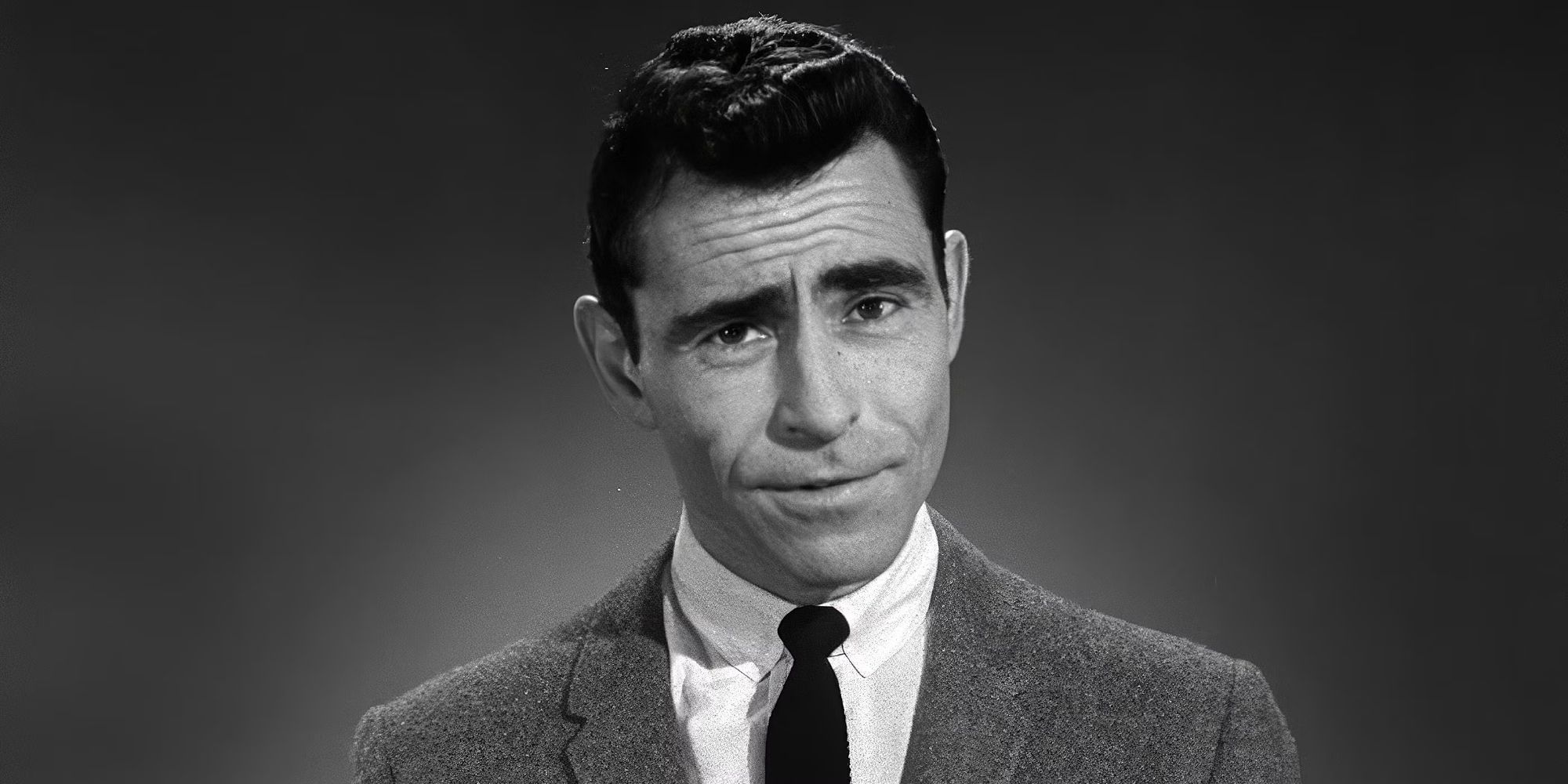
In his opening narration, Rod Serling is up front about the roots of the State in "The Obsolete Man," saying, "This is not a new world, it is simply an extension of what began in the old one." The words are downright chilling in their truth, with the world within the episode eerily reminiscent of the regimes of Adolf Hitler and Joseph Stalin (in fact, both are referenced, with the Chancellor stating that they didn't go far enough, with "too many undesirables left around, eventually forming a core of resistance"). Those same words are creepily relevant today, making it feel like our society is on a direct path to "The Obsolete Man." Serling's closing narration is no less truthful: "Any state, any entity, any ideology that fails to recognize the worth, the dignity, the rights of Man... that state is obsolete."
But what makes "The Obsolete Man" a game-changer is the character of Romney Wordsworth, through an excellent performance by Burgess Meredith. That begins with the character's name itself, with "Wordsworth" an allusion to the value of the written word (it's also the second time Meredith played a book-lover in the series, the first in the classic Season 1 episode "Time Enough at Last"). Meredith's Wordsworth is defiant without actually being defiant. He's played by the rules of the State, only to expose their weaknesses from coast to coast in a brilliant twist. Dystopian futures on the screen are rarely successfully challenged, let alone so peacefully, and while the ripple effect of Wordsworth's act isn't fully known, there's reason to believe that he's sparked a movement, the very thing that the Chancellor had claimed was practically impossible to do after "correcting the errors" that the likes of Hitler had made. Add the stunning camera work and sets that lean heavy into German Expressionism, and Wordsworth's actions become even more pronounced and unforgettable. Until the words in Serling's closing narration are heeded, though, such futures remain real possibilities in the real world. Creepily so.
KioskNews shows a cleaned-up reading view extracted from the publisher’s page — the original always lives on their site, not ours.