[Korea travels] Walking the path to success in Ulsan’s Tongdo Temple
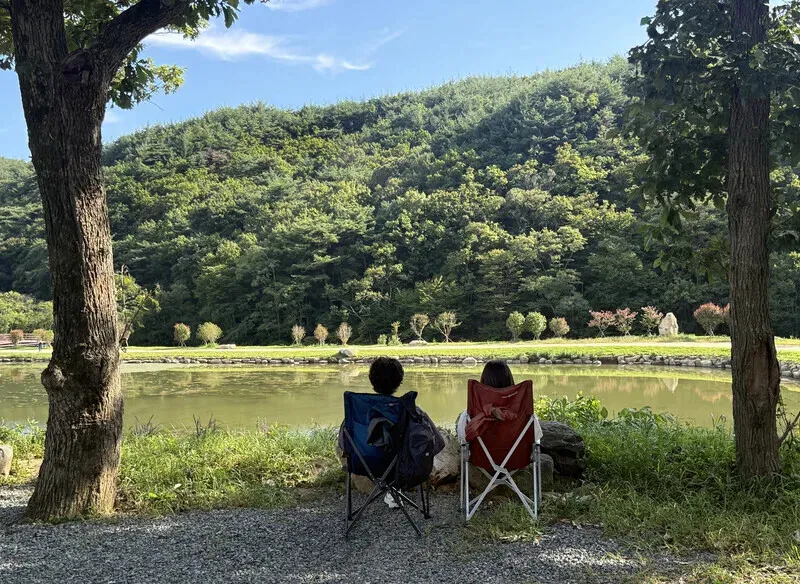
Travelers enjoying a getaway near Bogyeong Lake, a hidden retreat known only to seasoned travelers. (Park Mee-hyang/Hankyoreh)
Why would a Buddhist temple have a path dedicated to success?
Worldly success and Buddhist practice would seem to have little in common. Elevating one’s social status or achieving fame are decidedly secular objectives, while a Buddhist temple is a place for renouncing worldly attachments and seeking enlightenment.
That is why visitors to Tongdo Temple — the ancient Buddhist shrine in Yangsan, South Gyeongsang Province — are often surprised to encounter the “Road to Success.”
Founded in 646 by the Buddhist monk Jajang during the reign of Queen Seondeok of the Silla Kingdom, Tongdo is one of Korea’s most celebrated temples.
Along with Haein Temple in Hapcheon and Songgwang Temple in Suncheon, it is considered one of the country’s three greatest Buddhist temples. In 2018, it was inscribed on the UNESCO World Heritage List.
The name Tongdo is said to have a threefold significance.
The first meaning is that both ordinary people and acolytes can attain enlightenment through the Buddhist teachings by way of the Geumgang Gyedan, or Diamond Altar, behind the temple’s main hall (Daeungjeon). The altar is said to enshrine sarira, or the sacred remains of the Buddha, in the form of bones or pearl-like relics left after he entered nirvana.
Second, Tongdo is said to signify a mastery of the principles of human existence that can guide living beings to the Buddhist paradise.
The name’s third meaning is that the ridgelines of Mount Yeongchuk (or Yeongchui), which surrounds the temple, resemble those of Vulture Peak, which known by the same name in Korean. Located in the Indian state of Bihar, Vulture Peak is famously the site where Shakyamuni, the historical Buddha, delivered his teachings.
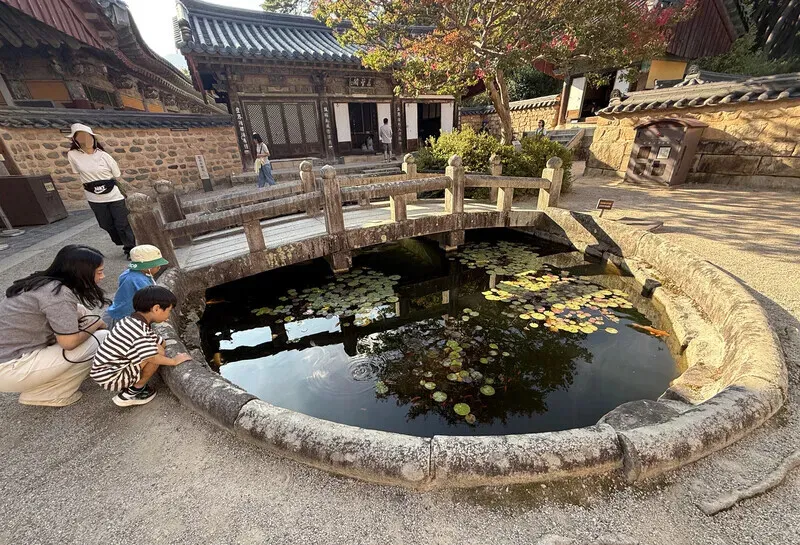
Tongdo Temple is dotted with charming ponds and other picturesque spots. (Park Mee-hyang/Hankyoreh)
The buildings of Tongdo possess an architectural grandeur that few temples can match, as well as a weighty history that is humbling to contemplate. The weathered pillars and rooftops bear witness to the existential anguish that humans struggle so desperately to escape.
The temple complex encompasses 17 hermitages, each with its own design, making the entire grounds feel like a place where humans and beasts welcome each other’s company and friendship.
Most visitors to Tongdo are likely to move on after seeing the main hall, the three-story stone pagoda and other structures familiar from temples elsewhere. To be sure, they are certainly more impressive than their counterparts at many temples.
But only seeing those features means missing the temple’s true treasures.
What lies at the end of the long and winding Road to Success
Tongdo Temple’s Road to Success is a treasure. Treasures need not be extravagant; if they can shine a light into the deepest part of your soul and push you to examine it without being arrogant, they are precious.
Such treasures become the foundations upon which the future is built.
I stepped onto the Road to Success on Sept. 12. I would’ve missed out on this road if it were not for a fleeting moment I shared with a stranger. They stopped me in my tracks, saying, “You simply must go there. Follow the stream next to Tongdo Temple, and you’ll find it.”
The urgency behind that recommendation moved me so that I found myself on that very road.
The Road to Success is a path of wooden decks. If you took a photo of this road and displayed it without any context, it would be difficult to believe that it was the grounds of a temple. The winding road undulates gently, and as you walk, your eyes are constantly fixed on the ridge of Mount Yeongchuk.
The walk is so peaceful that you cannot help but wonder: How could a road this tranquil prepare you for success in a world as callous as ours? The road to success is usually imagined as a grueling journey, full of hellish sections that leave you winded and discouraged.
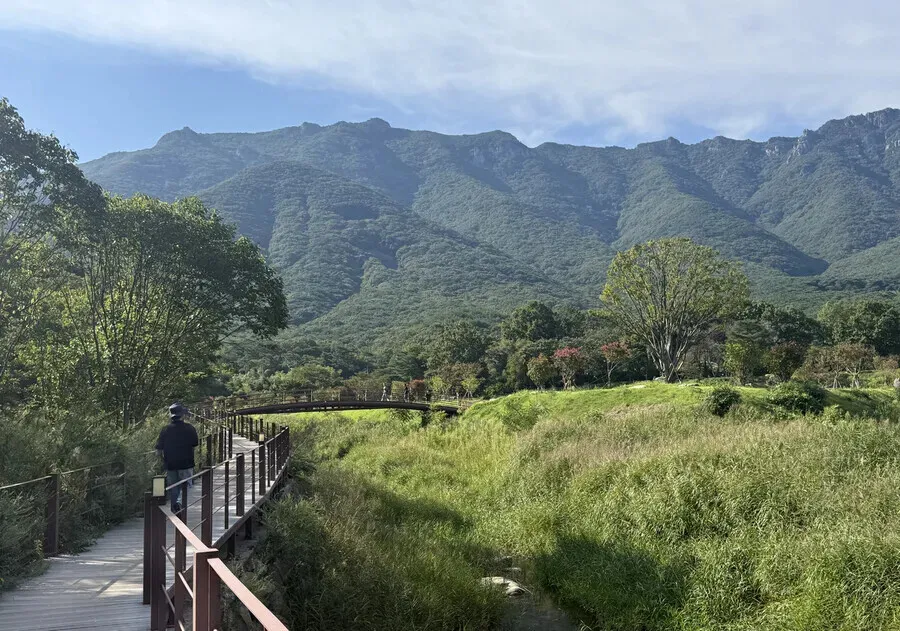
A small bridge marks the end of Tongdo Temple’s “Road to Success.” Crossing it brings you to Bogyeong Lake, revealing the path’s true meaning: not a journey toward worldly success, but a spiritual passage toward the Buddha’s enlightenment. (Park Mee-hyang/Hankyoreh)
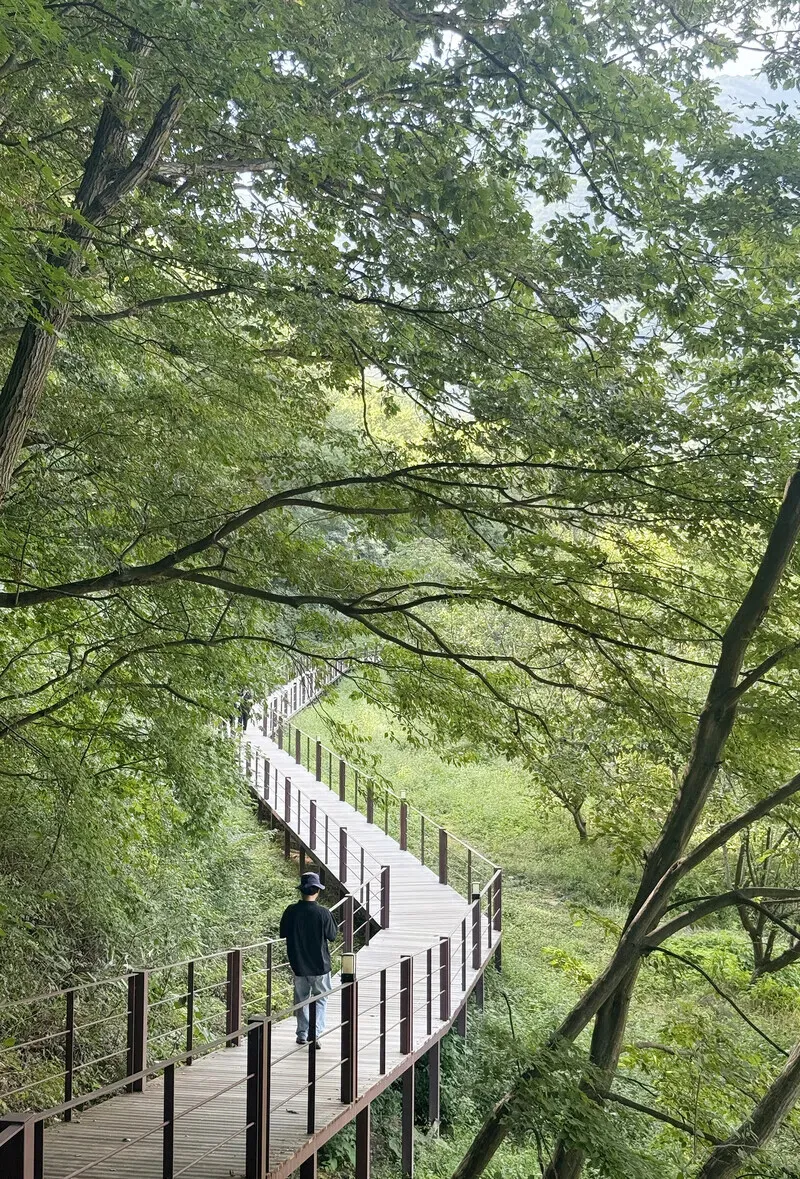
A traveler walks along “Road to Success,” a path at Tongdo Temple that symbolizes the journey toward enlightenment. (Park Mee-hyang/Hankyoreh)
When I’d been walking for around 20 minutes, I ran into an arched bridge. Crossing that bridge led me to Bogyeong Lake. This is where the true charm of the Road to Success lies: the serene lake at the end of its path.
A gentle layer of sunshine mirroring the Buddha’s benevolence covered the lake, much like a thin layer of lacquer.
It was at that exact moment that my lips parted, letting out an inexplicable sigh of relief. Why did that happen?
“Phew.”
That single syllable, which emerged as I pursed my lips, tensed my lower abdomen, and exhaled, brought me to a sudden realization: this road was not one that led to worldly success.
The success it was pursuing was the kind that involved leaving the secular world behind and stepping into the realm of the Buddha’s teachings. Travelers need not be Buddhist to attain enlightenment while on this road.
A rock formation that looks like it has been put there by Jean-Michel Othoniel can be seen in the middle of the lake. It is a cluster of five rocks, and two birds were perched on different stones. They were so still, I assumed they were sculpted.
Not even the strongest gust of wind could make these sculptures budge. I wondered why anyone would go to the trouble of installing sculptures on the rocks, until I realized my mistake. Perched motionless, they resembled Buddhist monks lost in meditation, wholly absorbed in their own path to enlightenment.
This was also where I ran into well-seasoned travelers. On a hill overlooking the lake, I saw people sitting in campaign chairs, whiling away time with their noses stuck in books. These folks knew how to properly enjoy Tongdo Temple by visiting gems that were practically hidden away — the Road to Success and Bogyeong Lake.
The bridge gracefully flowing through the Lake of Lotus Leaves
There is more. Right beside it lay a field of buckwheat, where delicate blossoms lifted their shy heads, stirring feelings of romance and nostalgia in passing travelers.
The Geungnak Hermitage, which is nearby, made one feel as if one had entered paradise. You might think that is because of the hermitage’s name, which literally means paradise, but you would be mistaken.
The small lake, carpeted with lotus leaves, an elegant arched bridge, and a shelter that offered a panoramic view of that same bridge all come together in the perfect picture of peace.
The more I gazed upon the sight, the more serenity filled my heart. In Tongdo Temple, there are 17 hermitages that each harbor a unique beauty. There are some people who only take a tour of the temple’s hermitages.
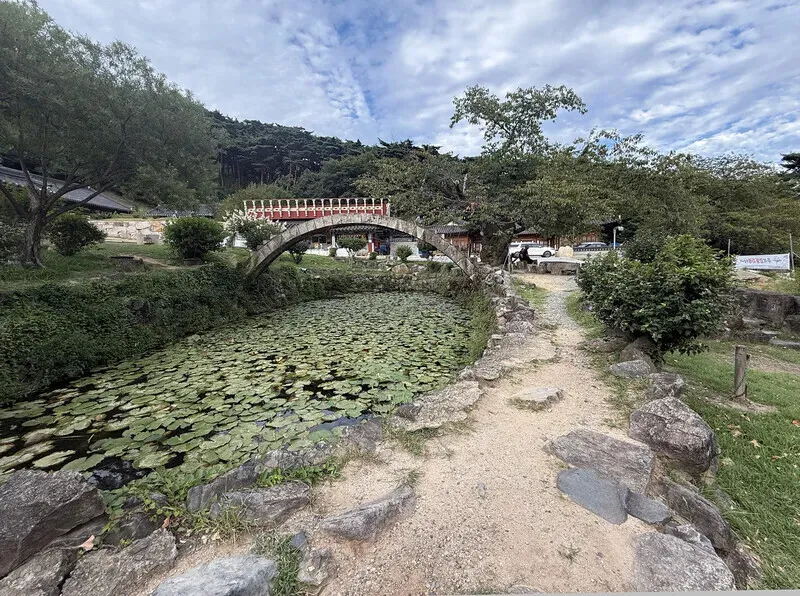
Geungnak Hermitage, one of the beautiful small temples nestled within Tongdo Temple. (Park Mee-hyang/Hankyoreh)
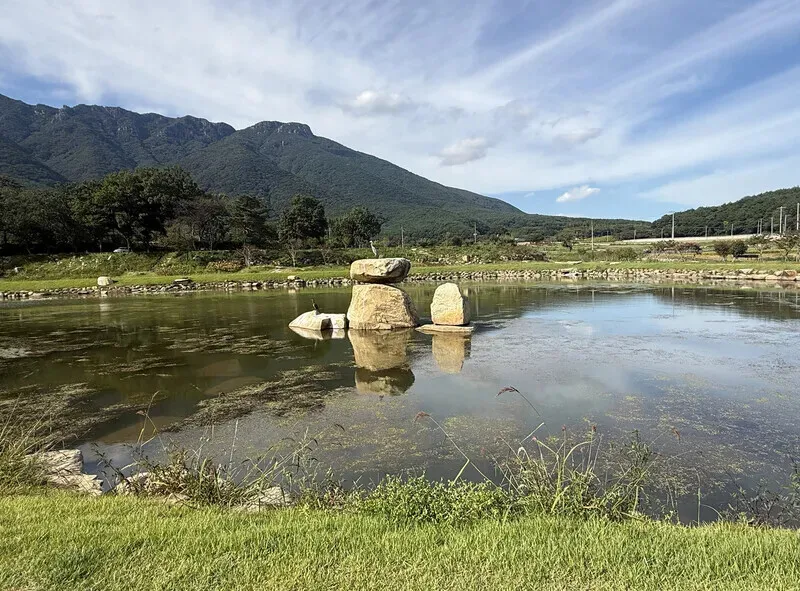
Bogyeong Lake comes into view at the end of the “Road to Success.” A bird stands motionless on a rock in the middle of the lake, seemingly absorbed in meditation. (Park Mee-hyang/Hankyoreh)
A trip to Tongdo Temple will always include a trip to Ulsan, which takes 20 minutes to get to by car.
Ulsan, Korea’s largest industrial city, home to leading countries such as Hyundai Motor, HD Hyundai Heavy Industries, and SK Energy. As such, not many people regard the city as a travel destination, but that means that too many people only know one side of the story.
Ulsan’s well-maintained roads and convenient transportation make it the perfect travel destination.
When you think of Ulsan, Daewangam Park will probably come to mind. A notable tourism attraction in the park is its suspension bridge. The Daewangam Park Suspension Bridge is a 303-meter tower-free suspension bridge completed in June 2021.
One can gaze at the vast waters off the coast of Ulsan while walking on the bridge, with the skyscrapers of downtown Ulsan serving as a backdrop. Once you cross the bridge, your journey through Daewangam Park truly begins.
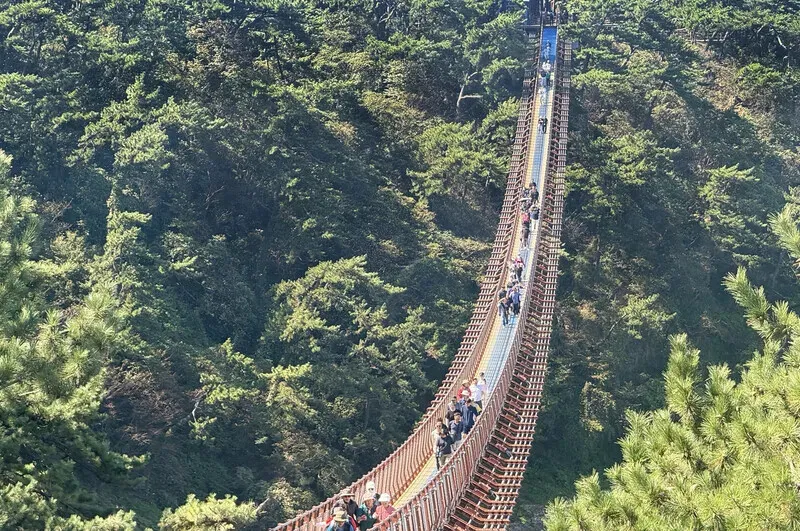
The dizzying suspension bridge at Daewangam Park offers sweeping views of both the city and the sea. (Park Mee-hyang/Hankyoreh)
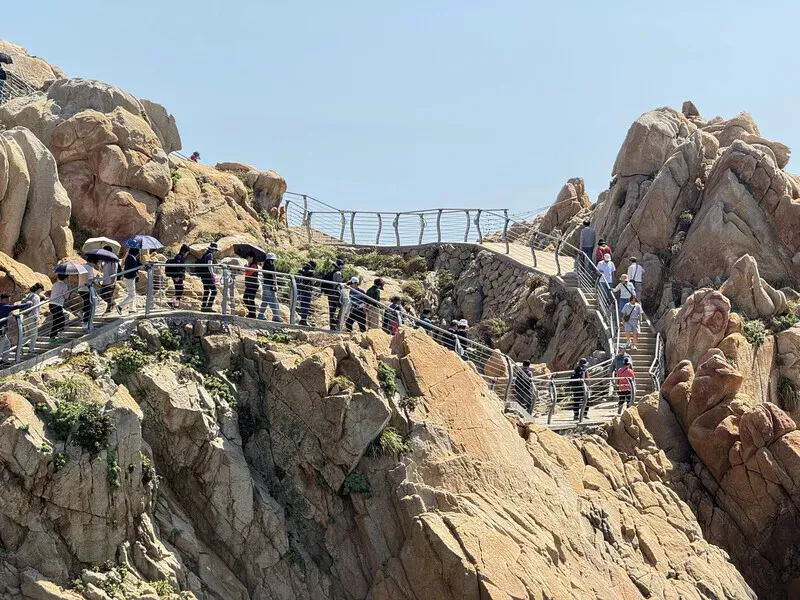
Travelers make their way up to Daewangam Rock. (Park Mee-hyang/Hankyoreh)
The park, which is located on the eastern side of Ulsan, features a 600-meter path lined with dense pine forests leading all the way to a lighthouse.
Pine trees that have been in the area for at least a century welcome travelers with a shelter of shade. The park is a seaside park that is almost unrivaled, as it encompasses Daewangam Rock, Ulgi Rock, Namgeun Rock, Tanggeon Rock, Cheonyeo Peak, and the Dragon Cave. You will continue to be entertained by this veritable feast for your eyes. Due to the bizarre and fascinating shapes of these strange rocks, they are often considered to be similar to the Geojedo Haegeumgang Islets.
Daewangam Park, originally called Ulgi Park, was given its current name in 2004. Legend has it that after King Munmu, who unified the three kingdoms of Baekje, Goguryeo and Silla, died, his queen transformed into a guardian dragon. After ascending to heaven, she supposedly sank underneath Daewangam Rock.
The park is famous for its beautiful sunrises, which are thought to rival the sunrises one can see at Ganjeol Cape in Ulju County.
The park also has established walking trails such as the Pine Forest trail, the Legend Rock trail, and the Four Seasons trail. Once one passes through the pine forests and the rock formations, one arrives at Daewangam Rock.
The whole area is full of a piercing light so sharp, it seems like it could bore a hole right through Daewangam Rock. However, when you think about how this is all part of a blessing given to us by nature, you cannot help but feel delighted by it.
You find yourself in paradise after feasting on a plate of sea urchins and sea pineapples at the Hanyeo Village, which is basically a seafood market located just below Daewangam Rock.
One haenyeo recalled, “At one point, there were more than 200 of us.”
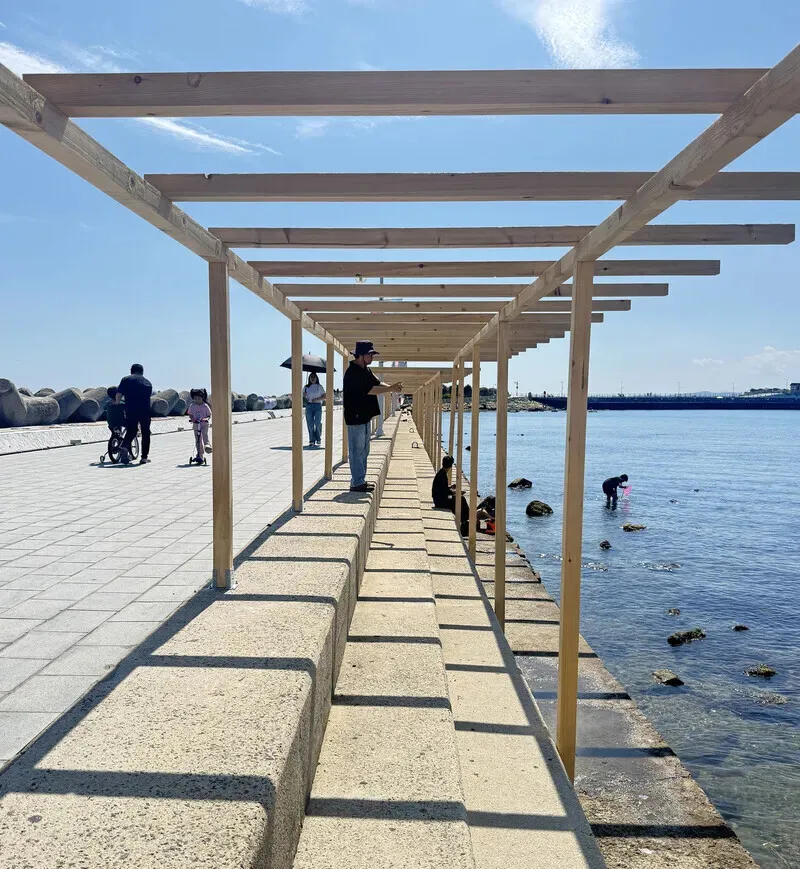
Seul Island offers visitors the added pleasure of fishing from platforms built along the shore. (Park Mee-hyang/Hankyoreh)
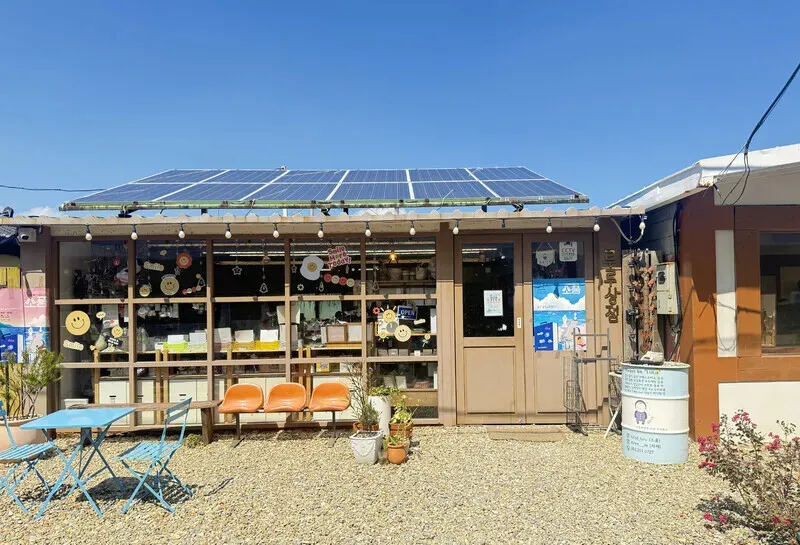
One of the stylish cafes on Seul Island. (Park Mee-hyang/Hankyoreh)
From there, I went to Seul Island. Upon my arrival, I noticed that the island had a completely different vibe from Daewangam Park. The area was full of fancy cafes and restaurants.
Youngsters who looked like models were drinking tea in various groups at one of those cafes, which had a quaint touch to it. There were many people fishing beneath wooden structures, a scene you would ordinarily observe in the sea just off Marseille, France. Ulsan always surprises you with its scenery, which will, without fail, consistently exceed your expectations.
Amethyst Cavern Park, a notable Ulsan theme park, is one such tourist attraction. Located in Eonyang, Ulju County, the park was developed from a former gemstone mine tunnel for amethysts.
Here you can embark on two different journeys by choosing to explore the park by boat or on foot. If you choose to go with the former, you will go on a boat tour that takes you along the water flowing through tunnels that are connected like the tunnels of an anthill. If you go with the latter, you will go on a leisurely walking tour where you stroll through the tunnels, which are filled with various sculptures and attractions, taking your time to explore and relax.
The tunnels span approximately 16,500 square meters and are wide enough for vehicles to pass through. The internal temperature of the cave remains between 12 and 16 degrees throughout the year, making it cool in the summer and warm in the winter.
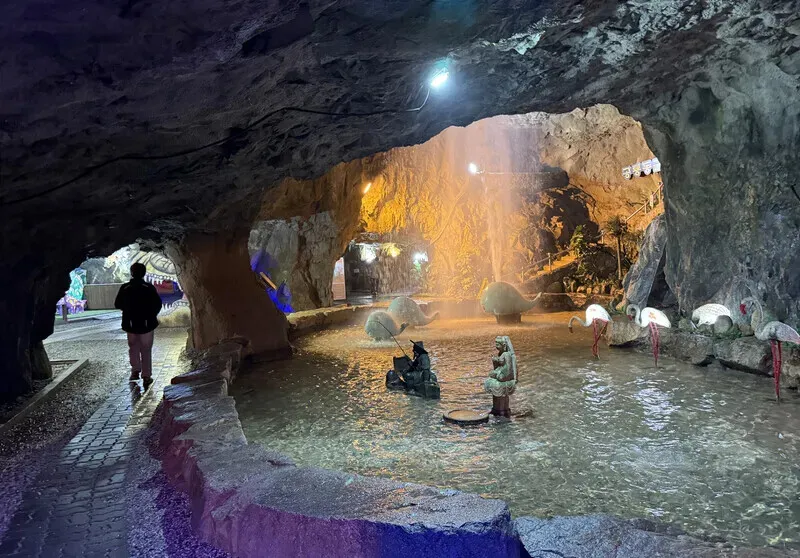
The winding tunnels of Amethyst Cavern Park have been transformed into exhibition spaces. (Park Mee-hyang/Hankyoreh)
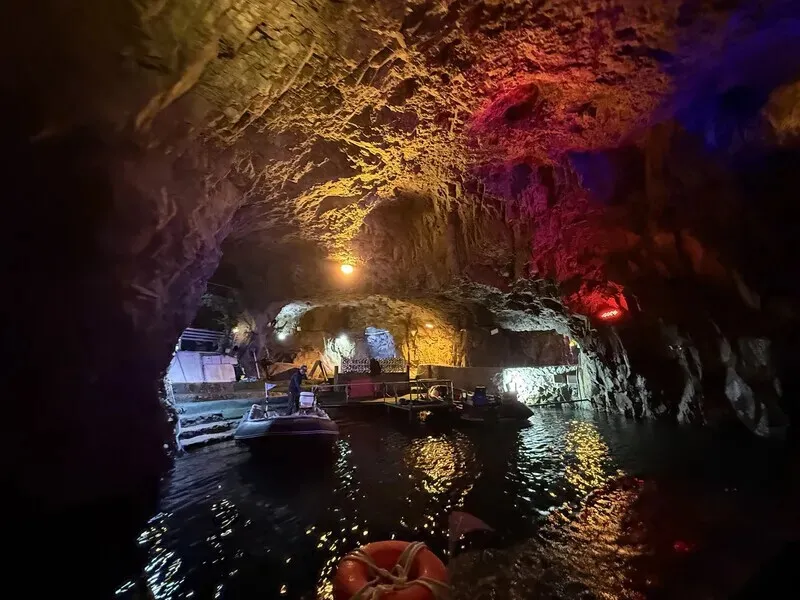
A boat tour takes visitors along the waterways inside the tunnels at Amethyst Cavern Park. (Park Mee-hyang/Hankyoreh)
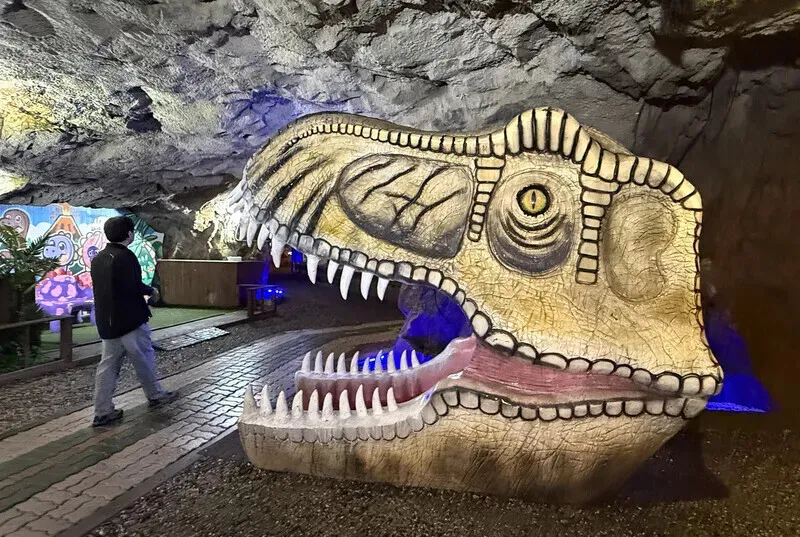
Amethyst Cavern Park is filled with unusual sculptures and installations. (Park Mee-hyang/Hankyoreh)
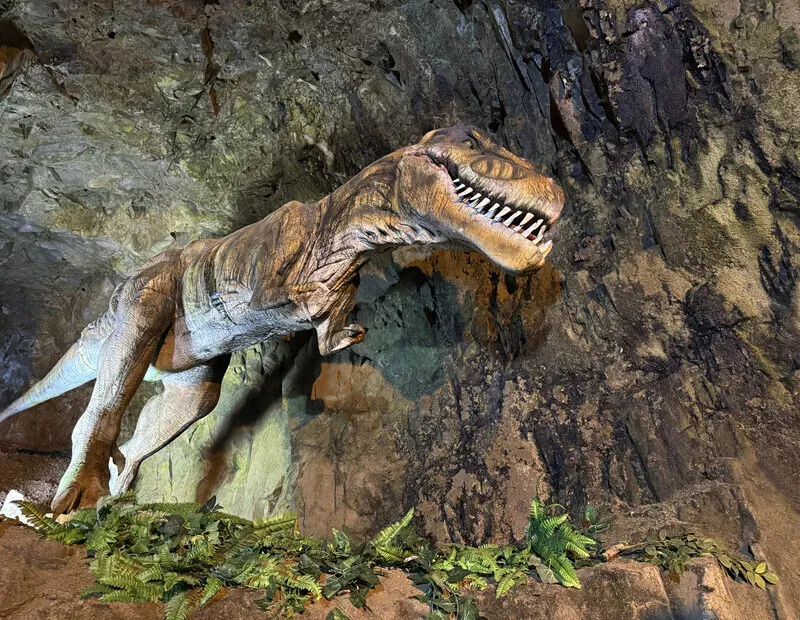
Amethyst Cavern Park is filled with unusual sculptures and installations. (Park Mee-hyang/Hankyoreh)
It is easy to get spooked during the boat tour, as it feels like the complete darkness of the cavern is attempting to swallow the boat whole. Darkness can be unsettling. But the colorful lights lining the tunnel walls ease your fears, replacing them with a sense of calm.
Inside are sculptures of dinosaurs, stars, Buddha statues, and prehistoric figures — all of which are unique and intriguing. Initially, I found myself laughing at the colorful, almost gaudy lighting, the kind you would expect in a Korean tourist attraction, and the fact that the sculptures appeared to be displayed without any context.
But the more I looked upon them, the fonder and more awestruck I became. Scattered throughout the cavern are amethyst shelters that are heated with ondol. Cards with the heartfelt wishes of passersby adorn the Cave of Wishes’ walls.
Other travel destinations in Ulsan include the Taehwagang National Garden, which encompasses the Simni Bamboo Grove, the Jangsaengpo Whale Culture Village, and the Petroglyphs of Bangudae Terrace in Daegok, Ulju County.
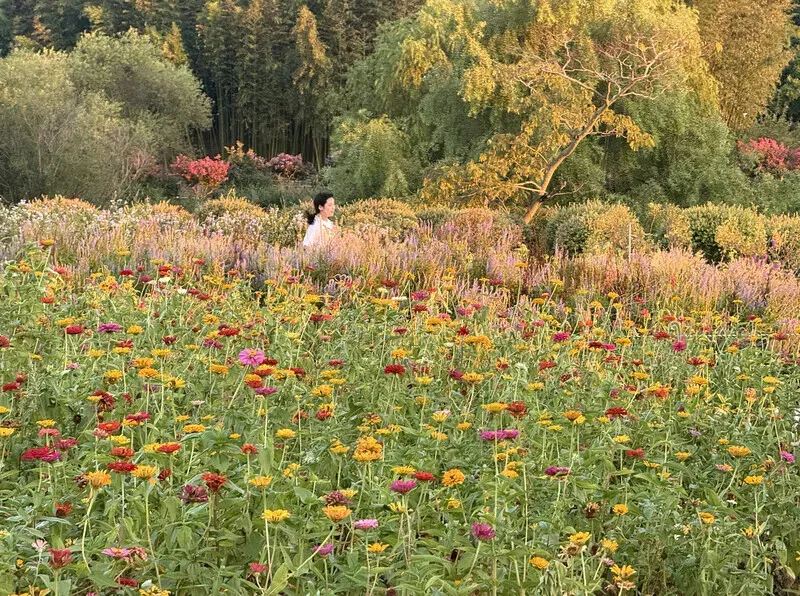
With autumn fast approaching, beautiful flowers are in full bloom at Taehwagang National Garden. (Park Mee-hyang/Hankyoreh)
Perhaps the point of travel is to encounter the mysterious — things that are unexpected, surprising and utterly captivating. In Ulsan, I found just that.
KioskNews shows a cleaned-up reading view extracted from the publisher’s page — the original always lives on their site, not ours.