Rain eases Indonesia's haze, but authorities warn fires could reignite
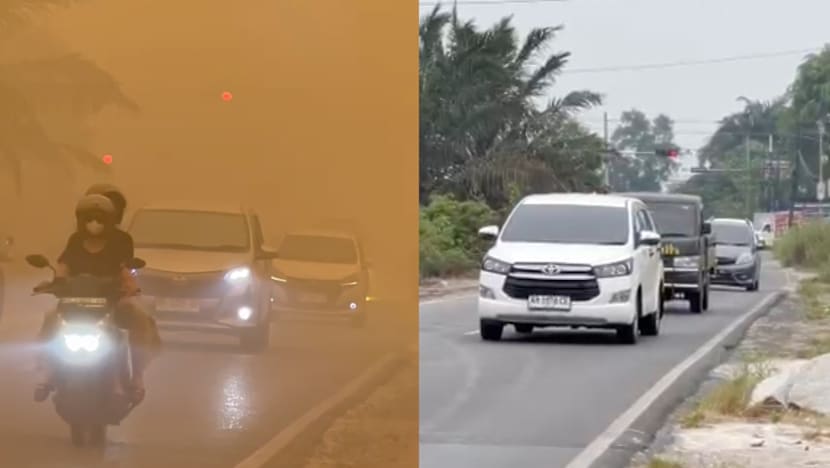
JAKARTA: Ronnie Alventa has endured months of toxic air in his hometown of Palangka Raya, the capital of Indonesia's Central Kalimantan province, as forest and land fires blanketed the city in thick haze.
Two days of rainfall on Sunday (Oct 25) and Monday brought much-needed relief to the town and other fire-hit parts of Indonesia, improving air quality and visibility after months of hazardous conditions.
“It has rained heavily, but the haze is still there,” said Ronnie, a teacher in his forties.
“But it’s much better now compared to the past few weeks.”
To keep the rain falling, Berton Panjaitan, spokesman for Indonesia’s disaster management agency BNPB, said the agency conducted 14 cloud-seeding flights on Tuesday, dispersing 22,800kg of salt over Central Kalimantan and South Sumatra to encourage rainfall.
This is considered a significantly large cloud seeding exercise.
Spread across the atmosphere, these millions of tiny sodium chloride particles act as magnets for moisture. If atmospheric conditions are right, this volume could trigger hundreds of thousands of tons of rainfall over the fire-ravaged zones.

While the situation has improved, the fires have not been completely extinguished and air travel in Central Kalimantan remains disrupted.
Authorities have deployed more than 51,000 people to battle the blaze across about 1,500ha of land across four provinces in Kalimantan and South Sumatra this week.
Indonesia's Meteorology, Climatology and Geophysics Agency (BMKG) expects more rain until the end of the week, raising hopes that conditions will continue to improve and the rainy season will begin in early November.
"We are still in a transition period to the rainy season," Andri Ramadhani, BMKG’s director for public weather services, told CNA.
On Tuesday, Indonesia’s disaster management agency (BNPB) spokesperson Berton Panjaitan said firefighting operations were still underway on about 1,500ha of land in Kalimantan and Sumatra.

RAIN REDUCES HOTSPOTS, IMPROVES AIR QUALITY
Andri from BMKG told CNA that light to heavy rainhad been recorded across Central Kalimantan, helping reduce hotspots and smoke.
Visibility has improved to between 3km and 6km in some areas - up from a low of 50m when fires were at their most intense - while hotspots have also declined significantly in South Sumatra and West Kalimantan, he said on Tuesday. Normal visibility before the haze began was between 5 km and 9 km.
However, some hotspots remain, including those in Ketapang, West Kalimantan.

Indonesia has also been exploring different ways to battle the blazes, including the deployment of dry ice.
"The dry ice is effective not for extinguishing fires, but for improving visibility," BNPB spokesperson Berton Panjaitan told CNA.
This, he said, could allow aerial firefighting operations to resume in areas where thick smoke had hampered aircraft operations.
Berton added that Indonesia was in discussions with the likes of Australia and Malaysia over possible assistance, involving specialised equipment such as heavy-lift helicopters capable of carrying large quantities of water.
"What we need is technology that we currently don't have," he said, stressing that Indonesia was seeking assistance that would complement its existing firefighting capabilities.

FIREFIGHTERS CONTINUE BATTLING BLAZE
Despite improving conditions, firefighters remain on the ground.
Berton from BNPB said 51,057 people had been deployed across Central Kalimantan, West Kalimantan, South Sumatra and South Kalimantan. At one point, more than 71,000 people were involved.
Meanwhile, around 1,140ha remained under firefighting operations in Central Kalimantan, with 391ha in West Kalimantan, 35ha in South Kalimantan and 23ha in South Sumatra.
Suwarto, a firefighter who has spent 51 days battling fires in Padang Sugihan, a wildlife sanctuary in South Sumatra, said he has only experienced light drizzles so far.
In his 20 years on the job, he has never seen fires this severe, outpacing even the 2015 blazes, long regarded as Indonesia’s worst in two decades. He pointed to intense heat, strong winds, and drying water sources as key drivers.
“The heat is intense, so extreme that it triggered recurring fires, which in turn further ignited combustible material,” he told CNA.
“Water sources dried up, and the fires spread across a vast area of a protected forest zone, where safeguarding the food supply for elephants is critical.”
BNPB spokesperson Berton said that rainfall alone would not necessarily extinguish underground peat fires.
"If it rains only once or twice, there is still potential for fires because embers may remain underneath," he said.
He added that firefighters would have to thoroughly saturate peatlands with water to prevent fires from reigniting.

AIRPORT DISRUPTIONS CONTINUE
The fires have also forced airlines to cancel flights across several airports, including Tjilik Riwut airport in Palangka Raya, Central Kalimantan, where operations have been suspended since last week.
Spokesperson Andi Wiguna said rain earlier this week improved visibility to around 3,000m, a sharp recovery from a low of 50m during severe haze over recent months.
While no other carriers have resumed services yet, Garuda Indonesia has decided to restart flights between Jakarta and Palangka Raya from Oct 29 to 31, and between Palangka Raya and Jakarta on Oct 30 and 31.
Andi said the haze has also taken a personal toll, forcing him to evacuate his family to Tangerang, on the outskirts of Jakarta.
"We have been breathing hazardous air for almost four months," he said, adding that his family will return to Palangka Raya only when conditions improve.
Meanwhile, Berton from BNPB said authorities would continue monitoring for new hotspots.
"If fires emerge again in the same locations, it means they were never completely extinguished," he said.
With more rain forecast over the coming days, attention has turned to whether the respite will last.
But Ronnie the teacher, who has experienced forest and land fires in Palangka Raya for decades, temporary relief is not enough. He wants the government to tackle the issue once and for all.
“The victims of these fires are humans, wildlife and the natural environment, which have already suffered severe damage due to the lack of prompt or serious fire-mitigation efforts.”
KioskNews shows a cleaned-up reading view extracted from the publisher’s page — the original always lives on their site, not ours.