PM Wong warns economic frustrations can deepen social, racial divisions in Singapore
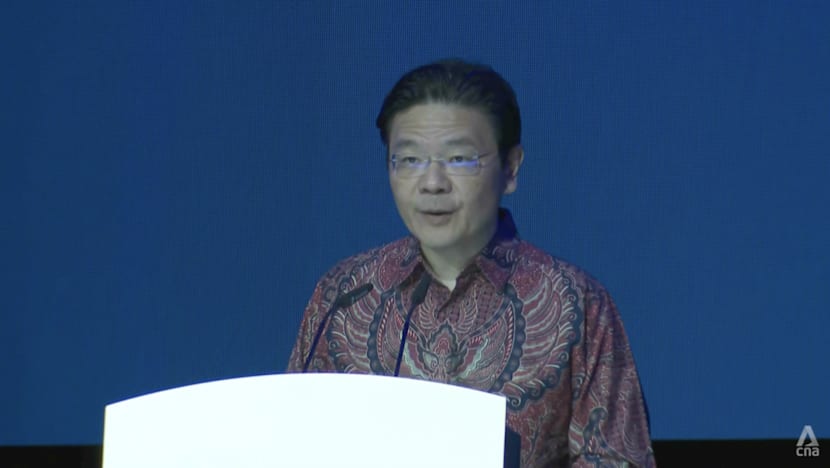
SINGAPORE: Economic challenges can deepen social and racial divisions, said Prime Minister Lawrence Wong on Saturday (Sep 12).
Singapore is not immune to these challenges, he warned, pointing to racist comments that surfaced online recently when investments in India were discussed.
Mr Wong's remarks, made at the Singapore Kadayanallur Muslim League's (SKML) 85th anniversary dinner, come a week after Minister for Home Affairs K Shanmugam said police were looking into "shameful" racist and xenophobic online comments about Singapore Airlines' (SIA) investment in Air India, as well as the Nepal-Tibet disaster.
Police have since identified and interviewed five people over online comments relating to the two matters. Investigations are ongoing.
While Singapore is generally harmonious and stable, Mr Wong said people may still draw lines between foreigners and Singaporeans, as well as between local-born and naturalised Singaporeans, and along racial and religious lines.
"These challenges are real," he said.
Mr Wong said societies around the world were becoming more fragmented, divided and polarised.
Part of this was due to economic challenges, he said. Not everyone achieves the same outcomes, and those who do not do as well may become disappointed and frustrated.
But the challenge goes beyond economic issues when these problems feed into a sense of identity, belonging and perceived unfairness, he said.
"That is when divisions really start to become more entrenched, and people start to build walls between – us versus them," Mr Wong said.
BUILDING TRUST AND BRIDGES
Mr Wong said the government would continue improving policies to tackle concerns over cost pressures and jobs, and to make sure every Singaporean gets a share in the nation's progress.
At the same time, Singapore must keep working on relationships and strengthening the bonds of trust that hold society together, he said.
Government policies can help create the conditions for cohesion, but ultimately, that cohesion is built through people, Mr Wong said.
"It depends on all our communities being confident in their identities, and at the same time being willing to reach out, build bridges and develop trust with one another," he said.
Mr Wong said Singapore had worked deliberately to build a multiracial and multireligious society, where every community has its place and can practise its faith, speak its language and celebrate its culture and traditions.
At the same time, common spaces and shared experiences in schools, neighbourhoods, workplaces and National Service allow Singaporeans from different backgrounds to mix, socialise and build friendships, he said.
SKML'S ROLE AS A BRIDGE
SKML can play an important role in strengthening connections across different Indian organisations and serve as a bridge between Singapore's Indian and Muslim communities, Mr Wong said.
He pointed to a new initiative led by Minister of State Dinesh Vasu Dash to strengthen connections across Indian organisations, and said SKML could also play a role in the M3+ initiative.
Mr Wong said SKML had remained deeply rooted in the Indian Muslim community while expanding its partnerships with organisations such as MUIS, MENDAKI and SINDA.
These partnerships have addressed practical needs, including through Mendaki's Community Leaders Forum on digital literacy and scam awareness.
SKML has also worked with stakeholders to develop people and leaders through its involvement with the Indian Muslim Professionals Network, and to preserve and share the community's history, Mr Wong said.
WIDENING THE CIRCLE
Mr Wong said SKML's journey mirrored the larger Singapore story, where people's sense of belonging had widened over the generations.
In Singapore's early years, people relied on those closest to them and organised around hometown, kinship, language, race or religion, he said.
But as generations put down roots, people from different backgrounds became neighbours, schoolmates, colleagues and friends, and developed a larger sense of belonging, not only to their individual communities, but also to Singapore and one another as fellow Singaporeans.
Mr Wong said SKML had similarly widened its sense of "our own" beyond the Indian Muslim community, while remaining rooted in and continuing to serve the community.
"In many ways, this is our Singapore story. We always look after our own. But we have also widened the circle of whom we regard as our own," he said.
"Our own" no longer meant those from the same family, language or faith, he added.
"Our own means Singaporeans regardless of race, language or religion," Mr Wong said.
"Because whatever our different roots and backgrounds, we are all Singaporeans, and Singapore is our country and our home."
KioskNews shows a cleaned-up reading view extracted from the publisher’s page — the original always lives on their site, not ours.