If you’re visiting Venice for the first time, this is the way to do it
I’ve been to Venice several times, but I’ve never seen it this way.
From the top deck of Uniworld’s river ship SS La Venezia, I curl up on a day bed and watch Venice’s many islands pass in and out of view.
It’s June, and the lightest of breezes brushes the deck. We’ve been slowly cruising around the Venetian lagoon all afternoon, one of only two ships – the other being the three-star Michelangelo – permitted to do so.
From this bird’s-eye view, Venice’s archipelago is a cavalcade of beauty. The water sparkles like sequins and enormous seagulls fly alongside, then overtake our leisurely pace.
The Venice that is familiar to tourists, the historical centre of the city with St Mark’s Square at its heart, is a puzzle of 126 tiny islands connected by 472 bridges, which is why every turn leads to water. Less than 50,000 people live there.
Sign up for the Traveller Deals newsletter
Get exclusive travel deals delivered straight to your inbox. Sign up now.
Beyond this, the city spreads to Mestre on the mainland (population about 100,000) and across the 500-square-kilometre lagoon, which is scattered with 60 or so different islands. Its waters are refreshed by three inlets from the Adriatic Sea.
For perspective, only about 1 per cent of the lagoon area is land. Seeing Venice by water is the only true way to really understand its essence.
Over seven days, La Venezia will cruise to the most distant reaches of the archipelago, as far as the outer MOSE (Modulo Sperimentale Elettromeccanico) gates, which control flooding during high tides, and to Chioggia, the fishing village at the southern entrance of the lagoon. Some islands are covered in vineyards; others are little more than mud flats that disappear at high tide.
We glide past a small island dominated by an old fortress. Another holds a ruined monastery. From another, a magnificent church basilica arises. A few islands, such as San Clemente Island and the Isola delle Rose, have been transformed into luxury resorts by Kempinski and JW Marriott respectively.
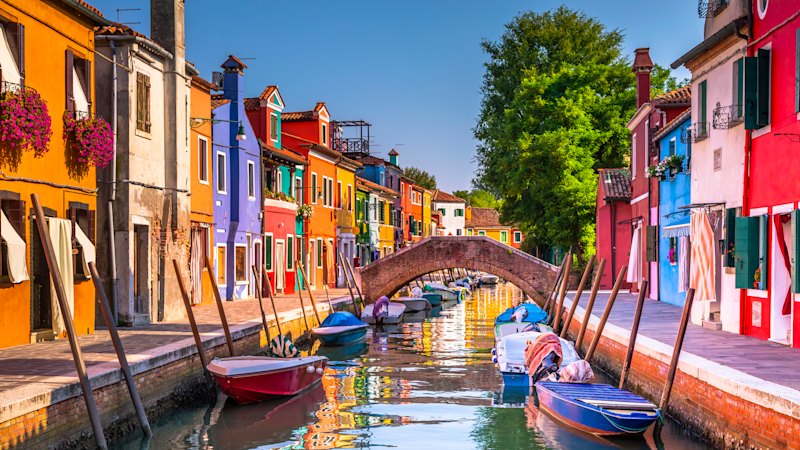
Only about 30 of these islands are inhabited. The Lido, a barrier island with a long, wide beach, has a population of 20,000. Tiny, colourful Burano, with about 3000 residents, is the most densely populated.
It’s a real treat to see the entirety of Venice’s waters in one voyage. And because we dock overnight on Burano and along the Giudecca Canal, we simply walk off the ship in the evenings and wander around when the other tourists have deserted.
Most of my fellow passengers – Americans, Canadians, Brits and a few Aussies – have never been to Venice before; if I were travelling to Venice for the first time, this is absolutely the way I would choose to see it.
Venice banned large ships from the inner lagoon and the Giudecca Canal in 2021. La Venezia has permission to cruise around it at leisure because the ship’s flat bottom doesn’t damage the shallow lagoon bed.
If we keep our speed to 11km/h in the shallowest parts and 20km/h in the deepest, we can join the vaporetto, ferries, speedboats and barges through the busy waterway. Maritime authorities watch our progress very closely.
Venice has a modern terminal at San Basilio on the canal, which processed the large cruise ships until the ban. It’s extremely convenient, but only the river ships and some smaller cruise ships are allowed to dock there these days.
The advantage for our 126-passenger river ship is that it doesn’t leave Venice so passengers can board without port formalities.
I take a short water taxi ride to the port and roll my luggage directly onto the ship. There’s a vaporetto station at the port and the Alilaguna, the airport water bus, stops about 10 minutes’ walk away.
La Venezia began life as Uniworld’s River Countess and had a major refit before it was relaunched in 2020 to specifically carry passengers on the seven-day Jewels of the Veneto itinerary. The bow is decorated with a whimsical Venetian mask, and the interiors are sumptuously furnished in Murano glass and Fortuny fabrics.
The sense of place is strong. Mariano Fortuny (1871-1949) was an inventor, artist and designer whose beautiful fabrics are found in the world’s luxury interiors. We’re docked directly across the lagoon from the Fortuny factory on Giudecca.
From my deluxe stateroom on deck three, I sleep with Fortuny and the tower of the Hilton Molino Stucky Venice, a converted mill, out my window.
At 14 square metres, the room is cosy and perfect for one. Its padded walls make it feel like a little jewel box with plenty of cupboard space, a sensibly organised marble bathroom with a good, hot shower, and a desk with a chair where I can work.
Outside, vaporettos and other boats churn past at eye level. It’s an ongoing entertainment, wondering how on earth they don’t collide with each other. The long, low ship’s panoramic windows allow us to be continually immersed in Venice’s wonderful waterfront chaos without getting splashed.
We glide past St Mark’s Square and the entire length of the canal several times during our voyage; the Gothic arches of the Doge’s Palace and the towering Campanile never fail to be heart-stopping, no matter how many times you’ve seen them.
The main dining room, Ristoranti Rialto, the casual Panini Bar and Hari’s Bar and Lounge, where we gather for drinks, daily briefings and lectures, all have great ringside views of the action. Even the small gym is low enough in the water for runners on the treadmills to feel like they’re racing with speedboats.
The partly shaded upper Lido deck is where guests flock when they’re not taking one of the many tours on offer. The drinks waiter does a good business in spritzes, the local tipple.
On our first night, the ship travels only a few kilometres along the canal to dock in Castello, one of Venice’s quieter districts, where you can experience the pace of real life.
Because there’s no port to negotiate, we can walk off the ship at any time after tapping our room cards on the scanner. Castello’s main street, Via Garibaldi, is full of restaurants and bars that locals patronise. It opens onto gardens and vistas, some of the best spots in Venice to capture sunsets. Several guests take the opportunity to join the locals in their evening passeggiata.
The days are a mix of guided tours and free time to explore individually. One morning, I team up with another guest and go shopping in Dorsoduro, an arty neighbourhood of little boutiques and famous museums such as the Peggy Guggenheim Collection and the Gallerie dell’Accademia.
I have enough free time to visit several churches and galleries I haven’t managed to visit before, including the exquisite Scuola Grande di San Rocco, within easy walking distance from the ship.
La Venezia’s secret weapon is cruise manager Louisa Warman, a Brit who moved to Venice to study art in 2001, fell in love with the city, and stayed.
She’s a fantastic source of high-quality knowledge on everything from art to shopping, and her lectures on lived experience, such as Venice’s floods and how Venetians cope with them (they check an app daily), are engrossing.
Classic experiences are among the included excursions, such as visits to the Doge’s Palace, St Mark’s Basilica, the glassblowers of Murano and the lace-makers of Burano. The excursion team can help negotiate the best price for a gondola ride. Guests can also sign up for a ride on a bragozzo, a traditional Adriatic sailing boat, or take a leisurely sail through the wetlands of the Po Delta, Italy’s largest nature reserve.
Our groups are small and staggered, and the emphasis is on private tours, so we have St Mark’s Basilica to ourselves for two hours one evening.
Visits to wineries, Habsburg palaces, palazzi and markets are included. There is also a menu of experiences additional to the included program, including an oyster harvest and tasting in the lagoon, along with a visit to Fortuny’s palazzo and factory, where his processes have been a tightly kept secret for 100 years.
One day, we leave the lagoon for either Padua, one of Italy’s oldest cities – where both Copernicus and Galileo studied – or Vicenza, known for the work of Renaissance architect Andrea Palladio, its hills scattered with exquisite Palladian villas.
I choose Vicenza, an elegant city, the highlight of which is the extraordinary Teatro Olimpico, considered Palladio’s masterpiece. It was built of wood, stucco and plaster inside a Roman amphitheatre and is the oldest Italian Renaissance theatre in existence.
Chioggia is a fishing town on a small group of islands at the southern tip of the lagoon, connected to the mainland by a long bridge, and we can walk to its centre as we’re docked on the island. Built on canals, it’s like a mini Venice, although cars are allowed.
The day we visit the main street is a riot of fairground rides and stalls due to a public holiday celebrating the town’s patron saints, the martyrs Felice and Fortunato – Happy and Lucky. They don’t sound so lucky.
Chioggia has an impressive fish market and what’s widely considered the world’s oldest tower clock. At its port stands a small replica of the St Mark’s lion, known jokingly as “the cat of Chioggia”.
Before this cruise, I thought I knew Venice but there’s so much more to the Veneto than I ever imagined. In fact, so much more that I would happily get back on this cruise and do it all again.
DETAILS Uniworld’s seven-night Jewels of the Veneto on the S.S. La Venezia costs from $5349 a person twin share in a Classic cabin and includes all meals, beverages, and 24-hour room service. Included shore excursions include after-hours visits to St Marks Basilica and Doges Palace. uniworld.com; From October 2026 Finnair flies Melbourne to Helsinki via Bangkok daily, with connections to 90 destinations in Europe, including Venice. See finnair.com
The writer was a guest of Uniworld

KioskNews shows a cleaned-up reading view extracted from the publisher’s page — the original always lives on their site, not ours.