NKF sets up mock home at Sengkang centre to help patients adjust to home dialysis
SINGAPORE – Twice a week, in between driving passengers, Huang Bingshen, 42, will park his private-hire vehicle, hang up a bag of dialysis solution in his car, and start his kidney failure treatment.
His peritoneal dialysis (PD) session lasts about 30 minutes, usually between 2pm and 4pm. The air-con in the car has to be turned off to maintain a still, clean environment.
The in-car session is one of three PD sessions that he undergoes each day. He does this when he has to attend a meeting outside or is too far from home. Most of the time, all three sessions are done at home.
PD continuously removes waste products and excess fluid from the blood, closely mimicking the constant functioning of healthy kidneys. It is done either during the day by using fluid bags or overnight using a small machine about the size of a small printer.
In contrast, haemodialysis is typically done at dialysis centres, where the patient is hooked up to a machine three times a week, with each session lasting several hours.
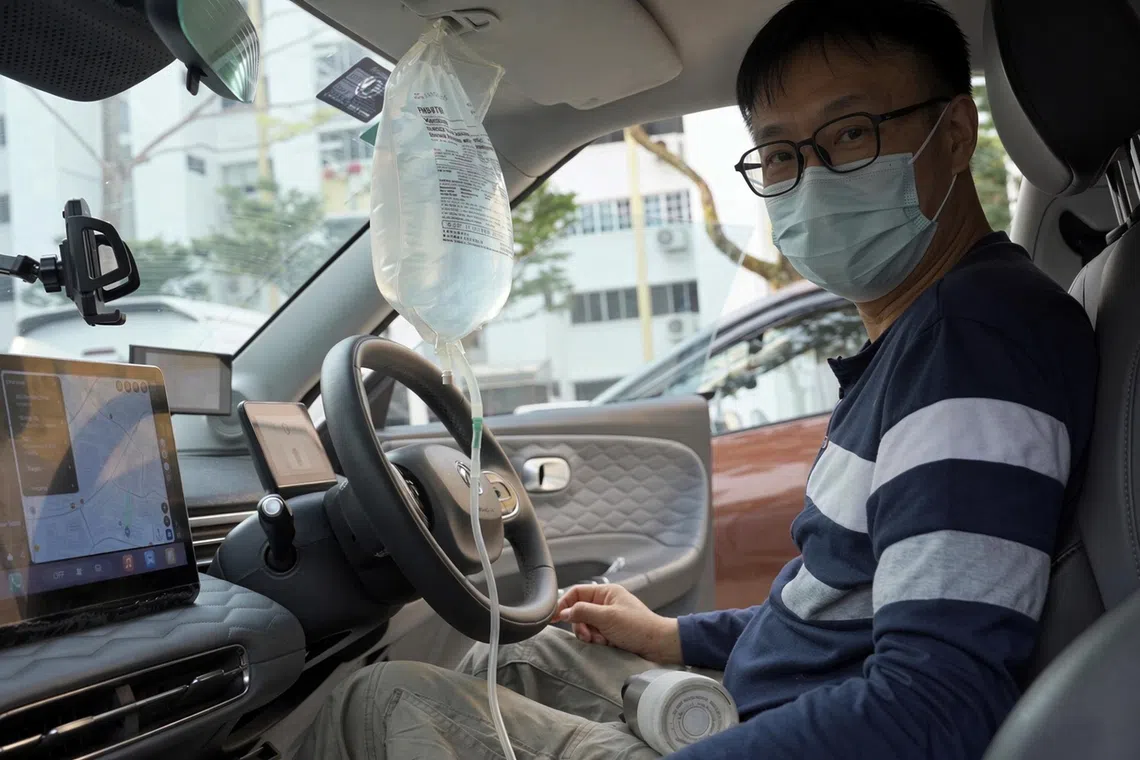
Huang Bingshen sometimes undergoes a peritoneal dialysis session in his private-hire car, in between ferrying passengers.
PHOTO: COURTESY OF HUANG BINGSHEN
Huang is among patients who have chosen PD amid efforts in Singapore to increase the take-up rate as the number of chronic kidney disease cases rises.
Despite the lifestyle independence offered by PD, most end-stage kidney disease patients continue to choose haemodialysis at centres with nurses present.
To boost the home dialysis rate, Singapore’s largest dialysis provider, the National Kidney Foundation (NKF), has introduced a PD Home Experience set-up. This is located at its Sengkang dialysis centre, which officially opened on Sept 27.
Located within Sengkang Community Hospital, the centre, which has 15 haemodialysis stations, was built with a $2 million sponsorship from the San Wang Wu Ti Religious Society.
The home set-up recreates a living room and a bedroom equipped with PD equipment, allowing patients to go through their initial treatment sessions in a home-like setting under the guidance of NKF’s PD nurses.
“By allowing patients to practise dialysis in an environment that resembles their own home, we hope to make the transition from hospital-based training to home treatment less daunting and more achievable,” said NKF chairman Ang Hao Yao in a media statement.
NKF has been pushing for more people to be on PD as its centres continue to see patients for dialysis. The Sengkang centre is one of 45 centres run by NKF.
NKF said Sengkang Community Hospital is the sixth public hospital that it is working with under a three-year initiative to get 300 patients to adopt PD.
Under the initiative launched in March 2026, NK deploys its PD nurses to hospitals so they can work alongside hospital renal teams to help patients and their families better understand home-based options before dialysis becomes urgent.
Its nurses conduct home assessments, provide hands-on training and offer clinical services including catheter care and medication.
So far, the initiative has enabled 70 patients to begin PD within six months, putting NKF well on track to reach its first-year goal of 100 patients, said NKF chief executive Yen Tan.
For patients like Huang, overcoming that initial fear of managing treatment on his own was a significant hurdle.
Until January 2026, he was living a normal life, unaware that his kidneys were failing.
He had gone to the accident and emergency department of a public hospital on the advice of his general practitioner to seek help for a severe leg swelling that left him fatigued after walking just 500m.
At the hospital, “the doctor told me I have Stage 4 kidney failure”, he said.
If not for PD, Huang would have to frequently go to a dialysis centre.
“I cannot be stuck to a machine... It was terrifying. In fact, I wanted to stop treatment. I felt that I had done everything in life. I had completed a big business project and managed to clear off my debts after eight years,” said Huang, who has a side gig selling construction materials.
He was initially unsure about operating the PD equipment but hands-on training and home visits from an NKF nurse gave him the confidence to do so.
Huang said he had a choice of doing overnight PD, but that did not appeal to him because the session lasts for at least eight hours.
Although he has to undergo regular treatment, he is thankful that his condition has helped repair his relationship with his mother.
Previously estranged from him, she was the one who encouraged him to undergo treatment.
KioskNews shows a cleaned-up reading view extracted from the publisher’s page — the original always lives on their site, not ours.