Macronix mulls capacity expansion
‘DIFFERENT APPROACH’: Company chairman Miin Wu said it would not recklessly chase expansion and prefers to invest in new products to hedge against bubble risks
By Lisa Wang / Staff reporter, in TAINAN


Macronix International Co (旺宏電子), a major supplier of NOR and NAND flash memory chips, on Wednesday said that it is cautiously evaluating capacity expansion to navigate the memory industry’s prolonged supply-driven upcycle through 2030.
Robust demand for artificial intelligence (AI) servers and AI-related applications has led to a crowding-out effect on production of less-advanced memory chips and a supply crunch, the Hsinchu-based chipmaker said.
To meet the demand, major chip suppliers have announced a slew of new capacity expansion plans, it said.
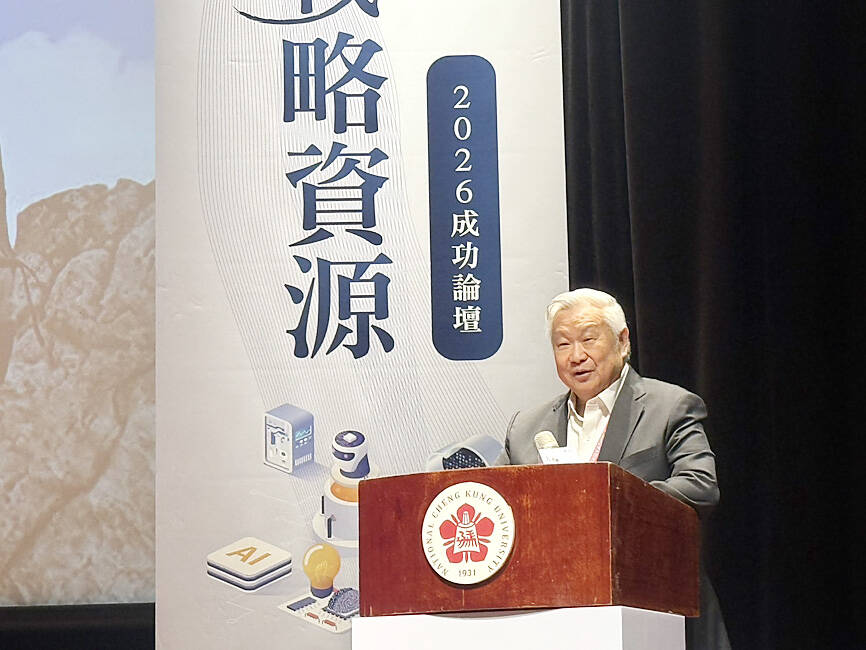
Macronix International Co chairman Miin Wu speaks at a forum in Tainan yesterday.
Photo: Lin Yi-ju, Taipei Times
Macronix’s local peer Winbond Electronics Corp (華邦電子), the world’s largest NOR flash memory chipmaker, on Tuesday announced that it had approved capital expenditure of NT$73.2 billion (US$2.23 billion) for its Kaohsiung fab expansion and production equipment.
The announcement came after Winbond in September clinched a deal to acquire Infineon Technologies’ NOR Flash and F-RAM business for US$1.12 billion.
Asked about its capacity expansion strategy, Macronix chairman Miin Wu (吳敏求) said that it has no intention to “build a new plant.”
Instead, the company prioritizes boosting factory utilization to full capacity, Wu said.
“Macronix is never a ‘me too’ company. Macronix likes to create [new] ideas,” he said.
Asked whether Macronix is scouting potential acquisition deals to rapidly boost capacity, Wu said: “We all have a vision, right? How to realize it will depend on one’s abilities.”
“We will definitely take a different approach,” he said. “We will not invest recklessly as other companies did.”
As Macronix’s factories are approaching full usage, it is counting on price increases rather than capacity addition to drive rapid revenue growth, the company said.
Any new capacity addition would take at least one year, it said.
The chip shortage is expected to extend into 2030, Wu said.
Macronix expects to add 5,000 12-inch wafers per month through a NT$15.8 billion investment, but it would not add to wafer capacity until 2028, mainly due to longer-than-expected equipment lead time, the company said.
Concerns over a potential AI bubble are mounting, with investors fearing that large-scale US cloud service providers might fail to translate their massive infrastructure investments into reasonable returns, Wu said.
At this juncture, strategic precision in capacity investment is critical for companies and Macronix prefers to invest in new product developments to hedge against AI bubble risks, he said.
The company has several new products in the pipeline for release next year, he added.
As a chipmaker capable of producing satellite-grade components, Macronix has secured a key deal to supply NOR and eMMC NAND flash memory to SpaceX for its low Earth orbit satellite constellations, Wu said.
The partnership is expected to boost the company’s annual shipment volume by more than 1 million units, he said.
Meanwhile, at a forum organized by National Cheng Kung University yesterday, Wu said he plans to donate US$2 million to establish a fund to foster talent.
His initial plan is that the fund will provide scholarships to support outstanding interdisciplinary students from National Cheng Kung University to study at Stanford University in California, he said.
KioskNews shows a cleaned-up reading view extracted from the publisher’s page — the original always lives on their site, not ours.