CNA Explains: Why are violent Gen Z protests breaking out across Europe?
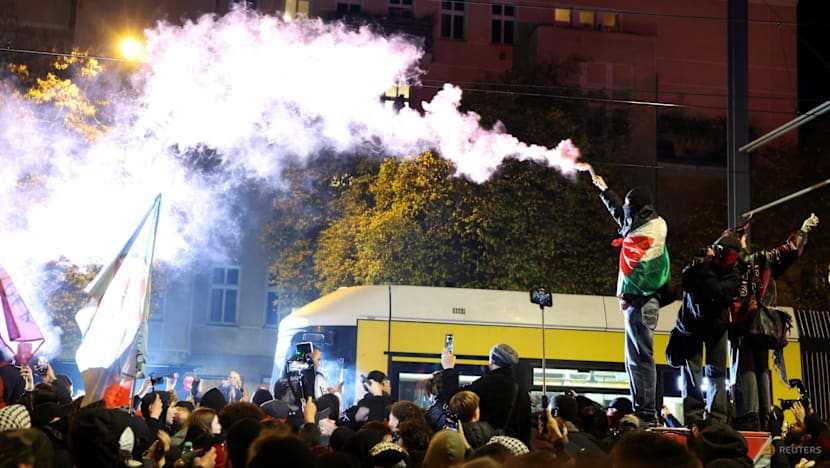
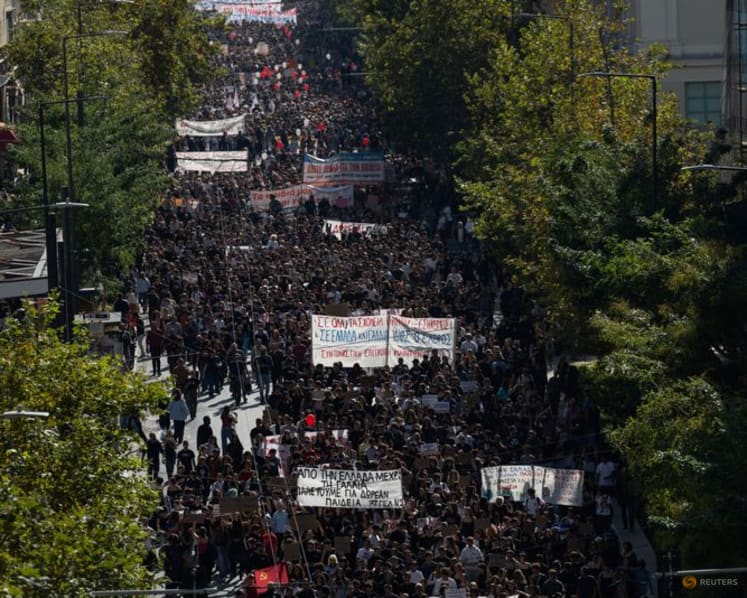
SINGAPORE: Youth-led protests have swept across Europe in recent weeks, with Germany becoming the latest flashpoint on Saturday (Oct 31), as demonstrators demand better public services, affordable living and greater investment in their future.
Some have descended into violence, with shops looted, buildings vandalised and protesters clashing with police.
CNA looks at why protests are breaking out across Europe, if they are connected and what risks they pose.
Where are the protests happening and why?
In Germany, a youth initiative called GenZ regelt, or "Gen Z has got this" in English, held demonstrations in more than 30 cities on Saturday.
The group wrote on its website that it is protesting for greater investment in education, social security, health, climate protection, and a more affordable lifestyle, while opposing any return to compulsory military service.
GenZ regelt said that around 120,000 people took part in the demonstrations.
One of the protesters, Janelle Schulz, said that more money should be invested in education.
“At my school, the ceiling is collapsing because of water damage, nothing is being done about it, we have a shortage of teachers, the toilets are broken,” the high school student from Berlin told AP.
In France, demonstrations began in mid-September over worsening school conditions, teacher shortages and dissatisfaction with the university admissions system.
According to American think tank Council on Foreign Relations (CFR), the movement began with a teachers' strike at a high school in Creteil, near Paris, before spreading nationwide, affecting more than 1,000 high schools and drawing hundreds of thousands of protesters.
The protests soon expanded, touching on the rising cost of living, public services and President Emmanuel Macron's leadership, drawing support from trade unions and the Yellow Vests movement.
On Oct 17, demonstrations involving an estimated 550,000 people deteriorated into some of France's worst rioting in years, AP reported.
Demonstrations continued on Saturday, drawing around 320,000 people nationwide, with more than 560 arrests reported by night.
Among the protesters was 21-year-old student Corentin Cabreux, who told AP that his state-run student residence had “damp stains all along the bottom of my walls, whole sections peeling off, cockroaches everywhere, rats”.
CFR research associate Rafaela Uzan highlighted a generational divide, with many young people feeling that the French government prioritises older generations despite high youth unemployment and mounting pressures on education.
In Spain, housing affordability has emerged as a central grievance.
The eviction of an 87-year-old woman from her longtime Madrid home in September, after a sharp rent increase, sparked nationwide outrage.
Protesters have called for rents to be frozen, a halt to evictions involving vulnerable people and tighter regulation of short-term and room rentals, according to The Guardian.
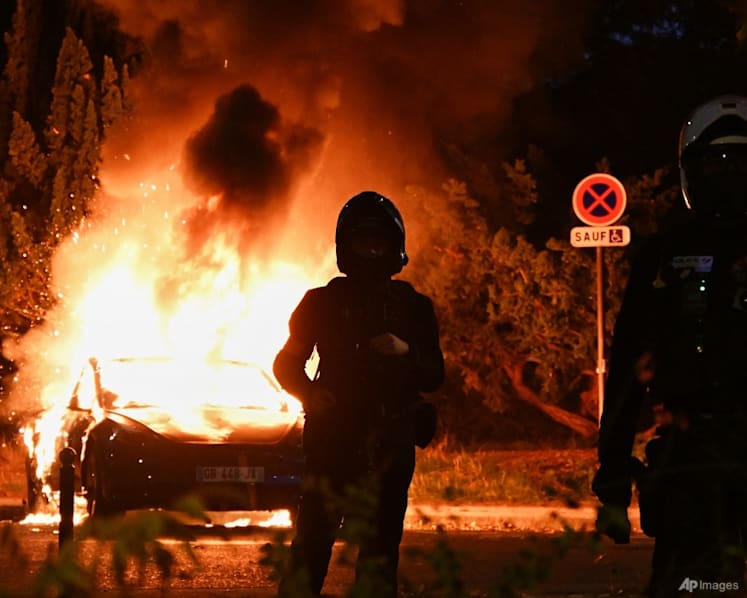
In Italy, young protesters have taken to the streets over living costs, education and concerns about their future. Demonstrations in several cities, including Milan, Turin and Bologna, escalated into violence in mid-October.
Protests have also taken place in Portugal, Belgium, Greece and Albania.
Despite the different triggers, many of the similar grievances shared by protesters across Europe are driven by ageing populations, which put further pressure on public finances, and sluggish economic growth, said Sascha Riaz, a Presidential Assistant Professor from the Singapore Management University (SMU).
In Germany, the gross domestic product “has barely grown” since 2019, he said.
Assistant Prof Riaz added that the prominent role of youths in the demonstrations reflects “a widespread sense of generational unfairness”.
“European societies are ageing, the young are an electoral minority, and many feel their interests are ignored while more and more public money goes to older generations, above all through pension systems that absorb a growing share of public budgets,” assistant prof Riaz said.
Genevieve Pons, president and director general of Brussels-based think tank Europe Jacques Delors, also pointed to sluggish economic growth as a factor fuelling public frustration.
"There is a difficulty to maintain the European social model in the present situation, and it will be very difficult to deal with this phenomenon," she told CNA.
Why have some protests turned violent?
While many demonstrations were peaceful, violence broke out in several cities, leading to looting, arson and clashes with police.
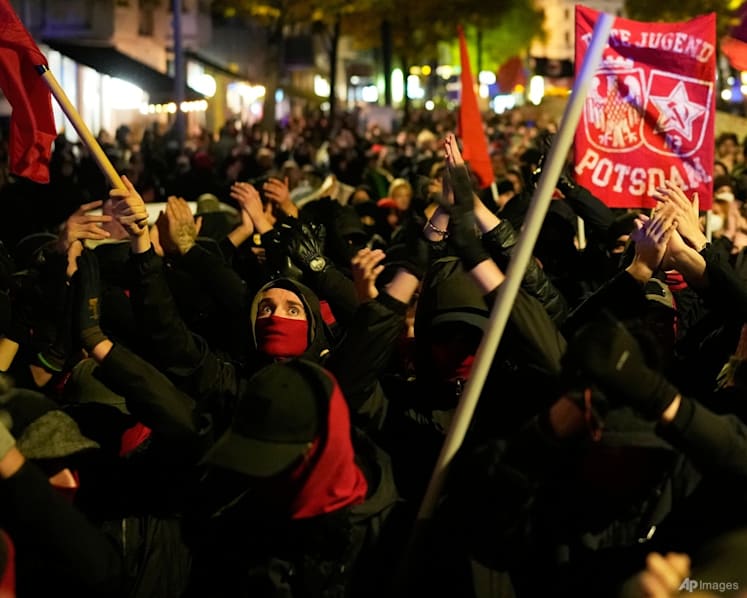
In Germany, Hesse state Interior Minister Roman Poseck said that around 100 identified left-wing extremists had infiltrated Saturday's protest in Frankfurt, where rioters smashed shop windows, looted businesses and hurled Molotov cocktails at police.
Among the businesses targeted was a gun shop. Police said that a suspect has been arrested and two weapons seized
In Cologne, police ended a protest march early after some protesters used pyrotechnics, threw stones at officers and covered their faces despite a ban. Water cannons were also deployed to disperse the crowd.
In France, the Oct 17 demonstrations saw rioters target boutiques, supermarkets and public buildings. In Marseille, rioters stormed the city hall and in Limoges, the town hall was set ablaze.
Around 3,000 shops, including luxury boutiques and small businesses, were looted that day, according to CFR.
Some protesters have defended the use of violence as a means of pressing their demands.
“The schools are not in good condition, people are struggling, people don't have enough money to eat, to live correctly and we are here to claim our rights,” one protester told CNA.
"Violence is justified here. It's not the end, it's just the means to get what we want," she added.
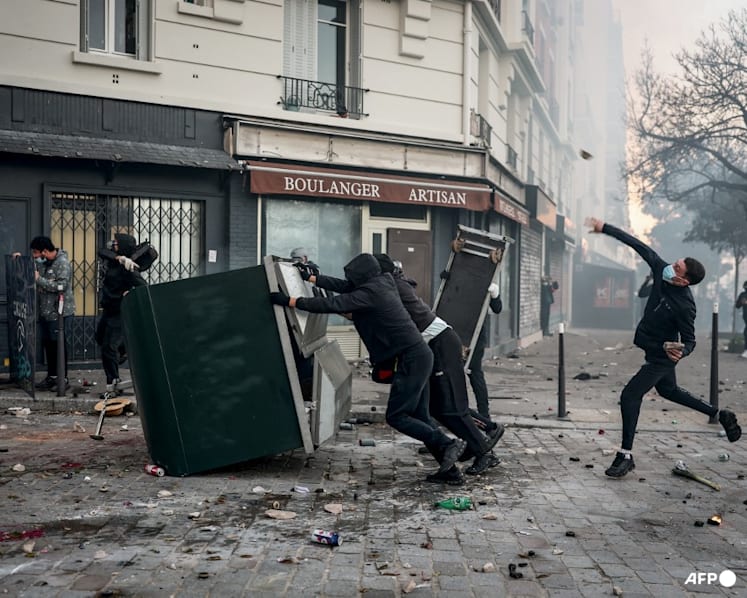
On Saturday, clashes broke out near Porte de Charenton in Paris, when protesters threw glass bottles and fireworks at the police, who responded with stun grenades and tear gas.
Macron sought to distinguish between peaceful demonstrators demanding improvements to living standards and education and those responsible for violence.
The French president said that a distinction must be drawn between protesters making genuine demands and "those who destroyed, smashed and looted".
Intelligence services in France and Belgium have described looting as largely opportunistic, according to the BBC.
They suggested that the unrest involved a combination of “mindless violence” and disturbances instigated by youths associated with radical far-left groups.
French media have also questioned whether radical activists and youths from disadvantaged neighbourhoods have formed informal alliances, with both groups expressing grievances over discrimination and police conduct.
SMU’s assistant prof Riaz noted that the vast majority of protesters have been peaceful, but a violent minority can cause significant damage and attract much media attention.
As “many of these protests are loosely organised, it is difficult to keep out extremists and those who come for a fight or to loot rather than to voice their demands”, assistant prof Riaz said.
Police responses, particularly in France, have also aggravated tensions and escalated the protests, he added.
Violent acts also do not necessarily reflect the aims of some movements.
In Germany, organisers of the GenZ regelt movement explicitly rejected violence, saying that extremist groups, racism and hate speech had no place in their demonstrations.
Are the protests across Europe connected?
While the protests have different immediate triggers, there are signs that demonstrators are drawing inspiration from movements in neighbouring countries.
Assistant prof Riaz described the protests across Europe as “diffusion rather than coordination” as “each movement has its own country-specific demands and organisational structure”.
“But protesters clearly draw inspiration from one another,” he said.
Assistant Prof Riaz pointed to similar patterns during student movements of the late 1960s, the Colour Revolutions of the 2000s and the Arab Spring, where protests spread across borders.
“Such diffusion tends to be strongest between neighbouring countries,” he added.
According to AFP, Germany's youth-led demonstrations were inspired by similar protests in France and Italy.
"I think it's really important to show solidarity with all the other protests currently happening across Europe, including in France," Milla, a 20-year-old student in Berlin, told AFP.
Similar sentiments were expressed in Italy, where 22-year-old protester Riccardo said the demonstrations could help draw attention to young people's grievances.
"Even if we don't manage to throw the country into chaos like in France or block every road like in Spain, the aim is at least people will start talking about these issues again," he told AFP.
Social media has helped spread the movements, with demonstrations frequently organised through platforms such as TikTok and Instagram, according to the BBC.
In France, videos of the initial school blockade in Creteil spread online before demonstrations expanded to high schools across the country, CFR reported.
In Barcelona, students were encouraged to demonstrate using the hashtag #InstitutsIndignats, echoing the French protest slogan Lycdes Indignds, or "Outraged High Schools".
Meanwhile, digital campaigns in Portugal urged people to take to the streets, drawing inspiration from demonstrations in neighbouring Spain.
In Athens, 17-year-old student Yiannis Papanikolaou told AFP said that "School buildings are terrible and poorly maintained … I think something might change, because of what France is doing, France will spur Greece."
What risks do the protests pose for Europe and beyond?
The demonstrations are increasing pressure on European governments already confronting weak economic growth, fiscal constraints and political divisions.
Unlike previous waves of unrest, European governments now have limited financial room to address protesters’ demands, assistant prof Riaz said.
During France’s Yellow Vest protests, Macron was able to spend billions of euros on concessions when borrowing was relatively cheap. Today, however, concessions could require spending cuts elsewhere.
“So it is hard to see how this ends soon, because what most governments can afford falls far short of what protesters are demanding,” Assistant Prof Riaz said.
In Spain, Prime Minister Pedro Sanchez proposed emergency housing legislation that included extending a ban on evictions until 2030 and regulating temporary rentals.
However, the legislation was defeated in parliament, prompting him to call a snap election for Nov 29, The Guardian reported.
In France, authorities have pledged to deploy 3,000 additional substitute teachers to address staffing shortages and scrapped plans to increase certain university registration fees.
The unrest has also taken an economic toll.
Listen:
French think tank Fondation IFRAP estimated that the violence on Oct 17 and 18 could have caused as much as 1.1 billion euros (US$1.22 billion) in damage and economic losses, according to an earlier CNA report.
The protests also come ahead of France's presidential election in April 2027, raising the political stakes for parties seeking to capitalise on public discontent.
Marine Le Pen, the presidential candidate of France's far-right National Rally party, has expressed support for the police and criticised the government's handling of the unrest, while blaming the far left for fuelling violence.
CFR senior fellow Matthias Matthijs said the unrest could allow National Rally to position itself as the party of law and order.
Beyond political consequences, the protests highlight the challenge of growing an economy to sustain public services.
Europe Jacques Delors’ Pons said that stronger growth was essential to addressing these pressures.
"If we want to correct this discrepancy we have to search for more growth. To have more growth we must, for instance, achieve the internal market which has not been done yet," she told CNA.
Want an issue or topic explained? Email us at digitalnews [at] mediacorp.com.sg. Your question might become a story on our site.
KioskNews shows a cleaned-up reading view extracted from the publisher’s page — the original always lives on their site, not ours.