Why Samsung, SK Hynix and CXMT shares are under pressure despite strong AI demand
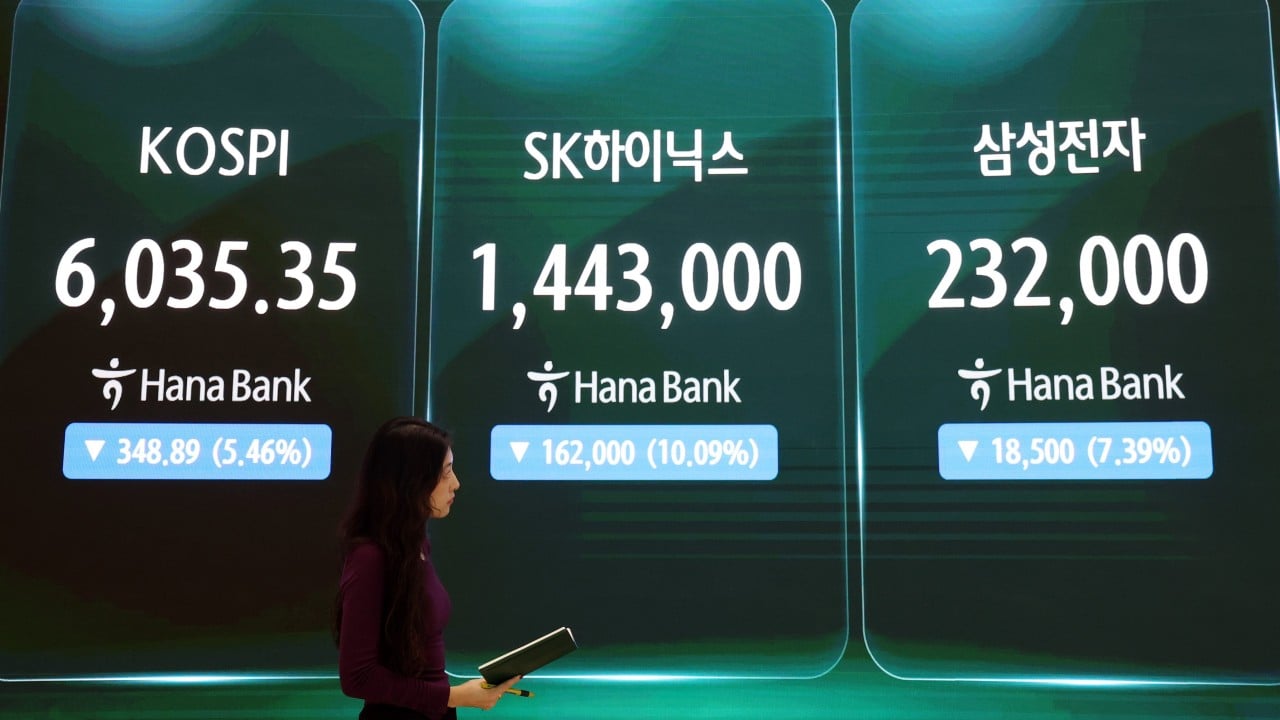
A sharp sell-off in Asian memory chip stocks this week signals growing investor doubts over whether the sector’s AI-driven profit boom can last, even as soaring prices drive strong quarterly earnings across the sector.
Samsung and SK Hynix closed down 7.4 per cent and 10.1 per cent, respectively. The companies have fallen about 16 per cent and 22 per cent, respectively, over the past five trading sessions. Together, they account for about half the weight of South Korea’s benchmark Kospi index, which closed 5.5 per cent lower after falling more than 7 per cent intraday.
In Shanghai, CXMT, China’s leading dynamic random-access memory (DRAM) maker, closed down 2.8 per cent at 46.99 yuan (US$7.01), extending its drop since the close before China’s National Day holiday to about 14 per cent.
Analysts said investors were becoming less confident that memory chipmakers could sustain their windfall profits amid longer-term supply risks and valuation pressures.
Morgan Stanley analyst Shawn Kim wrote in a Sunday note that investors were looking beyond the current surge in earnings, supported by demand for AI-related chips. “We think the easy money is past,” he wrote.
The recent rally may also have encouraged some investors to lock in gains. Kiwoom Securities strategist Han Ji-young wrote in a market commentary on Tuesday that foreign investors were reducing their holdings after a strong run in South Korean equities.
02:14
Why did shares of Chinese chipmaker CXMT surge over 460 per cent in a day?
The retrenchment came despite strong financial reports. Samsung’s shares fell on Thursday even after the tech giant forecast quarterly operating profit of 107.4 trillion won (US$79.9 billion), broadly matching market expectations.
That pressure quickly spread to the United States, where chipmaker Micron lost 3.9 per cent and Sandisk fell 6 per cent on Monday. The two stocks were down a further 2.4 per cent and 2.8 per cent, respectively, in early Tuesday premarket trading.
The change in sentiment has also affected CXMT, whose shares surged as much as 614 per cent above their July offer price to a record 61.80 yuan in mid-August. By Tuesday’s close, however, the shares were down about 20 per cent from their September 23 close.
Analysts said CXMT could be particularly exposed if memory price growth cooled. Visible Alpha, part of S&P Global Market Intelligence, forecast that CXMT’s average selling price for conventional DRAM chips would rise 206 per cent this year, far outpacing projected shipment growth of 79 per cent.
Research firm SemiAnalysis estimated that CXMT’s cost of producing each bit of DDR5 memory remained more than 30 per cent higher than that of its three largest global rivals, while high-bandwidth memory (HBM) contributed little to its revenue.
Slower price increases could limit CXMT’s margin gains, even if it continues to sell more chips.
At the same time, CXMT’s rapid expansion could pose a growing challenge to its overseas rivals. Counterpoint Research estimated that the company’s share of global DRAM revenue reached 10 per cent in the second quarter, up from 4 per cent a year earlier.
CXMT also announced over the weekend that it aimed to introduce a new DDR5 server-memory product by the end of the year using a 4F square cell architecture. The next-generation design is intended to reduce the area of a memory cell, potentially allowing more memory to fit on the chip.
If the company is successful, the technology could strengthen its position in server memory, a lucrative segment long dominated by Samsung, SK Hynix and Micron.
Tesla CEO Elon Musk weighed in on China’s prospects in the memory industry. In a post on X on Monday, he said Chinese manufacturers expand production rapidly once they have learned to make a product. “Their ability to scale is often greater than the rest of the world combined”, he wrote.
Musk added that China appeared to be making rapid progress in low-power memory standards such as LPDDR5 and LPDDR6, while suggesting that newer HBM architectures would prove harder to master.
However, market watchers cautioned against assuming CXMT posed an immediate threat. Han of Kiwoom Securities said the company’s planned server product had not entered mass production, while its manufacturing yields, performance and customer qualification remained unverified.
Near-term market supplies also remain tight. Market intelligence firm TrendForce expected conventional DRAM contract prices to rise by a further 10 to 15 per cent this quarter, albeit at a slower pace.
Morgan Stanley expected memory prices to remain firm through 2027, with increases slowing as supply caught up with demand or clients paused orders to digest existing inventory.
Investors are now looking to Samsung’s full earnings announcement on October 29 for more details on memory-supply arrangements for 2027 and HBM pricing. Morgan Stanley analysts said those indicators would matter more to the company’s stock than its preliminary profit figures.
KioskNews shows a cleaned-up reading view extracted from the publisher’s page — the original always lives on their site, not ours.