Expansive exhibition in Jaffa gives Gaza border artists a chance to air their trauma

As emotive art showings go, Voices from the Gaza Envelope has most of them beat. The voluminous group exhibition opened at the Amiad Center in Jaffa on September 14 and features more than 200 works from some 75 artists. The vast majority of them come from our southern communities near the border with Gaza and, hence, experienced the horrors of Oct. 7, 2023, firsthand.
Shosh Segev certainly did. On that fateful day, the septuagenarian multidisciplinary artist was at home, on Kibbutz Kfar Aza, with her husband, Benzi. “Our house is right next to the young people’s quarter,” she explains. “There were terrorists inside the residential secure spaces (mamad) in those homes,” she adds.
The Tree of Life
When the IDF eventually made it to Kfar Aza, just 5 km. east of Gaza, one of the soldiers tried to pry the Hamas gunmen out by using a bulldozer to smash the windows of their hideouts. Unfortunately, when he reversed towards Segev’s house, he knocked down a Prosopis cineraria tree. However, that mishap turned out to be a cloud with a life-saving silver lining.
“The tree, which was massive, probably 6 meters or more tall, crashed into our balcony,” Segev recalls. “It blocked the sliding glass doors at the rear of our house. When the terrorists ran out of our neighbors’ mamads, they couldn’t get into our house from the back, because of the tree. Since then, I call it the Tree of Life.”
For the past three years, Segev, who has several works on show in Jaffa, and her husband have been living at Kibbutz Shefayim along with some 100 other families from Kfar Aza. That’s a long time to be in temporary accommodation. She says she and Benzi have been given another year to stay at Shefayim before they return to their – by then – rebuilt domicile down south.

“Benzi doesn’t want to go back at all, and I am ambivalent about it.” She says they have a persistent feeling their home has been violated. “I used to live by the maxim that my home is my castle, a place where I can feel safe and secure. But that isn’t the case anymore, not since Oct. 7. Now I’m afraid to go back home.”
That sounds like a challenging state of affairs but, like all the exhibitors in Jaffa, at least Segev has an outlet for her trauma, her fears, and her pain. But you won’t see that too clearly in her work. She primarily engages in painting, but there are also merry papier-mâché figures in her extensive portfolio. The latter seem to burst with bright, rich colors, exuding a sense of optimism and hope. Neither of those sentiments is in generous supply these days for many of us, particularly among the likes of Segev, who still bear the deep-set scars of that terrible day.
But, unlike the majority of the other exhibitors, you couldn’t tell that from her post-Oct. 7 work. “If I feel down, I wait until my mood lifts before I get back to work,” she notes. “I can’t create out of depression. For me that just doesn’t work.” Segev’s acrylic paintings are mostly awash with color, and convey a sense of joie de vivre. Her slot in the Jaffa collection, which was curated by Iris Elhanani and initiated by the Gershoni Foundation to support artists from the Sha’ar Hanegev region, in collaboration with the Sha’ar Hanegev Regional Council and the Sha’ar Hanegev Community Center, takes in a couple of paintings and a fetching polychromic mischievous-looking papier-mâché character.
Stubborn as goats
Daniel Ohana’s brace in the exhibition grabs the eye and also tugs on the heartstrings with gusto. He clearly has a thing about goats. His mosaic-looking paintings present the sturdy milk-giving farm animal in an alluring manner that imparts something of a sense of the creature’s subconscious. “The goat is an animal of contradictions,” he explains. “It can fall prey but it is also more readily associated with survival in extreme living conditions.”
Ohana takes the metaphor a step further, into national climes. “For me, it symbolizes the character of our nation: stubborn, fearless, always pushing itself to climb higher towards the summit, against all odds.” Stirring words indeed, and his artwork is no less moving and impressive.
He has the existential Oct. 7-related credentials for his place in the exhibition. “I am a born and bred resident of Sderot and have always lived in the shadow of war. And having experienced Oct. 7 close up, for me my attraction to this figure [of a goat] is essential escapism.”
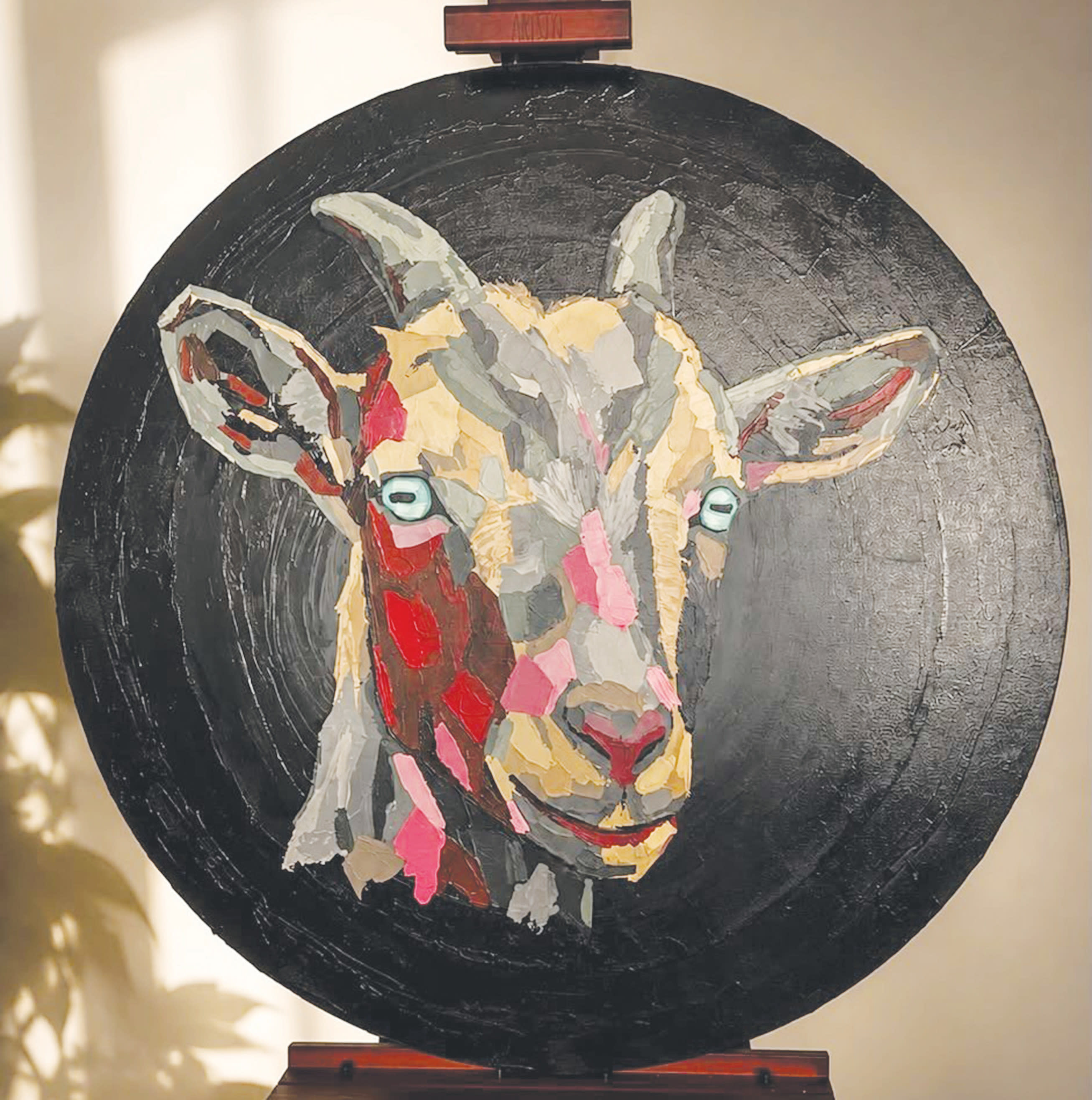
That comes through in spades in his delectably crafted paintings. “Through these two works I chose to take the experience of survival – collective and my own – and transpose it to an animal that refuses to succumb to the conditions that nature puts before it,” he declares. “This is an attempt to find strength, beauty and optimism in a place where it is all too easy to fall, and to remind us that we too, just like the goat, are always climbing.”
Bringing in the crowds
There are, indeed, positive messages to be gleaned right across the spread that fills the cavernous venue, which, Elhanani informs me, was made available gratis by the Municipality of Tel Aviv. “They and Mayor [Ron] Huldai have been very supportive,” she says.
The curator also pulled out several stops to help Gaza border artists get their lives back on creative track. She was instrumental in organizing an auction of works by Israeli artists in London, with the proceeds going to funding the establishment of studio facilities for evacuated artists.
She is well-versed in the work and lives of many of the artists, and is delighted to have the opportunity to push their art out there, to culture consumers of all ilks. The Amiad Center, she says, fits the bill on various levels. “It is a very large space. It is a wonderful venue. And we get thousands of people coming to see exhibitions here. I’ve curated shows that have drawn 25,000 visitors.”
That’s pretty good going, and a traffic volume which Establishment art repositories such as the Tel Aviv Museum would be more than happy to bring in. Not disparaging the Jaffa location one iota, I still wondered whether Elhanani might have been happier to have Voices from the Gaza Envelope run over at the more prestigious downtown venue on Shaul Hamelech Street. “Yes, of course, I’d like the Tel Aviv Museum to take the exhibition on. The question is whether they would want to.” Her intonation and facial expression clearly conveyed her skeptical take on that.
From the collective to the personal
Oct. 7, And all its corporeal and emotional fallout, comes through time and again across the display, and in all sorts of guises. Limor Klein Tivoli went for a definitive military apparel hook and embroidered a broad range of faux military unit insignia that tell the story of that cataclysmic event down south going on three years ago now, in her own unique way.
Her set goes by the highly suggestive moniker Where Did You Serve? It comprises a complement to a series she called Trauma Treatment, which she contributed to the Women Relate War: Voices from the Front exhibition, which took place earlier this year. That show, in turn, fed off stories related by female soldiers who took part in running battles with the Hamas terrorists on and immediately after Oct. 7, 2023. “This body of work was inspired by my encounter with the testimonies of female combat soldiers following the events of Oct. 7,” Klein Tivoli says.
The line she took was to try to portray some of that battlefield emotional detritus in physical aesthetic form. “I focused on the way in which trauma continues to be absorbed into the body, in memory and daily life, even after the actual event is over,” she explains.
Where Did You Serve? was sparked by the testimony of a particular soldier. “She is dealing with PTSD. Her story served as conceptual raw material for looking at the possibility of translating an ongoing psychological experience into visual language, and examining the tension that exists between the female experience and the military system which is associated with codes of strength, hierarchy and belonging.”
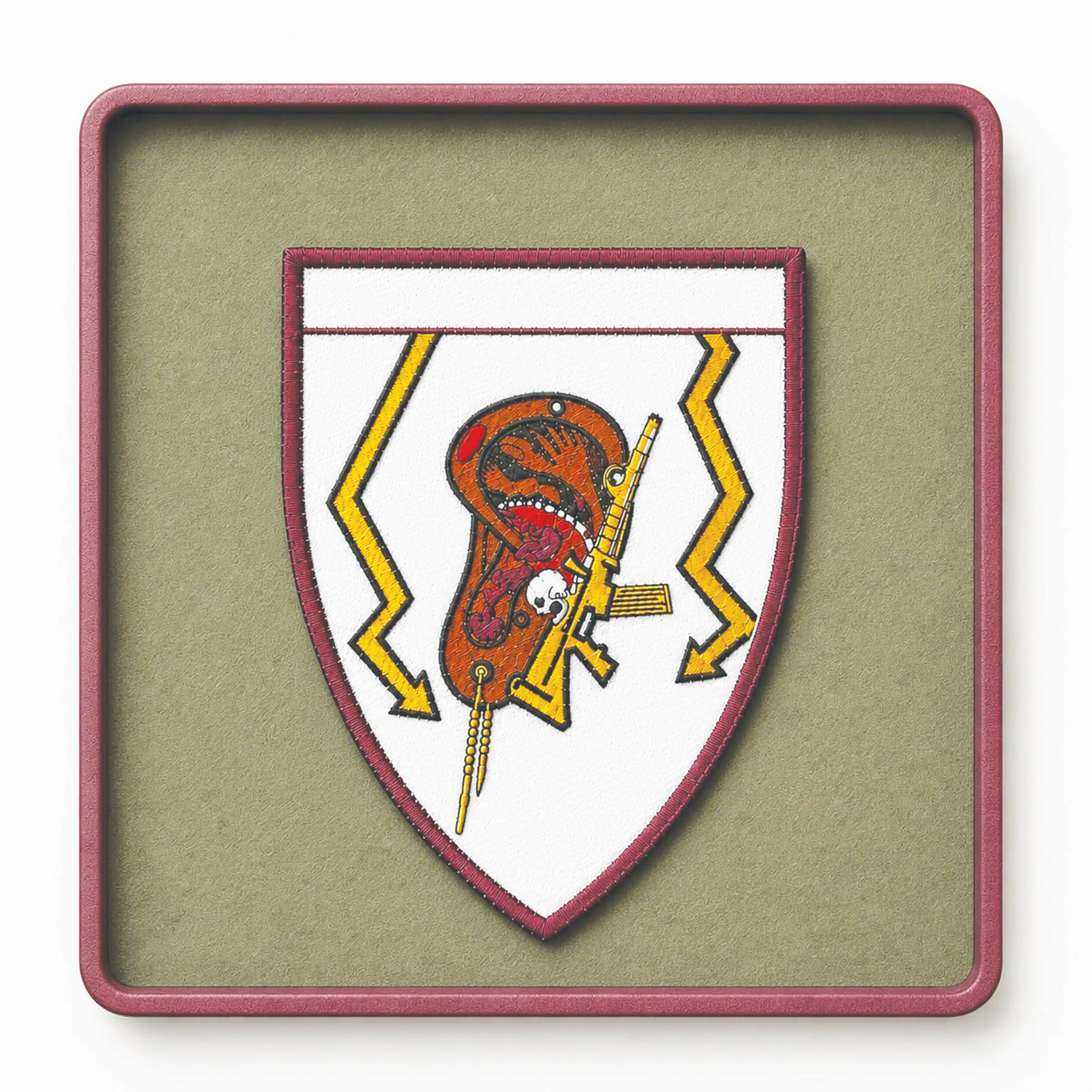
That led directly to Klein Tivoli’s choice of epaulet insignia, and the way she flexed military aesthetics into a very different philosophical domain. “The insignia – a definitive symbol of identity, belonging and role – are diverted away from the original meaning. They stop representing a military unit and become repositories of personal memory, vulnerability and resilience,” she expounds. “They enable us to consider the relationship between the collective and the individual, force and fragility, and between an institutional symbol and personal testimony.”
Klein Tivoli manages that artfully by delicately crafting designs that, at first glance, appear to be bona fide army shoulder tags. But as you spend a
moment or two getting into the colorful compositions, the finer details begin to filter through with their patently non-military components, and extramural line of thought and execution. That is partly a result of the time Klein Tivoli spent in Japan, where she learned to note and leverage the minutiae of everyday life around her.
Blood flowers across the earth
There are so many images that flash before our eyes when we recall the carnage at the Nova Festival and the kibbutzim and moshavim near the border with Gaza. The color red has dual, and ambivalent, significance for that area of the country. Nature lovers may be familiar with the Darom Adom – Red South – festival, which takes place there towards the end of winter when the whole region is swamped by anemones as the normally arid plains sprout thousands of the beloved red flower.
Yaffa Solomon took that ubiquitous seasonal highlight and ran with it every which way. “The anemone is primarily a memory of the earth on which anemones bloom after the rain,” she says. Her contribution to the exhibition in Jaffa takes the form of a large sculptural affair with dozens of ceramic red flowers with elongated metal stems. Her sweeping artistic rendition of the Oct. 7 tragedy features thousands of crafted anemones she installed across the Nova site, and at other relevant locations such as the Oct. 7 victim section of the cemetery on Mount Herzl in Jerusalem.
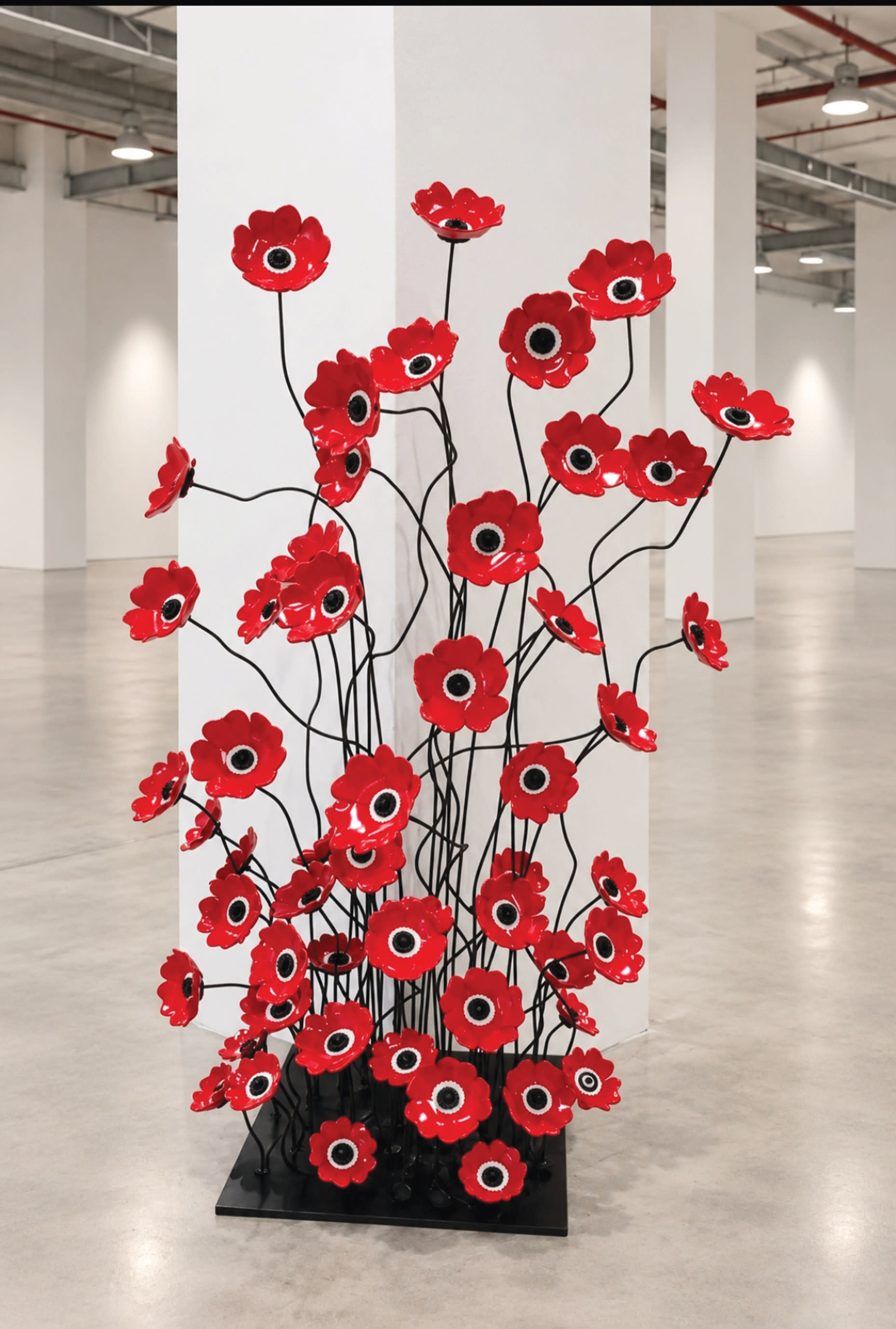
She recently also finished work on a book on the floral memorial venture called Anemones Before the Rain. The tome is due out for distribution in the near future. I asked about her choice of temporal preposition. Her response brought tears to my eyes.
“When the dry and arid ground of the Western Negev was soaked with the blood of the murder victims [on Oct. 7], it was dyed red with the blood of the fallen. That is the same soil that, after the rain, drowns in the red of the anemones. The war broke out on the same ground where the anemones bloom after the rain.” Hence also her choice of material for her grand sculptural tribute. “It is a metaphor. The ground is the clay [of the ceramic flower heads], and the blood is the anemone which also plants hope in us, and reappears anew every year.”
There is no missing the angst in Nadine Bar-Noy’s portraits. The monochromic paintings drip with melancholy and a sense of inner searching for tranquility or, at the very least, acceptance. “She lives in Sderot,” Elhanani tells me. “She is still in shock after Oct. 7. She is suffering, badly.” That spills out of her works in a – hopefully – cathartic outpouring of her sorrow.
Furrows of life
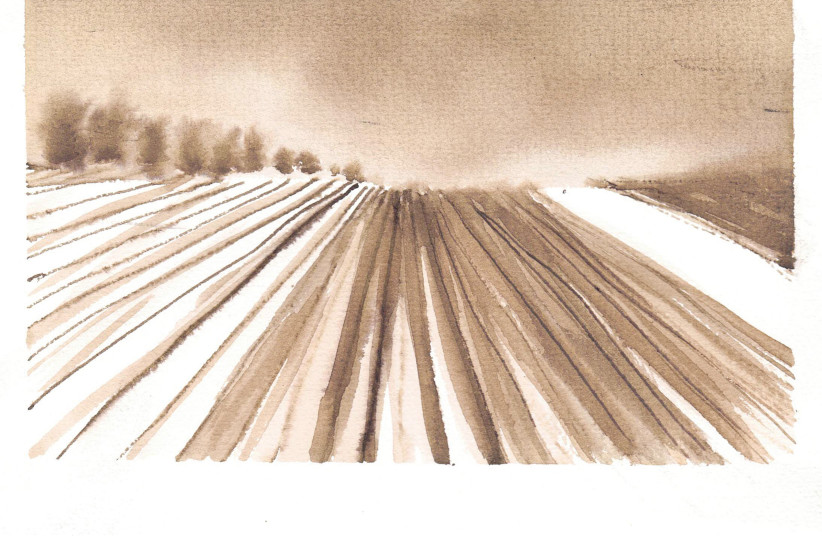
Brit Einstein from Kibbutz Magen, less than 5 km. east of Gaza, was one of those who chose an active response to the trauma. “She was evacuated to Jaffa and then went back down south to work on a tractor. They were short-handed down there,” Elhanani explains.
Einstein’s stint plowing the fields on the kibbutz left her with an enduring image of the furrows. She subsequently photographed them and then transposed them into a set of nuanced monochromic paintings that convey the texture of the parched pre-autumnal rains soil, and the stillness of the air as the violence of the barbaric Hamas attack hovers over the future crops.
Orly Landber Tokolevsky’s ceramic set feeds off a pragmatic view of emergency situations and is a delight to the eyes. Her ceramic work is called Residential Secure Space Kit and comprises deftly fashioned items that may serve one well in such dire circumstances. A hefty-looking colorful glazed bowl contains an apple, a pencil, paintbrushes, and even a wad of dollar bills.
“There are some wonderful works here, with some big-name artists too, like Eyal Asulin,” says Elhanani. “There are works that express the sorrow, and there are others that impart optimism and hope for the future.”
Bridging the mortal artistic divide
The exhibitor roster also includes creations by artists murdered on Oct. 7, such as Aviv Atzili, Haim Perry, Roy Idan, Eliko Reichenstein, and Yuval Reviya. “Their work is shown alongside that of artists who continue to create today, creating a dialogue between voices that endure and voices that were silenced. The exhibition is not only an act of remembrance, but also a testament to artistic resilience, hope and continuity,” the curator notes.
There is quality art to be found among the ashes of the ravaged southern communities. “Our goal is to reveal the extraordinary artistic richness of the Western Negev and to present outstanding contemporary art that continues to flourish despite loss and devastation,” Elhanani states. “This exhibition speaks about the strength of artistic creation and the resilience of the human spirit.”
There are a number of events lined up for the exhibition, through to the closing date of October 3. There will be a conversation with South African-born former hostage in Gaza Aviva Siegel, from Kfar Aza, about her book The Main Thing Is to Wake Up to a New Morning. Siegel wrote the book together with journalist and author Amir Tibon, about her experiences on Oct. 7 and in captivity in Gaza. There will also be live dance and music, and film screenings.■
KioskNews shows a cleaned-up reading view extracted from the publisher’s page — the original always lives on their site, not ours.