Israel Election 2026: What does Yair Golan’s Democrats party stand for?
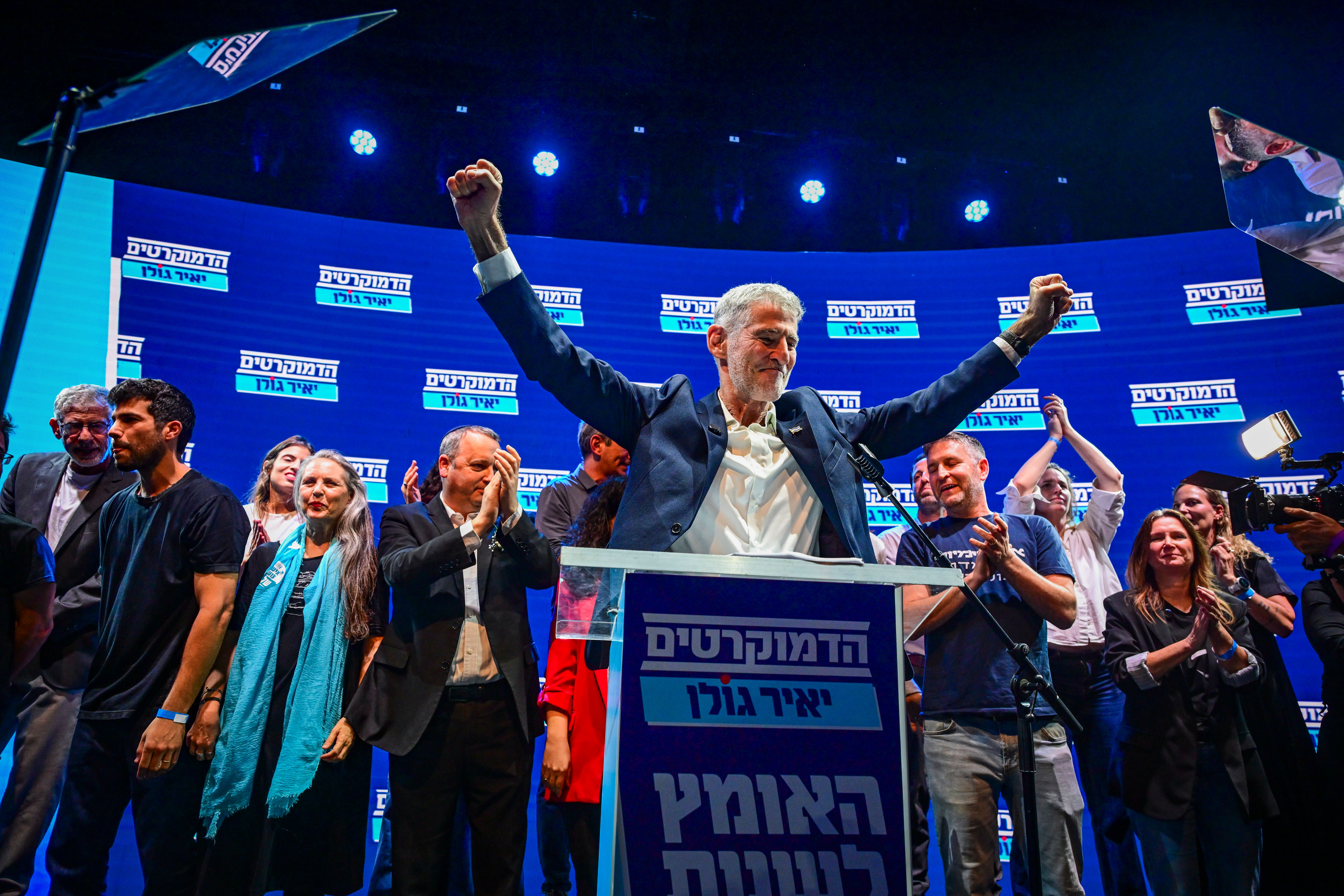
The Democrats, formed in 2024 through the merger of the veteran Labor party and the far-Left Meretz party, is one of the parties vying for citizens’ votes in the elections for the 26th Knesset, which will be held on October 27.
Led by former IDF deputy chief of staff Yair Golan, who also previously served as an MK for Meretz, the Democrats sits on the Left of the political aisle and is one of the four main parties in the opposition bloc seeking to replace Prime Minister Benjamin Netanyahu.
The party's 2026 primary produced a slate with Golan first, followed by MKs Naama Lazimi, Gilad Kariv and Efrat Rayten, and the only party employing a gender-based ‘zipper system’ in its structure, alternating men and women down the list. The party is currently polling at around 9-11 seats.
The list includes 17 leaders involved in protest movements and public activism, 12 former IDF officers, 11 candidates with backgrounds in the civil service, 19 women, nine candidates under the age of 45, eight former Knesset members, four candidates from the Arab community, three from the Druze community, and two members of the LGBT community.
The Democrats brings together two of the Israeli Left's historic political parties.

Labor, formally established in 1968 through the merger of the historic ruling party Mapai, Ahdut HaAvoda and Rafi, was the successor to the movement that dominated Israeli politics from independence through the 1970s and was rooted in Labor Zionism, social democracy and the building of the Jewish state. Labor's political history includes the governments of David Ben-Gurion and Golda Meir, its first defeat in 1977, and Yitzhak Rabin's return to power in 1992, when the party became closely associated with the Oslo peace process.
Meretz, founded in 1992 through the merger of Ratz, Mapam and Shinui, emerged from the peace movement and established itself as a more explicitly dovish, secular and civil-rights-oriented force on the Israeli left. Its platform emphasized a two-state solution, human rights, equality and a social-democratic economy.
In recent years, the two parties struggled electorally. In 2022, Labor won a record-low four seats while Meretz fell just below the electoral threshold. In June 2024, they formally merged under the name The Democrats, describing the new party as a “liberal-democratic Zionist party” intended to unite their political base and ensure there would be no loss of left-wing votes, as what occurred in 2022 and brought about Netanyahu's right-wing government.
Golan's Democrats seek 'fundamental change' - and safeguarding the judiciary
According to Golan, the party’s primary mission is to bring about what he calls “fundamental change” in Israel’s political system, particularly regarding democracy, the rule of law, and government accountability.
“We are not satisfied with slogans about a ‘better government’ or ‘good governance.’ We have come to repair and change the very system that made this disaster possible in the first place,” Golan said when unveiling the party’s election platform.
He has also pledged legislation preventing politicians under criminal indictment from serving as prime minister.
“In our government, there will be zero criminal defendants. Zero,” Golan said. “Anyone under criminal indictment cannot serve as prime minister or as a government minister.”
The party's political identity has been shaped in part by the anti-government and judicial-reform protest movements. Golan has described those movements as “part of the backbone” of The Democrats, while several prominent protest leaders joined the party ahead of the election, including hi-tech entrepreneur and anti-judicial reform activist Moshe Radman.
The party has sought to preserve the judiciary's role as an institutional check on government power. Golan and Democrats MKs have defended Attorney-General Gali Baharav-Miara during the government's attempts to fire her. Golan gave “full backing” to the attorney-general and accused National Security Minister Itamar Ben-Gvir of politicizing the police.
Golan has also been an opponent of Ben-Gvir's handling of crime within the Arab sector as part of his role as national security minister. He has called to combat the spike in Arab sector crime during the government's four-year term. He has also placed an Arab candidate, Somaya Bashir, in a realistic slot on the party's Knesset slate.

The party has also placed significant importance on the separation of religion and state, with Golan calling to protect the right of businesses to operate on Shabbat where legally permitted, and has framed the issue as one of individual freedom.
“A business that wants to open on Shabbat in a place where the law allows it, will open,” he said. “Whoever wants to observe Shabbat, will observe it.”
Golan has also criticized restrictions on personal religious life, saying Israelis should not have religious authorities dictate “how to marry, how to live, where to travel, or what to wear.” He advocates for the state to recognize civil marriages not done through the Chief Rabbinate.
Finding diplomatic solutions - and fighting against West Bank settlement expansion
Golan has been a fierce critic of Netanyahu's military approach following October 7, calling for the government to seek out diplomatic solutions over repeated rounds of fighting with its adversaries.
The Democrats' predeccesors have historically supported a two-state solution, although Golan has called for a more nuanced solution following October 7. Kariv has been more explicit, saying Israel should ultimately divide the land and establish a demilitarized Palestinian state as part of a regional agreement.
In its platform, the party argues against annexation of the West Bank and has taken a hard-line against what it calles "escalating Jewish terror which endager the security of the state," referring to increasing settler violence targeting Palestinian towns across the West Bank.
The party says it will stop state funding of newly-constructed outposts and farms in the West Bank, which it argues were established "illegally and in contradiction to security considerations."
It added that it would reverse the government's establishment of the civil administration, led by Finance Minister Bezalel Smotrich, and "return the authortative control in the area to the IDF."

What a vote for this party is likely to produce
A vote for the Democrats would strenghen its negotiating power during coalition negotiations with the three main parties in the opposition bloc: Gadi Eisenkot's Yashar party, former prime minister Naftali Bennett's B'Yachad party, and Avigdor Liberman's Yisrael Beytenu faction.
The party has ruled out joining a government with Netanyahu and the ruling Likud party, with Golan also stating the party would not sit with haredi (ultra-Orthodox) parties in the same coalition.
The Democrats is the only party in the opposition to openly support the inclusion of Arab parties, namely Ra'am, in a potential coalition. This position is at odds with the party's potential coalition partners, some of which hold a hard-line stance against such a move following October 7.
Golan has said that an Arab party’s participation in the next government would be “natural, right, appropriate” and democratic, while also saying The Democrats is working to ensure “appropriate representation” for Arabs in the next government, putting it at odds with other opposition leaders who have rejected such a coalition make-up.
The party has also been preparing for coalition negotiations, identifying the Defense, Justice, Education, National Security, and Communications ministries as portfolios it would seek, while demanding concrete commitments on democracy, the rule of law and the judicial system.
The party's stated governing agenda would put particular emphasis on democratic and judicial reform, opposition to haredi draft exemptions, religious pluralism, Arab political representation and a change from policies laid out by previous Netanyahu governments, while leaving several detailed economic and diplomatic policies less clearly defined.
KioskNews shows a cleaned-up reading view extracted from the publisher’s page — the original always lives on their site, not ours.