In China’s fierce race for success, mental health struggles are starting earlier
Her diagnosis came as a shock. “My mum broke down in tears,” said Chen, now 17.
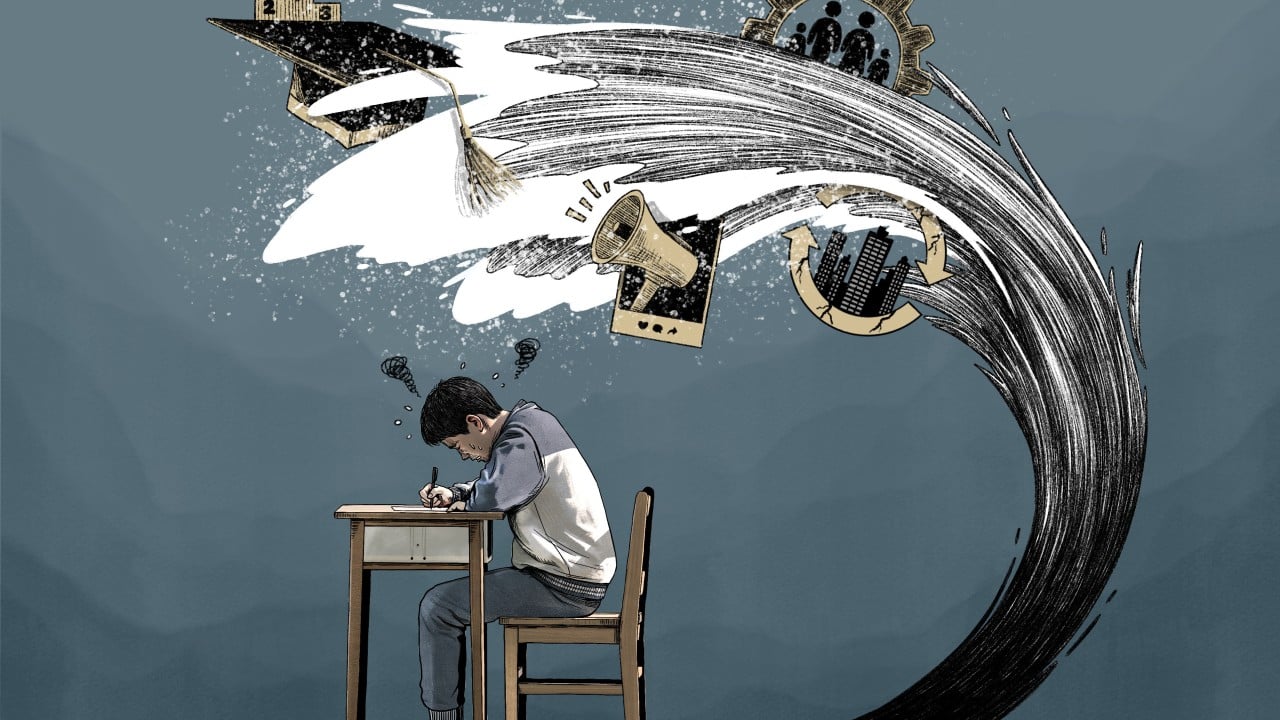
However, it perhaps should not have been so surprising, as a growing number of young Chinese people of her generation are wrestling with mental health struggles. Experts say that as academic pressure is growing on younger students, so is the mental strain. It reflects the mounting pressure within Chinese society, where people are locked in cutthroat competition for opportunities, with serious implications for their lives ahead.
A nationwide survey led by Beijing Anding Hospital that was published in 2021 found that 17.5 per cent of children and adolescents in China suffer from mental disorders, with anxiety and depressive disorders among the most prevalent conditions.
The lead researchers told Chinese media that the 17.5 per cent figure may well be an underestimate for minors overall, as the survey only examined school-going children aged six to 16.
According to a 2022 report by the Chinese Academy of Sciences (CAS), 14.8 per cent of surveyed adolescents showed varying degrees of depression risk, a rate higher than that of adults.
13:01
Why is China’s gruelling gaokao college entrance exam so tough?
According to an earlier report by CAS, roughly 30 per cent of surveyed junior high – or lower secondary – students reported depressive symptoms — a sharp jump from about 10 per cent among primary school pupils. The figure climbed to nearly 40 per cent for the senior high - or higher secondary – classes.
Psychologists noted that the surge in mental health issues among Chinese youth could not be reduced to any single cause.
“Rather, it reflects the convergence of multiple structural forces: the intensification of educational competition, the pervasive penetration of digital media, the transformation of family structures and a broader uncertainty about meaning accompanying rapid social transition,” said Shimin Zhu, an associate professor at Hong Kong Polytechnic University whose research focuses on adolescent well-being.
When her issues first surfaced, Chen said she was facing tough expectations and lacked emotional support.
During her time in the lower grades, Chen’s academic schedule stretched from 7.20am to 10.30pm, with weekends swallowed up by classes at cram schools.
“Almost everyone here takes extra classes. There are tutoring centres everywhere,” Chen said.
All her efforts were aimed at securing a place in secondary school, an increasingly challenging task.
China's ‘sky school bus’ lifts pupils to mountain-top classrooms and a brighter future
Under China’s nine-year compulsory education system, schooling is guaranteed only through junior high.
Facing shortages of technical labour, policymakers are now relying on the senior high school entrance examination to sort students into academic and vocational tracks. Depending on the region, only around 50 to 70 per cent of test-takers can follow the academic track and get into senior high school.
But given the deep cultural preference for academic success, many families treat going to vocational school as a life-ruining failure.
Against this backdrop, Zhu said, the panic once reserved for the gruelling college entrance examination now gripped teenagers years earlier, right as they underwent dramatic physical and hormonal shifts.
While Beijing has pushed in recent years to elevate society’s view of vocational education, Zhu noted that winning widespread public acceptance was bound to be a long process.
“People are more likely to embrace vocational pathways when they see clear career prospects and better pay for skilled workers,” she said. “Academic competition can also intensify during this transition.”
Even entering university offers little relief. Zhu said the rapid growth in the number of college students and challenging graduate job market meant a degree no longer guaranteed stable employment, and this uncertainty has pushed youth stress to record highs.
China’s surveyed unemployment rate for urban youth aged 16 to 24 has hovered around 18 per cent in recent months, with August reaching 18.9 per cent – the worst reading in a year.
Outside the classroom, Chen found little refuge. Consumed by work, her parents had little time to offer companionship.
“They didn’t understand that I was in agony, nor did they realise how severe my physical reactions were,” Chen said. “They just thought I was too fragile.”
09:07
AI tool promises to detect depression by simply looking into your eyes
During her darkest moments, she began to self-harm, scratching her hands with staples.
While adolescents naturally yearn for autonomy, their sense of security still hinged on emotional support from home when a crisis hit, Zhu noted.
Citing her previous research, she added that when children enjoyed quality interactions and warm relationships at home, they showed greater confidence in facing challenges and a lower likelihood of self-harm.
Digital media penetration further complicates the landscape.
Video games, social media and emerging AI-generated microdramas increasingly crowd out physical exercise and face-to-face interactions – activities that are indispensable for adolescents’ development.
For depressed teenagers starved of real-life connection, screens offer an immediate escape. “Such readily available dopamine provides temporary emotional relief – a refuge some young people turn to when they feel overwhelmed,” Zhu said.
Yet the retreat into virtual worlds often worsens their social isolation.
This [AI] transition is like a subterranean tsunami. No one knows when it will fully strike or what dramatic upheavals it will bring
Beneath the depressive and anxious emotions lies a deeper existential disorientation: adolescents are struggling to find purpose in a society transforming at breakneck speed – with the rapid ascent of artificial intelligence (AI) serving as the latest disrupter.
“This transition is like a subterranean tsunami. No one knows when it will fully strike or what dramatic upheavals it will bring, stirring widespread anxiety among many people,” Zhu said.
Beijing has recognised the need to tackle the youth mental health crisis. The government has pledged to ease students’ academic burden while establishing a nationwide system of mental health screening and crisis intervention.
It has also said that by 2030 all primary and secondary schools should be staffed with a counsellor and host at least one psychological lecture or dedicated activity each school year.
Progress towards these goals is under way. According to the State Council, 92 per cent of primary schools and 95 per cent of junior high schools now have a counsellor.
But despite these promising numbers, major hurdles stand in the way of effective support.
12:03
Hong Kong’s struggle to ease academic competition among its young people
For many sufferers, the social stigma surrounding mental illness is more suffocating than the condition itself, which stops them from seeking professional help.
“Many parents we encounter are terrified when their children need psychological counselling or psychiatric intervention,” Zhu said.
“Alongside concerns about getting appropriate care, some parents worry that a diagnosis recorded in their child’s medical history could affect future opportunities.”
This reluctance to arrange support means that minor emotional setbacks often turn into chronic, severe crises.
Lily Li, 17, took the initiative to ask for medical help after suffering recurring bouts of full-body numbness and shortness of breath. Her pleas were initially dismissed by her parents.
“I paid the hospital registration fee myself and took a 2½ hour subway ride to the hospital alone,” Li said. “Only when the intake desk refused to see me without a guardian present did my mother finally agree to come.”
Li was later diagnosed with moderate depression and severe anxiety.
Her experience mirrors national trends. According to a CAS study on adolescent depression and rehabilitation dilemmas in China, only 27.4 per cent of parents take their children to a clinic the first time a child asks for help, while nearly 30 per cent of parents act only after their child has made pleas four or more times.
Meanwhile, qualified medical professionals remain in short supply.
12:18
What is the outlook for China’s fresh graduates in an already crowded job market?
A 2019 paper published in the medical journal The Lancet said that China had only around 500 qualified child and adolescent psychiatrists nationwide, with the vast majority concentrated in metropolises such as Beijing and Shanghai.
“Whether we talk about certified psychotherapists or child psychiatrists, their numbers remain minuscule relative to China’s massive population base, and resources are unevenly distributed,” Zhu said.
The prohibitive cost of private therapy creates an equally daunting barrier.
Hourly rates for psychological counselling commonly range from 100 yuan (US$15) to upwards of 1,000 yuan, which would be a major expense for many Chinese households, and meaningful clinical progress generally requires at least three to five sessions.
For adolescents who do manage to get clinical care, ensuring treatment works is another challenge.
Mental health conditions are predominantly treated through medication and psychotherapy, but maintaining consistency is notoriously difficult.
According to the World Health Organization, medications for depression and anxiety take weeks to show initial benefits in sleep, mood and energy. They should also be continued for at least six months after remission to prevent relapse, with discontinuation carried out gradually under medical guidance.
Chen stopped taking her medication because she felt the drugs offered little relief, while Li also abandoned hers after suffering dizziness and nausea.
Beyond medical and financial access, another challenge lies in how society views distress itself.
While welcoming government initiatives to ease student burdens, Zhu noted that top-down measures should avoid treating all stress as something to be eliminated, as frustration was an inevitable part of life.
“Learning to cope with the ups and downs of life as we grow up is the core of educating the next generation and of educating ourselves,” Zhu said.
She added that policies should not merely focus on reducing academic pressure or on whether the children are happy. The goal, she emphasised, should be nurturing “psychological resilience and inner strength”, equipping adolescents to face adversity.
“Growing up is an incremental accumulation,” Zhu said.
“We must not let children feel that a single poor exam score means the sky is falling.”
KioskNews shows a cleaned-up reading view extracted from the publisher’s page — the original always lives on their site, not ours.