FIRST READING: The eyewatering cost of the projects Canada is pitching to investors
First Reading is a Canadian politics newsletter curated by the National Post’s own Tristin Hopper. To get an early version sent directly to your inbox, sign up here.
Sign In or Create an Account
This week saw Prime Minister Mark Carney preside over the first-ever Canada Investment Summit, a large, Toronto-based gathering of international financiers. At the centre of the summit was a “pitchbook,” outlining a slate of pre-approved projects open for investment, most of them resource-based.
The projects are also incredibly expensive, with several proposals dwarfing anything that’s ever been built in Canada with private capital.

Columnist Jesse Kline keeps you up to date with what’s happening in Israel and the effects of antisemitism on life here in Canada. Friday mornings.
By signing up you consent to receive the above newsletter from Postmedia Network Inc.
A welcome email is on its way. If you don't see it, please check your junk folder.
The next issue of Channel Israel will soon be in your inbox.
We encountered an issue signing you up. Please try again
High prices aren’t all that off-brand for the Carney government. Its 18-month tenure has been marked by a series of big-ticket purchases that are not just expensive, but expensive beyond all existing standards for what such a thing should cost.
The Liberals are continuing to pursue a high-speed rail project through Ontario and Quebec that is projected to cost up to $90 million per kilometre. In Europe, such a railway would come in for just $40 million per kilometre.
And just this month, Ottawa earmarked $4.7 billion for Via Rail to build 313 passenger cars – about $15 million per car. For comparison, just a few months ago, Siemens signed a deal with the Swiss government to supply up to 200 six-car passenger trains at a cost equivalent to C$3.4 billion. That’s closer to a unit cost of between $2.8 and $5 million per car.
Below, a quick guide to some of the priciest items in the summit’s pitchbook, along with context about what kind of infrastructure money that represents.
Port of Churchill expansion
Quoted price: $80 billion (US$57 billion)
What that could buy instead: 16 St. Lawrence Seaways
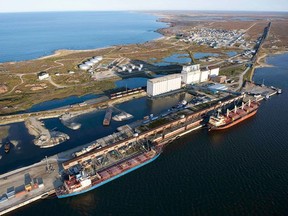
The single most expensive item in the Carney pitchbook, the Port of Churchill expansion, carries a capital cost more than twice as large as the entire annual budget of the province championing it. This year, Manitoba will ring up about $27 billion in total expenditures.
A Government of Canada description of the project notes that the expansion would prioritize “Indigenous equity ownership,” and is a plan to upgrade the port with an “all-weather road, an upgraded rail line, a new energy corridor, and marine ice-breaking capacity.” The last point being particularly important, as the port is currently frozen in much of the year. The idea is to make it an all-weather port.
As megaprojects go, one of the most successful in Canadian history is usually cited as the St. Lawrence Seaway, a system of canals and locks completed in the 1950s that connected the Great Lakes to Atlantic Ocean freighter traffic for the first time. And even when adjusting for inflation, the total cost of the seaway comes to about $5.3 billion. Or, about 17 per cent of the quoted Port of Churchill expansion price.
Wind West
Quoted price: $61.3 billion (US$44 billion)
What that could buy instead: Quebec’s largest hydro dam x 6
The Nova Scotia government is billing Wind West as both Canada’s first “offshore wind development” and the key to making their province “an energy superpower.” It’s basically a plan to install enough wind turbines in a particularly windy area off Nova Scotia to equal 40 gigawatts of power – about a quarter of the electricity that Canada is drawing at any one time.
Although, like all wind power, that’s only if the wind is blowing. There’s also a lot of unknowns for a project that size. Europe has been building offshore wind for decades, and it still has only installed a cumulative 19 GW worth as of 2023.
As to what kind of energy project $60 billion could fund instead, it would cover the construction cost of the largest hydro dam in Quebec six times over. The Robert-Bourassa generating station was built for the modern equivalent of about $9 billion in the 1980s.
West Coast Oil Pipeline
Quoted price: $35 billion
What that could buy instead: About three U.S. pipelines
This is the Government of Alberta’s signature contribution to the pitchbook. The West Coast Oil Pipeline is the province’s much-hyped plan to build a second oil export pipeline to the Pacific Ocean, with the final destination pegged for Delta, B.C.
The high projected development costs for the pipeline have always been an issue. For context, when Enbridge was shopping around plans for the ultimately cancelled Northern Gateway pipeline, the company was thinking it could build it for about $8 billion.
And from the perspective of a major financier, pipelines in the rest of the world aren’t nearly as expensive as Canadian ones, particularly this one. As just one example, Carney’s former employer, Brookfield Asset Management, recently completed acquisition of the U.S.-based Colonial Pipeline.
The Colonial system runs about 8,000 km as compared to the approximately 1,250 km that the West Coast Oil Pipeline would run. And Brookfield bought it for the equivalent of C$12.5 billion.

Former prime minister Stephen Harper was a featured speaker at the Canada Investment Summit, where he endorsed Prime Minister Mark Carney’s decision last month to suspend trade negotiations with U.S. President Donald Trump. “I do believe that our government had no choice but to take this path,” he said.
First Reading is a Canadian politics newsletter curated by the National Post’s own Tristin Hopper. To get an early version sent directly to your inbox, sign up here.
Join the Conversation
This website uses cookies to personalize your content (including ads), and allows us to analyze our traffic. Read more about cookies here. By continuing to use our site, you agree to our Terms of Use and Privacy Policy.
KioskNews shows a cleaned-up reading view extracted from the publisher’s page — the original always lives on their site, not ours.