Eisenkot, Netanyahu have 'very similar views,' Trump says, suggests both would support him
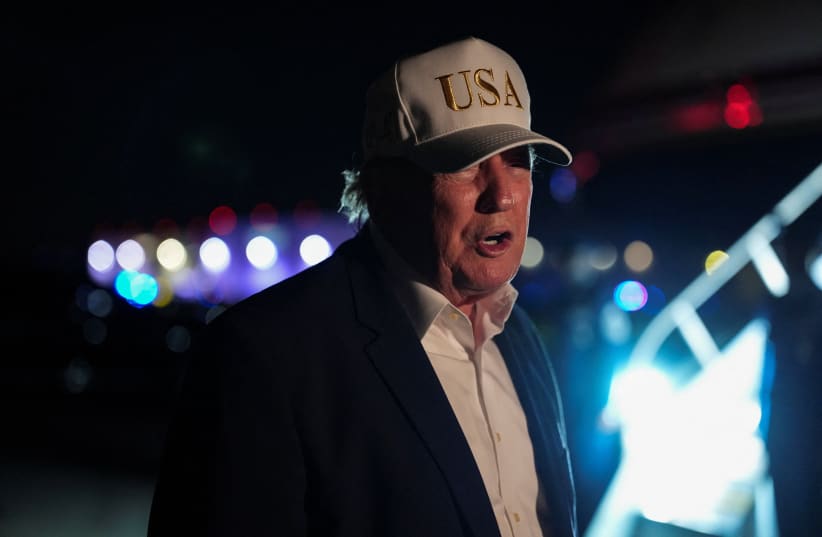
US President Donald Trump weighed in on Israel’s post-election political battle on Sunday, describing Gadi Eisenkot and Prime Minister Benjamin Netanyahu as having “very similar views” and suggesting that either leader would strongly support his policies.
Speaking to reporters, Trump was asked about Eisenkot being tasked with forming Israel’s next government, following the October 27 election in which Netanyahu’s governing bloc failed to secure a parliamentary majority.
“Well, you know they’re both fighting for that. They’re very similar in terms of their policy and their view,” Trump said.
“And I guess he said very nice things about me. He says he loves Trump, but I don’t know. I haven’t seen what’s happening,” the president added, referring to Eisenkot.
“But it’s certainly a contest between him and Bibi Netanyahu. We’ll see what happens. They have very similar views. They’re both strong on what I do.”
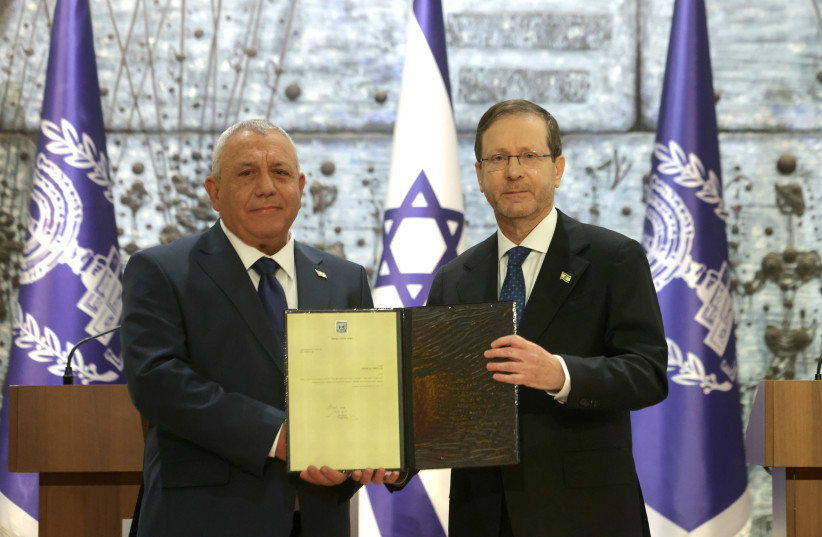
Trump’s comments came as President Isaac Herzog formally tasked Eisenkot, chairman of the Yashar party and a former IDF chief of staff, with forming Israel’s next government. Eisenkot received recommendations from factions representing 67 Knesset members, compared with 46 who recommended Netanyahu.
The former military chief now has 28 days to assemble a coalition, with a possible extension of 14 additional days.
Trump’s description of the two Israeli rivals as politically similar is particularly noteworthy given his previous endorsement of Netanyahu ahead of the election. Despite that endorsement, Trump stopped short on Sunday of expressing a preference over which of the two should ultimately lead Israel.
Trump on Iran: ‘We won that war. It’s just a question of closing it out’
The president also delivered an extensive defense of his military campaign against Iran, repeatedly insisting that the United States had already achieved victory and prevented Tehran from acquiring nuclear weapons.
“We won in Iran. We won that in Iran. It’s just a question of closing it out now or later,” Trump said.
“We may wait. Some of their neighbors would prefer that we just keep it the way it is.”
Trump argued that the US military campaign had destroyed Iran’s nuclear capabilities and prevented what he described as an existential threat to Israel and the broader Middle East.
“We hit them with the B-2 bombers,” he said, referring to the American strategic bombers used in strikes against Iranian nuclear facilities.
“We knocked out their nuclear capacity and probably saved Israel and probably saved the Middle East. I believe we saved the Middle East and Israel combined.”
He went even further, claiming that the region would not have survived had Iran obtained nuclear weapons.
“If they would have had it, there would be no Israel right now. There would be no Middle East.”
Trump again criticized the 2015 nuclear agreement negotiated under former President Barack Obama, describing it as a path toward an Iranian nuclear weapon.
His claims that Iran’s nuclear capabilities had been eliminated were not accompanied by new independent assessments of the country’s remaining nuclear infrastructure or material.
‘We’re choking Iran off’: Trump describes expanded blockade
Trump also discussed the newly announced US effort to restrict Iranian supply routes by land, describing the campaign as a central element of his strategy to force Tehran into an agreement.
“We’re trying to end the war in Iran, and we’re doing well because you know all we have to do? We’re choking it off,” Trump said.
“We have Operation Iron Gate that just went into effect. That means nothing comes in by land, and as you know, the naval blockade, nothing comes in by water, so we have it very well blocked off.”
US Central Command announced on Saturday that Adm. Brad Cooper had ordered the formation of Task Force Iron Gate, a roughly 20-person military and civilian team based in Tampa, Florida.
According to CENTCOM, the task force will coordinate with other US government agencies to prevent the movement of advanced weapons, dual-use technologies, sanctioned materials and illicit funds across Iran’s land borders and the Caspian Sea.
The initiative expands American efforts to restrict Iranian supply routes, although CENTCOM described it as an interagency coordination mechanism rather than a comprehensive physical blockade of every Iranian land crossing.
Trump claimed that the combined pressure of military strikes, economic sanctions and restrictions on Iranian trade had placed Tehran in an increasingly desperate financial position.
“They’re not paying their soldiers. They’re not paying their guard. They have 301 percent inflation. They have no money, and they’re not doing well,” he said.
“And at some point, they’re going to be reasonable.”
The president did not provide supporting data for his inflation estimate or his claims about unpaid Iranian military personnel.
Trump threatens bridges and power plants, but says he wants to avoid destruction
Despite emphasizing the pressure of the blockade, Trump warned that he could order a much more destructive military campaign if negotiations failed.
“Now, I could go in and blow them up right now,” he said.
“The problem with that is you’ll never be able to rebuild it. If I blow up the bridges and the power plants, the thing that takes the hardest to rebuild are the big bridges.”
Trump described Iran’s mountainous terrain and the importance of bridges connecting different parts of the country.
“It would take them years. It would take them 10, 12, 15 years to rebuild,” he said.
He also identified power plants as particularly difficult infrastructure to replace.
“That puts an awfully big burden on the people. I don’t like that.”
The comments echoed Trump’s earlier statements to CNN, in which he said the US military had identified dozens of Iranian bridges that could be destroyed rapidly if he ordered renewed operations.
On Sunday, however, he emphasized that he would prefer to avoid inflicting such damage, describing the economic pressure campaign as a possible alternative to further large-scale attacks.
‘We have not seen it’: Trump addresses concerns over Iranian nuclear materials
Asked about the US government’s efforts to obtain intelligence on the movement of Iranian nuclear materials, Trump said Washington had not observed such activity.
“If they are, we want to know about it, and we’ll take them out. But we have not, we have not seen it,” he said.
The president pointed to American surveillance capabilities and specifically mentioned Pickaxe Mountain, a fortified site associated with Iran’s nuclear program.
“We know exactly what’s going on with Pickaxe Mountain, as an example,” Trump said.
“We never hit Pickaxe because there was no activity there. But we could do that in five minutes if we needed to.”
His remarks followed a new US government reward offer of up to $20 million for information about Iran’s nuclear program, including facilities, equipment, personnel and the movement of related materials.
The president’s statements do not independently establish whether Iran has moved nuclear material or whether all potential nuclear sites remain under effective American surveillance.
Trump defends Hegseth against impeachment efforts
The president also strongly defended Defense Secretary Pete Hegseth amid renewed efforts by lawmakers to pursue impeachment proceedings over the Iran war.
Asked about Democratic threats to impeach Hegseth and Health Secretary Robert F. Kennedy Jr., Trump described both as highly capable officials.
“These are two very fine people,” he said.
Trump credited Hegseth with helping oversee what he characterized as successful military campaigns in Venezuela and Iran, arguing that the defense secretary was being targeted despite those accomplishments.
“Pete Hegseth, so he wins two wars,” Trump said.
Referring to Iran, he added: “We knocked out their nuclear capacity and probably saved Israel and probably saved the Middle East.”
He questioned the logic of seeking to impeach a defense secretary whom he believes played a major role in eliminating Iran’s nuclear threat.
“What are we going to do with one of the guys that was most responsible? They want to impeach him.”
Trump also compared the military campaigns with previous US wars, including Vietnam, Iraq and Afghanistan, arguing that American casualties had been far lower under his leadership.
He said that 18 American service members had died across the conflicts he cited, while claiming that no troops had been lost in recent months.
The president’s claims about military achievements and casualties were not independently verified in the exchange.
Trump on Vance’s Iran criticism: ‘He was right, but I’d do it again’
In one of the most politically significant exchanges, Trump was asked whether Vice President JD Vance’s recent criticism of the Iran war had damaged their relationship.
“Not at all,” Trump replied.
“But a lot of people didn’t like his comments. But not me. He was right.”
The president nevertheless said Vance should have included a crucial qualification in his public assessment of the war.
“He should have made one other statement. One statement that I think is very important. If you had it to do again, would you do it again? The answer is yes.”
Trump then offered an emphatic defense of his decision to attack Iran.
“I can tell you, if I had it to do again, this historically, for history, will go down as one of the best things we ever did,” he said.
“Because if they ever had a nuclear weapon, they would blow up the world. You know why? Because they’re crazy.”
Vance had blamed the Iran war for the Republican Party’s sweeping defeat in last week’s midterm elections, arguing that many voters who supported Trump in 2024 had turned against the administration because of the conflict and its economic consequences.
Trump’s response suggested that, while he accepted Vance’s assessment of the political damage, he remained unwilling to express regret over the military campaign.
Possible meeting with Putin and Xi on nuclear disarmament
Trump also said that his upcoming trip to China could include a three-way meeting with Russian President Vladimir Putin and Chinese President Xi Jinping.
“One of the meetings I think will be with President Putin and President Xi, and that’ll be interesting,” he told reporters.
“We’ll talk a lot of things, including denuclearization.”
The proposed summit remains under discussion, with no final announcement confirming that all three leaders will meet.
For Trump, the possible talks would take place against the backdrop of the continuing confrontation with Iran and his broader ambition to negotiate agreements on nuclear weapons with the world’s other major powers.
Yet his remarks on Sunday underscored the limits of his willingness to compromise with Tehran: while insisting that he wants to end the war, the president continued to present the elimination of Iran’s nuclear weapons capability as a nonnegotiable objective, backed by the threat of renewed American military action.
KioskNews shows a cleaned-up reading view extracted from the publisher’s page — the original always lives on their site, not ours.