A casualty of war: Israel's breathtaking historical site remains out of reach after October 7
It’s one of the most stunning views in the Judean Desert, and maybe in all of the Middle East.
Over the Green Line from Jerusalem, on Road 1 heading toward the Dead Sea, a brown official Tourism Ministry sign beckons with “Wadi Kelt/St. George’s Monastery,” just before the left turn to enter the settlement of Mitzpe Jericho, about six km. east of Ma’aleh Adumim.
Instead of making a right past the checkpoint to enter the settlement, another Tourism Ministry sign directs drivers to the left in the direction of Wadi Kelt, past a number of community structures, including a farm and a brand new country club and outdoor pool, all in Area C of the West Bank (fully under Israeli military and civil control).
The road winds around from west to east for three kilometers until you arrive at a parking area across from an imposing stone archway topped by a cross.
A combination of a hustler’s shuk, a livestock display and a solemn religious trek – done up Middle Eastern style – the parking area outside St. George’s Monastery felt like a Tower of Babel collision of worlds.

Amid buses and minivans filled with tourists and pilgrims parked willy-nilly, Bedouin vendors like Ibrahim, a father of seven, aggressively hawked everything from beaded trinkets to freshly squeezed pomegranate juice (and probably some other things you might have to ask for in hushed tones).
Desert cowboys offer to lead visitors for about NIS 100 (haggling encouraged) down the steep 500 m. decline to the monastery grounds via well-worn donkeys, who were clearly less inclined and motivated than their handlers to make the draining journey.
For those who prefer not to descend to the monastery, there was another much more maneuverable horizontal path winding around the rocky enclave toward a panoramic expanse of the Judean desert overlooking Wadi Kelt.
Across the gorge is the stunning view – a fortress-like series of structures built into the severe rock formations of the Judean Desert, St. George’s Monastery – 4 km. from Jericho along Wadi Kelt – a world-class wonder that has attracted untold visitors, both Jewish and gentile, since Israel took control of the area after the 1967 Six Day War.
It’s the highlight of many tourists’ visit to Israel, according to Jerusalem-based tour guide Hannah Rosenberg. “It’s a magical place. Whenever I would bring a group of tourists to the Dead Sea or Masada, on the way back to Jerusalem, we’d take an unannounced detour and turn off to the lookout,” she said.
“They’d say ‘where are we going? I thought we were going back to Jerusalem.’ And I told them, ‘I have a little surprise.’
“I’d tell them, just walk for one minute and you’ll see what the big deal is. They were always stunned and fascinated. It was the ‘wow’ factor that they would always remember.”
Rosenberg was talking in the past tense because, for the last three years, ever since Oct. 7, the road leading to St. George’s Monastery has been blocked by a Gaza-worthy labyrinth of electronic-arm barriers, codes, and blockages – some erected by Mitzpe Jericho, some by the army.
Whether due to bona fide security concerns about visiting the site, which is also in Area C, or because the residents of Mitzpe Jericho no longer will tolerate an influx of tour buses and unsupervised (Palestinian) motorists driving past their settlement expansion to the west, the upshot is that one of the truly wondrous and breathtaking tourism sites in all of Israel has become inaccessible.
And nobody – from the Mitzpe Jericho residents, to the IDF, to the Tourism Ministry, to the ailing tour guide professionals – seems to be bothered by it.
ST. GEORGE’S Monastery was established in the 5th century by the Egyptian monk John of Thebes (St. John of Choziba), together with five Syrian hermits who were living in caves overlooking Wadi Kelt. The monastery is named after its most famous monk, St. George of Choziba, who lived in the 6th century.
At the time, it was common for monks to abandon worldly distractions and travel into the Judean Desert, where they would live in isolation in the caves of Wadi Kelt. In fact, the word “monastery” comes from the Greek, meaning “dwell alone.”
According to the site Historical Sites in Israel, in 1878, more than a thousand years after the destruction of the monastery by the Persians in 614 CE, a Greek monk devoted himself to restoring the monastery, which was completed in 1901. Later, in the 1950s, a bell tower was added.
The monastery’s location in Wadi Kelt makes it an attractive destination not only for hikers and tourists but also for its religious significance. It is thought to be the Biblical Valley of the Shadow, and it lies parallel to the old Roman road to Jericho, where the parable of the Good Samaritan was set.
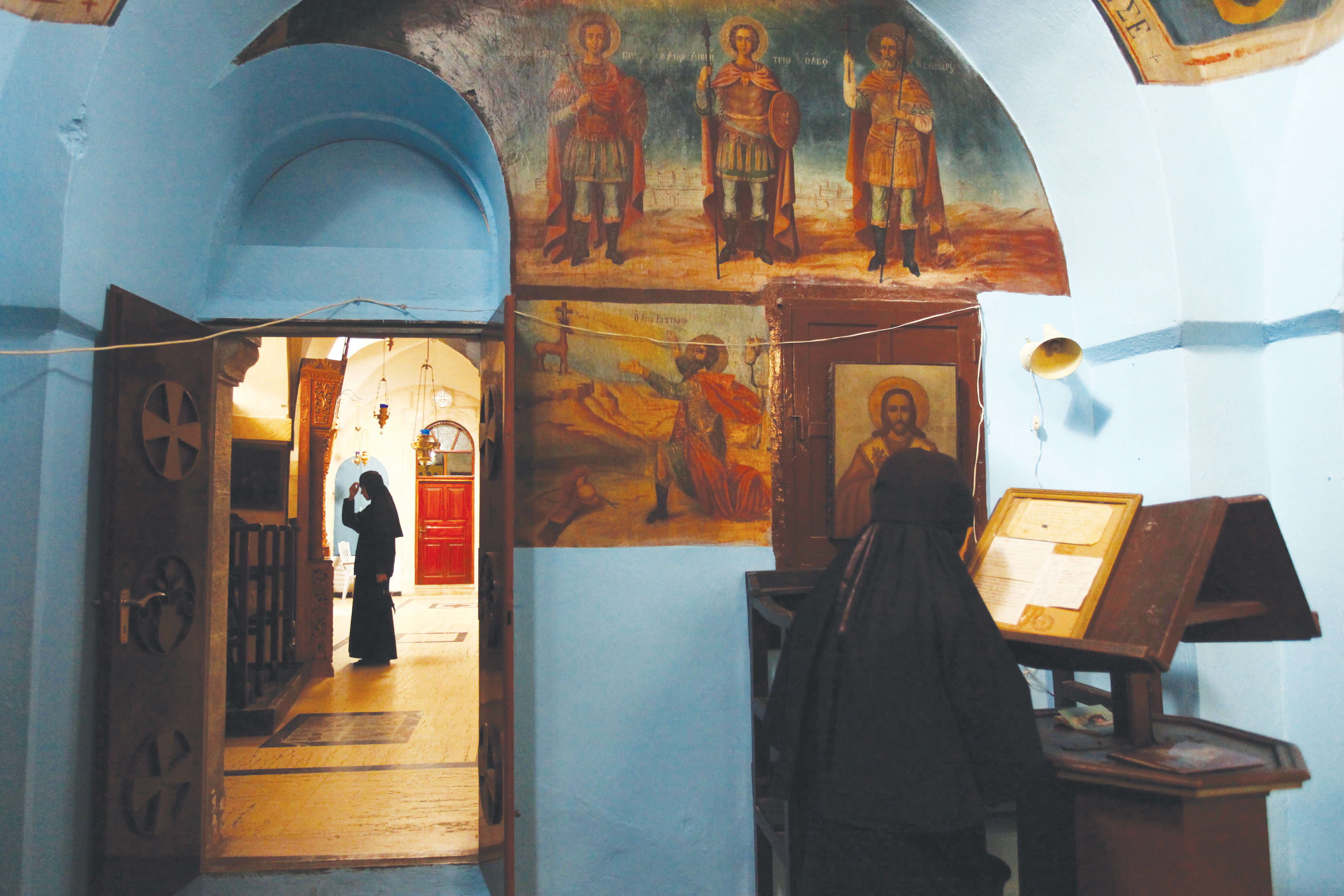
The monastery complex was built on a long, narrow rock ledge on the northern bank of the wadi. Today, the monastery is divided into three main levels: the upper level, where an ancient cave is located. The middle level, where most of the residential buildings, churches, and the bell tower are located. The lower level, built of arches and containing the monastery’s storerooms and monks’ graves. There are also hermitages in the cliffs where the monks are secluded.
The churches are rich with religious paintings, icons, and mosaics. There are also reputed to be the bones of the monks massacred by the Persians in 614 CE. The crypt also holds the remains of the original five Syrian hermits who established the monastery with John of Thebes.
Estimates are that today there are between five and 10 monks living at the monastery. In 2001, during the Second Intifada, Father Georgios Tsibouktzakis (also known as Father Germanos), a Greek Orthodox monk and abbot at St. George’s, was shot and killed by a Palestinian terrorist in a drive-by shooting on the Jerusalem-Ma’aleh Adumim road. He was the only terror fatality on that road during the entire uprising.
Walking around the grounds is enchanting and other-worldly, like one was transported to the 14th-century set of The Name of the Rose. There’s barely an indication of any nods to modernity.
During an open house visit to the monastery six years ago, a monk explained to this reporter over a cup of tea that most of his brethren were Greek and Romanian. They lived under a rotation method that swapped them out of the isolated Spartan lifestyle every six months.
When asked where they procured supplies for the rugged location, he put down his teacup and matter-of-factly said, “Rami Levy.”
He said that the monks enjoyed the visits from the public, but also cherished their silence and isolation at the cliffside monastery. However, in recent years, those visits have shriveled to zero, and the isolation has increased.
The monastery is open to the public daily, except Sundays
TODAY, THE monastery is generally open to the public daily, from 9 a.m. to 1 p.m., except on Sundays. Entrance is free, and modest clothing is mandatory – no shorts for men, and women must cover their legs and shoulders.
However, attempts to get to the monastery and lookout are an exercise in futility and one – literally and figuratively – filled with potholes.
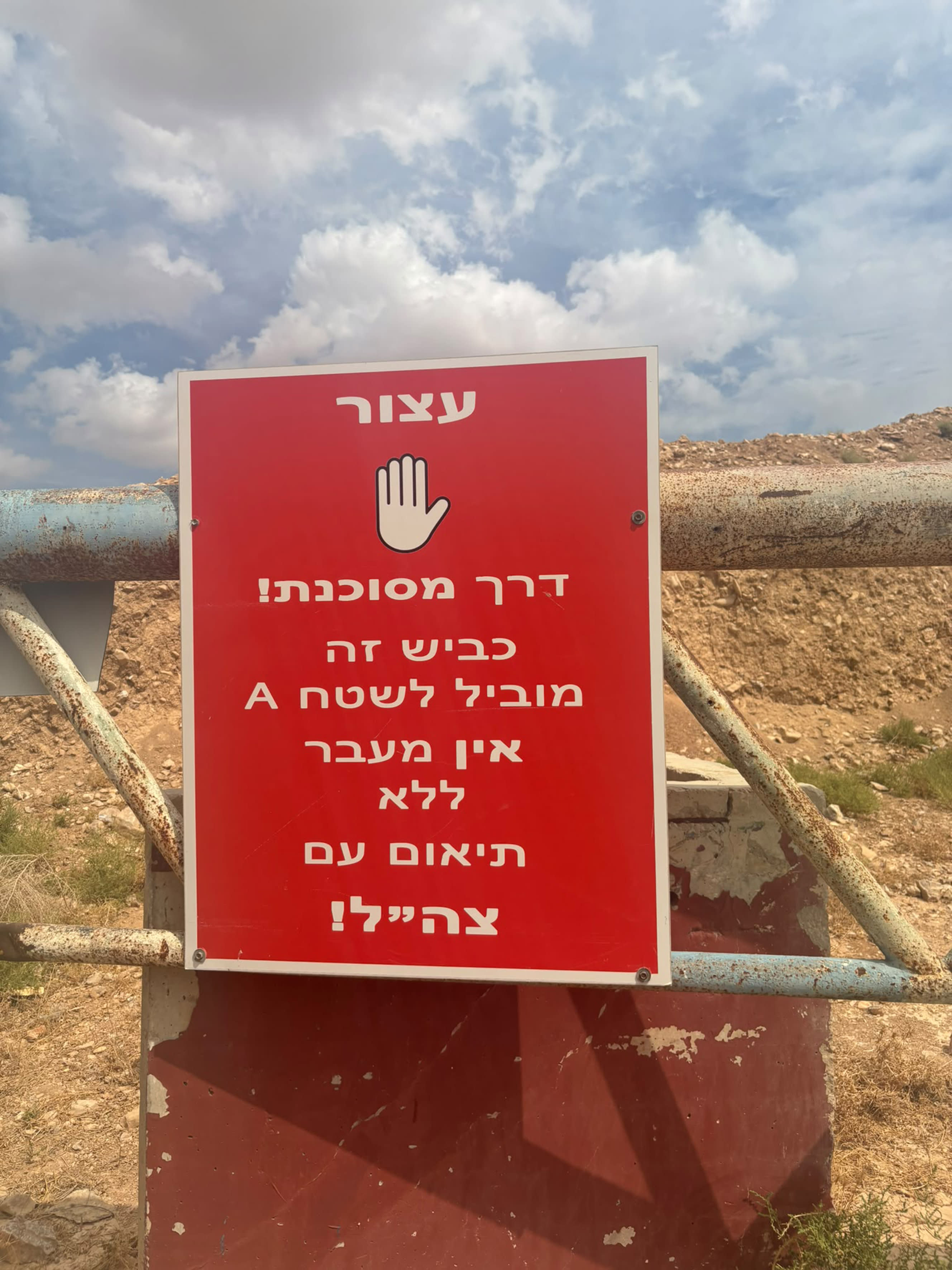
One roadblock directs you to a phone number that then directs you to a rocky dirt road some 5 km. away. There, you can drive the treacherous route for 20 minutes to circumvent the roadblock, only to be met with another electronic arm and a sign saying “This road is dangerous. It leads to Area A. No entrance without coordination of the IDF.”
In an attempt to learn who is responsible for the electronic roadblocks and the less-than-user-friendly alternate route that leads to a dead end, The Jerusalem Post reached out to Mitzpe Jericho, the IDF, the Tourism Ministry, and local residents.
In response to an email query from the Post about the electronic arms inside the settlement, Mitzpe Jericho’s local council head Aliza Pilichowski wrote: ”I don’t feel comfortable in my role as mayor talking to the press. I also have not set up anyone else to talk to the press.” Talk about a dead end.
A Mitzpe Jericho security official told the Post that the electronic arm was a necessity to prevent possible terror attacks on the road, which has been built up by the settlement in recent years. Open access by Palestinians driving past settlement businesses, farms, and the country club increases the likelihood of attack, he said.
Tour guide and Mitzpe Jericho resident Mordechai Weiss said that immediately after the Hamas-led massacres in Israel on Oct. 7, and in the subsequent month, there was a permanent IDF position where the electronic arm is now.
“It’s the way things have evolved leading to today’s barriers. It’s part of a whole new mindset,” said Weiss, who made aliyah from the US in 2003.
He explained that the monastery road had been the original road for travelers driving between Jerusalem and Jericho before Road 1 was built – for Palestinians and Israelis alike.
“At certain times before Oct. 7, there were mounds of dirt at the end of the monastery parking area preventing drivers from continuing into Jericho [and Area A, under the Palestinian Authority’s control], but other times there weren’t. It always depended on the security situation,” he said.
Ironically, with the road being closed to vehicles to get to the monastery, there’s no prohibition or barriers preventing hikers from trekking the 3 km. to the site via Wadi Kelt, provided they can reach the entrance either by walking from Mitzpe Jericho or taking the arduous Good Samaritan bypass road.
Wadi Kelt, which connects west to Ein Maboa below Alon and Ein Prat near Anatot, has long been a prime hiking destination, with lush growth and plenty of water holes.
However, its appeal was permanently marred in 1993, shortly after the onset of the Oslo Accords, when Palestinian terrorists shot and stabbed to death two Israeli hikers, Dror Forer and Aran Bachar. The echoes of the brutal murders have continued to resonate in the canyon and beyond ever since.
“Security has always been an issue in the area. When I moved to Mitzpe Jericho in 2003, there were still horror stories about the terror attack that happened 10 years before,” said Weiss. “But that never prevented people from hiking or going to St. George’s. That all changed since Oct. 7.”
A military representative familiar with the area dismissed the difficulties in reaching the area.
“Of course there’s free access to everyone; it’s a tourist site, and the army won’t prevent people from going to a tourist site,” he said. “There is the issue of the gates along the way, but those can always be opened with the proper coordination.”
According to tour guide Rosenberg, who is often in touch with the army when entering sensitive areas around the country, it’s not that easy post-Oct. 7.
“I’ve tried gaining access to the site following all the protocols, yet have never been able to reach the right number to coordinate a trip,” she said.
Even a reporter from The Jerusalem Post, with the paper’s military correspondent assisting with contacts deep inside the IDF, had to make numerous queries via various military bodies to reach a number to coordinate a visit.
When asked why the electronic arm had been erected along with the red warning sign at the entrance to the monastery road, the IDF Spokesman’s Office erroneously said that the monastery was in Area A, and then clarified that even if a location is in Area C but leads to Area A, visits must be coordinated with the IDF – an idiosyncratic change in policy since Oct. 7.
A spokesperson for the Tourism Ministry said the ministry doesn’t get involved with locations deemed as security risks by the military.
When asked why the prominent signage was still on the road directing drivers to the inaccessible area three years after it was closed, the spokesman said that plans were underway to cover them up.
Weiss downplayed the lack of access to St. George’s, saying that because of the drastic drop in tourism since Oct. 7, it hasn’t really been an issue.
“If there were a return to somewhat good old days and the demand returned, I assume there would be efforts to reopen it or for tour guides to find a way to get clearance. But I understand and appreciate the security risks,” said Weiss.
“The reality is that today, local tourists who come to the area now go to Café Al HaKatze on the edge of the desert in Mitzpe Jericho. You can’t see the monastery from there, but it’s an amazing view.”
IDF opens up travel with advance coordination
DURING HOL HAMOED Sukkot last month, the IDF, with a huge presence every couple hundred meters, opened up the roads and arms to organized groups – allowing groups who coordinated in advance to travel on the road to St. Georges and, then continuing to the outskirts of Jericho – still considered Area C and home to an impressive archaeological site, the Hasmonean Palaces, and the final palace built by King Herod.
Stopping at the monastery lookout, the vendors and the donkeys are gone, but the site remains pristine. And the view is as breathtaking as ever.
It seems that nobody is invested in changing the post-Oct. 7 status quo of keeping the road closed and denying everyone access to the exquisite location.
Are the security risks still there? Does it not suit Mitzpe Jericho’s interests to be a conduit to the site? Will the Tourism Ministry ever cover up or remove the misleading signage?
If there were a desire or a demand to reopen the road to the monastery, it seems like it could be done. Keeping it inaccessible doesn’t make any sense, according to Yisca Harani, a scholar of Christianity, tour guide, and lecturer, who has brought countless pilgrims to the site in the past.
“It is totally unacceptable,” she said, adding that the site is one of the most breathtaking and significant in all of Israel.
Keeping it behind gates exposes a certain inconsistency in the policy. Even as the road heading toward the lookout and the monastery is barricaded, the hiking path down below in Wadi Kelt is open.
If, as the red sign at the gate to the road entrance claims, the road is a security risk because it leads to Area A and Jericho, then erect an official barrier at the far end of the monastery parking area that prevents that passage. It would ostensibly take away the risk and block the contiguity between the monastery and Jericho.
But in the delicate disputed areas of the West Bank, and the power struggle chess match continually taking place between settlements, the IDF, the PA, and the Bedouin, change is painstaking.
St. George’s Monastery is a microcosm of that overlapping alphabet soup reality where security, tourism, settlements, and land intersect.
It’s a complex and historic area where the army is confused between Areas A and C; where a world-class tourism site is hidden behind barriers that serve the interests of real or perceived security needs and the natural growth of settlement communities; and where those tasked with the challenge of rebranding Israel as a tourist destination in some far-off, hoped-for era of stability don’t realize that there’s a treasure right in front of them that has become impossible to visit.■
KioskNews shows a cleaned-up reading view extracted from the publisher’s page — the original always lives on their site, not ours.