The missing ‘peace’ in Israel’s election campaign
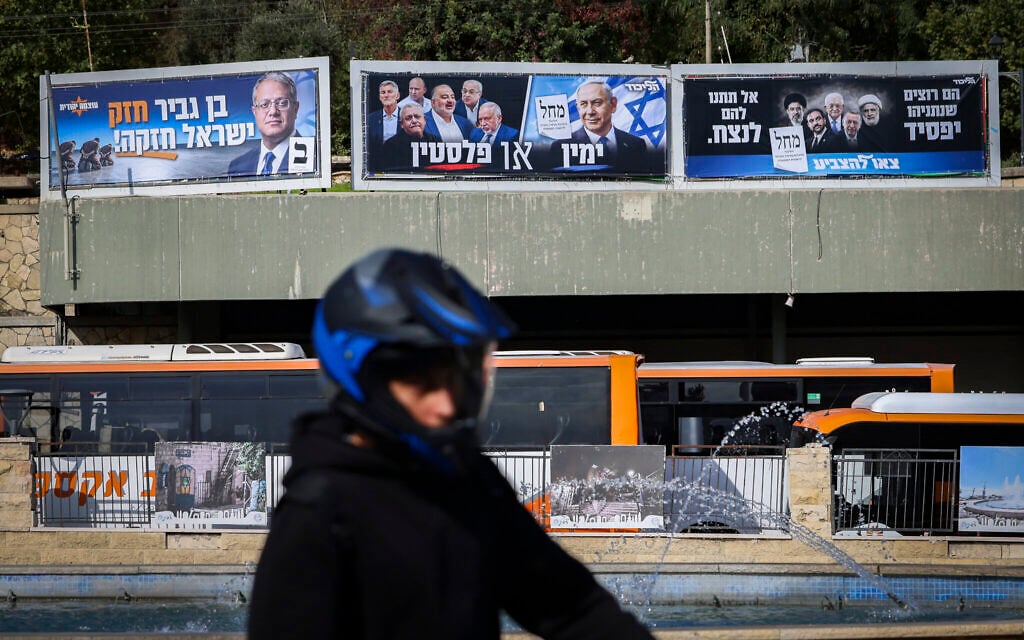
JTA – There’s a short video clip that’s been circulating on Israeli social media channels in recent days showing a massive crowd of jubilant young Israelis at a music festival singing along on repeat to “The Song of Peace.”
The scene, using an anthem forever associated with assassinated prime minister Yitzhak Rabin and the peace momentum that surrounded him in the 1990s, feels ironic today. As Israelis prepare to vote on October 27, peace – the idea at the heart of the song and that was once at the heart of the political debate in Israel – is strikingly absent this time around.
More than three years of war have reshaped the country, but few candidates are offering a vision for relations with the Palestinians, let alone a path toward resolving the conflict.
0:00 / 0:00
Promoted: JPPI, Rabbi Sharon Brous

Meanwhile, rising settler violence in the West Bank and mounting international pressure to resolve the decades-old intractable conflict with a two-state solution are making the costs of that political silence increasingly difficult to ignore.
“Objectively, this is just not the main issue in this election,” Prof. Gideon Rahat, a political scientist at Hebrew University of Jerusalem, told the Jewish Telegraphic Agency in a recent interview.
Get The Times of Israel's Daily Edition by email and never miss our top stories
By signing up, you agree to the terms
In contrast to the years leading up to Rabin’s assassination in 1995 – and even those that followed – the divisions in this election have little to do with the question of peace with the Palestinians.
Rather, said Rahat, they are more about the fundamentals, the future character of the state and security. For the past four years, the government under Prime Minister Benjamin Netanyahu has sought to overhaul the judiciary, while a burgeoning ultra-Orthodox population has avoided compulsory military service even though Israel has been fighting a relentless war on seven fronts.

And while there has been an attempt by Netanyahu’s ruling Likud party to frame the debate as one between right wing and left wing, pro- and anti-Palestinian statehood, Rahat said this was misleading.
Most of the parties making up the opposition – those seeking to oust Netanyahu and the current government – are a mix of center-right and right-wing parties. Only one Jewish party in the bloc, the Democrats, appears open to addressing the Palestinian issue.
Rahat pointed out that Hamas’s attack on Israeli civilian communities in southern Israel and at a music festival had served to harden even those who previously thought a peaceful solution with the Palestinians might be possible.
Surveys published in recent years had already shown that support for a Palestinian state, or even a process to reach some kind of solution, had been steadily decreasing even before October 7.
According to Tel Aviv University’s Peace Index, which has published regular data on Israeli attitudes toward peace with the Palestinians since the first Oslo Accords were signed in September 1993, in July this year only 29% of the Jewish public in Israel now supports any form of negotiations with the Palestinian Authority, the Palestinian leadership governing the Palestinians in the West Bank.
Broken down into right-wing vs. left-wing voters, the divisions on the issue of the peace process still appear to be sharp, with only 7 percent of those who identify as right-wing saying they support negotiations, compared to 83% of those on the left. Yet this is somewhat misleading, as overall, the percentage of people who identify with views traditionally associated with Israel’s peace camp and the left has been steadily shrinking.
Following a historic low turnout for the two traditional left-wing parties, Labor and Meretz, during the last election in 2022, the two factions joined forces to form The Democrats, now headed by former IDF general Yair Golan. And while the Democrats believe in pursuing separation from the Palestinians through a diplomatic and regional process, Golan has refrained from talking about the position throughout the election campaign.
Additionally, former prime minister Yair Lapid, who heads the center-left Yesh Atid Party and has stated in the past that he supports a two-state solution for Israelis and Palestinians, has cooled on the idea.
He has teamed up with former prime minister Naftali Bennett, who is emphatically against the concept of two states side by side, and is saying that the Hamas attack had postponed the possibility of Palestinian statehood at least for now.
“I don’t think the idea is dead. I think it will be delayed significantly because we need to find ways to secure the safety of our people,” Lapid reportedly said in an interview to a London-based Saudi Arabian newspaper in December 2023.
On the issue of settlements in the West Bank, recent surveys show that the majority of Jewish Israelis support the concept. A poll published by the Israel Democracy Institute this month shows that around 55% of Jewish Israelis support the policies of various governments to allow, and even encourage, the establishment of settlements. Only 32% think that settlement expansion was not correct, the research found.
While the question of peace with the Palestinians — and the possibility of a nation-state for them in Gaza or the West Bank, which many Israelis refer to by its biblical name of Judea and Samaria — is not being discussed on the political level, violent events in that contested area are becoming increasingly hard to ignore.

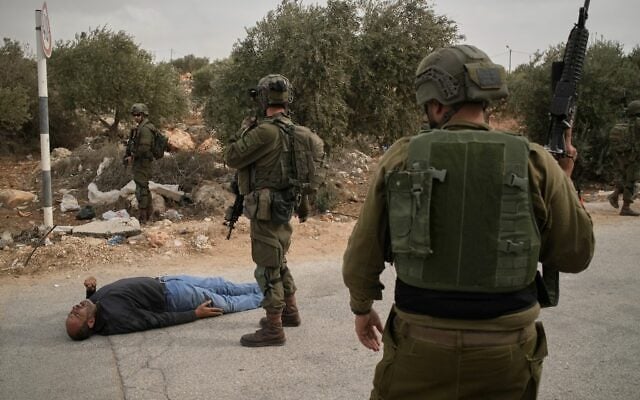
On Friday, Heidi Levine, a photojournalist with The Washington Post, was brutally attacked by masked settlers, as shown in video footage. And on Saturday, a group of European diplomats said they were similarly attacked. Both incidents took place as Palestinian farmers harvested their olive crop.
An influential rabbi associated with far-right National Security Minister Itamar Ben Gvir had issued an edict that Jews were permitted to attack Palestinians and take their olives to “demonstrate our ownership of the land.”
Palestinians, Rabbi Dov Lior, the former chief rabbi of Kiryat Arba, wrote in a decree, had “stolen land in their hands,” and really it belongs to Jews.
The phenomenon of extremist Israeli settlers attacking Palestinians is not new, but, according to human rights organizations and the United Nations, it has increased in frequency since October 7, 2023. Ben Gvir, who oversees the Israel Police, has struggled, along with the military, to maintain law and order.
The violence has resulted in multiple Palestinian deaths. Several governments imposed sanctions on individuals and organizations linked to settler violence. Netanyahu continues to insist that it is only a handful of disorderly youths who are responsible for the disorder.
The increasing violence has drawn condemnation from Netanyahu’s rivals and even some who support him.
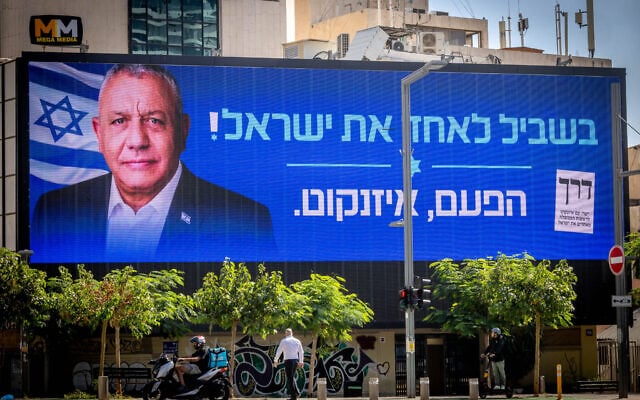
Gadi Eisenkot, the former military chief, whose party Yashar leads the opposition bloc, described the attacks, in a post on X, as “Jewish terrorism, under the auspices of the Israeli government.”
He said it was “burning away the little legitimacy the State of Israel still possesses.”
Avigdor Liberman, a former defense minister under Netanyahu who is now running as part of the opposition bloc, also criticized the violence, saying it was “wiping out Israel’s last bastions of support in the United States and around the world.”
“Bibi is putting out statements in English, but the defense minister and the national security minister are doing nothing to stop this madness,” Liberman wrote on X, referring to Netanyahu by his nickname.
“In the end, the damage is first and foremost to the State of Israel and the settlement enterprise. This just proves that Bibi doesn’t care about the country — he only cares about staying in power,” he wrote.
Israeli journalist Amit Segal, known for being pro-Netanyahu, wrote on X that the violence had caused great damage to Israel’s standing among its greatest friends.

Ilana Shpaizman, a senior lecturer in the department of political studies at Bar-Ilan University, said that the flare-up in violence was putting the Palestinian issue back in the spotlight in Israel and beyond.
“For many years or even decades, Israeli policy in the West Bank was carried out quietly… It wasn’t like people didn’t know what was going on, but they tried to promote it as quietly as possible to maintain legitimacy to the settlement project,” she said, adding, “When we look at what has happened over the last couple of days, not only has the international community condemned it, but also Israeli politicians.”
“People are starting to realize that this government’s support in the West Bank has become very dangerous,” Shpaizman said.
It’s not just Netanyahu, she said – the government that was in office between 2021 and 2022 also failed to address the Palestinian issue.
Shpaizman said that Netanyahu was known for being indecisive and reluctant to address the Palestinian issue, and Bennett and Lapid’s slogan was about addressing the only issues that could be solved and leaving the tougher question of peace with the Palestinians to a later time when other, domestic rifts were resolved.
But, she said, the Palestinian issue is the most explosive issue and one that “cannot be ignored for a long period of time.”
Rahat said the rising tensions in the West Bank and the increasing international pressure, which will likely keep growing if Netanyahu’s government retains power, could end up forcing a solution, or at least putting the Palestinian issue back on the agenda.
KioskNews shows a cleaned-up reading view extracted from the publisher’s page — the original always lives on their site, not ours.