MOE to explore smaller classes where needed for more students in pilot with six schools
SINGAPORE - More students could benefit from smaller class sizes, as part of a pilot to improve teaching and learning, starting with six schools from January 2027.
Education Minister Desmond Lee said on Sept 16 that smaller classes could allow teachers to give students closer attention and more timely feedback.
But it must be part of a broader redesign of teaching and learning, including reviewing teachers’ other duties and using technology to support their work, he said, addressing about 1,900 school leaders and teachers at the Schools Work Plan Seminar held at the Singapore EXPO.
The pilot schools are St Anthony’s Canossian, Woodgrove and Zhangde primary schools, and Commonwealth, Deyi and Jurongville secondary schools.
“This is a complex pilot, so we will proceed carefully. We will keep schools updated and share what we learn, before considering how these approaches can be applied more widely,” said Lee.
MOE will assess whether the changes improve learning and enable teachers to teach and nurture students more sustainably, he said.
Lee noted that smaller classes do not necessarily mean less work. Teachers may have to take on more teaching, as they do in some other countries, he said.
“Nor can we simply hire many more teachers alone as a strategy. Our workforce is limited, and even if we were to hire more teachers, it must be done in a sustainable manner, without compromising quality,” he said.
“If teachers need to teach more classes, then we must create the capacity and conditions for them to do so,” he added.
Reviewing teachers’ duties would help them devote more time to teaching, but this must be complemented by tools such as technology, he said.
To simplify teachers’ daily work, MOE will roll out an online platform Teacher Workspace to all MOE schools by 2027, following a pilot in around 20 schools.
The platform brings together student information, tools and daily work processes through a single login, reducing the need to navigate different systems. It will help teachers build a fuller picture of each student, coordinate support and communicate with parents and partners.
More functions will be introduced progressively. These include using AI to bring together relevant student information and generate first drafts of commonly used administrative reports.
AI is already helping teachers plan lessons and understand students’ learning, Lee said.
At Bukit Panjang Primary School, science teachers previously spent considerable time analysing pupils’ written responses for patterns and misconceptions. The AI-enabled Data Assistant in the Student Learning Space can now help identify common gaps and strengths almost instantaneously, he said.
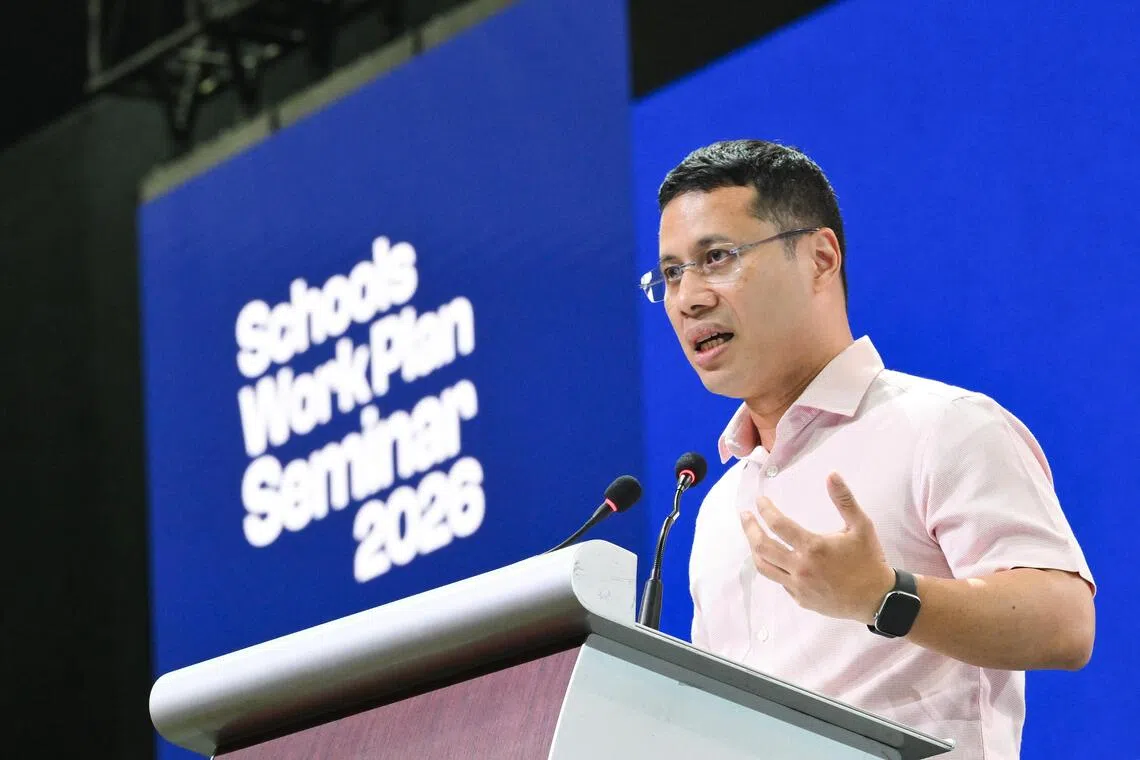
Education Minister Desmond Lee speaking at the Schools Work Plan Seminar on Sept 16.
ST PHOTO: LIM YAOHUI
On class sizes, Lee said MOE would explore where smaller groups can best support teaching approaches that involve students investigating problems and learning together.
The question, he said, is not just what the ideal class size is, but what learning schools want to enable and what environment best supports it.
This builds on its existing approach of providing smaller classes according to students’ needs.
Primary 1 and 2 form classes have been kept at around 30 pupils since 2006 to give children closer attention as they move from pre-school to primary school.
Learning Support Programme classes have about eight to 10 students, while the typical class size at Crest and Spectra secondary schools is 20.
Under Full Subject-Based Banding, secondary subject class sizes can also vary according to students’ learning needs and the nature of the subject.
“We have observed positive experiences on the ground,” Lee said, adding that smaller classes allow teachers to cater to individual learning needs and engage students.
One of the six pilot schools, Woodgrove Primary, will explore having smaller classes aligned with pupils’ learning needs. This will create more avenues for teachers to try innovative teaching methods, provide targeted support, and equip pupils with a broader range of competencies, such as critical thinking and social-emotional skills.
For instance, the school has been redesigning its curriculum to stretch pupils with academic strengths and talents.
KioskNews shows a cleaned-up reading view extracted from the publisher’s page — the original always lives on their site, not ours.