‘China shock 3.0’ to be driven by AI, biotech and robot exports, economist says
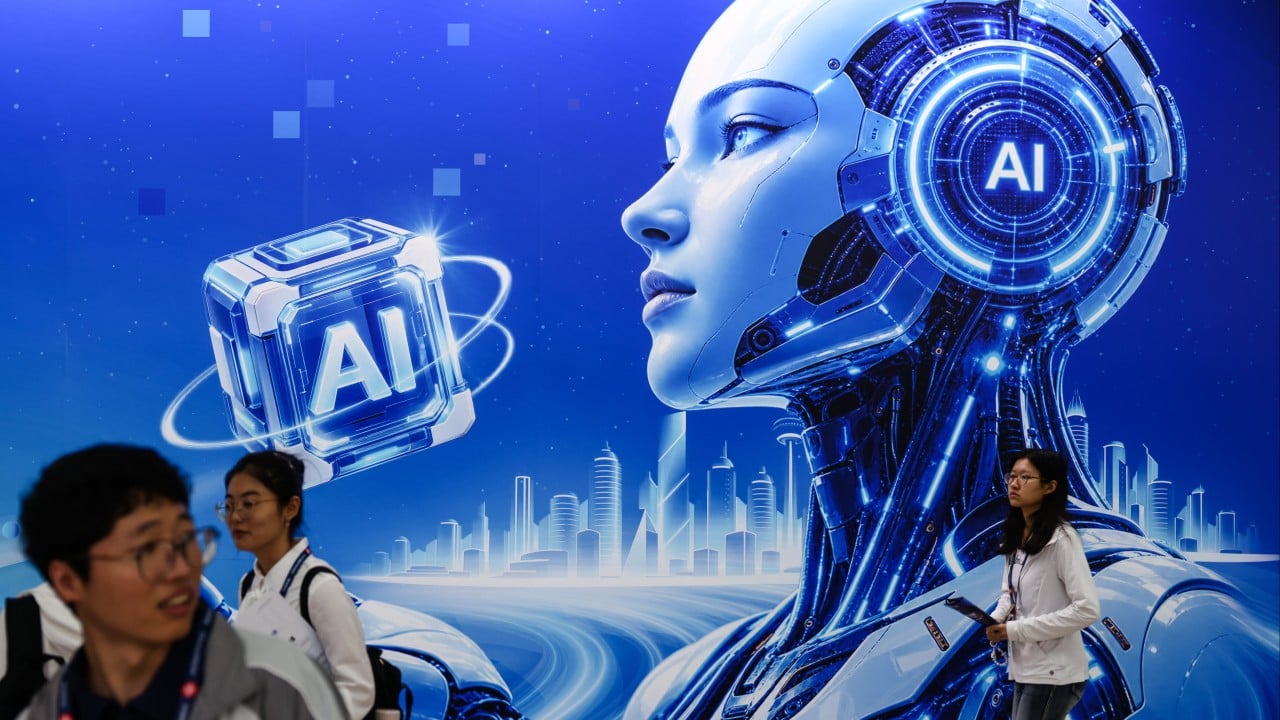
“We are already at the starting point of the China shock 3.0,” Alicia Garcia-Herrero, a senior fellow at Brussels-based think tank Bruegel and chief economist for Asia-Pacific at investment bank Natixis, told the South China Morning Post from Taipei after a virtual panel hosted by the Washington-based Peterson Institute for International Economics (PIIE) on Wednesday.
The third wave would centre on artificial intelligence, covering both hardware and software, along with biotechnology and robotics, she said.
China, while still a major importer of advanced chips, was developing its own AI hardware and software and planned to export them once domestic demand was met, Garcia-Herrero said in the interview. These exports could come alongside bundled data centre and cloud services, and humanoid and industrial robots could follow, creating a shock that would exceed the current one, she said.
“If you think about embodied AI, humanoid robots or industrial robots, think about the humongous shock that this is going to be, beyond [the] existing shock,” she said.
02:40
Dancing humanoids from Unitree Robotics secure spot in America’s Got Talent finale
On the panel, Garcia-Herrero said China’s cheap energy would give it the world’s lowest computing costs, carrying its competitive strength beyond industrial goods and into services. A huge economy that is competitive across the board but largely closed to imports, she argued, must be “extremely reasonable”.
The term “China shock” was popularised by US economists David Autor, David Dorn and Gordon Hanson, whose research linked the surge in Chinese imports after Beijing joined the World Trade Organization in 2001 to the loss of US manufacturing jobs and the decline of factory towns.
The “2.0” wave began around 2018, though some date it to the 2020s, and has been driven by more advanced manufacturing, including cars and machinery.
European and US officials have accused China of overcapacity, meaning it produces far more than domestic and foreign demand can absorb, and of exporting the surplus at low prices.
China has rejected the claims. In a position paper titled “China’s Position on the So-called Excess Capacity Issue,” published on July 28, the Ministry of Commerce said Beijing had never deliberately pursued a trade surplus and that its exports were driven by innovation and reform, not subsidies or weak domestic demand.
“There is no necessary connection between industrial subsidies and overcapacity,” the paper said.
China’s trade surplus reached US$938.11 billion in the first nine months of the year, customs data showed on Wednesday, keeping it on track to beat last year’s record of US$1.189 trillion. September exports jumped 36.3 per cent from a year earlier, and the month’s surpluses with both the US and the European Union (EU) topped US$34 billion.
SCMP Plus is a new premium news platform that gives you an
all-inclusive edge to stay ahead on China news.
To access our exclusive content you’ll need to subscribe.
Already a subscriber?
LOG IN
On October 7 in Paris, the US and 14 other economies, including the EU, signed a statement pledging action on structural excess capacity in sectors including electric vehicles, batteries, chemicals, chips and solar power.
China was not among the signatories. Analysts have described the move as an effort by Washington and Brussels to assemble a “multilateral coalition” to pressure Beijing.
Panellists at the PIIE event differed on how to respond. Nicolas Lamp, an associate professor of law at Queen’s University in Canada, argued the West should invite Chinese investment rather than treat all trade as a threat.
Garcia-Herrero was more sceptical about the benefits of Chinese investment and business engagement, saying Chinese carmakers’ European plants would likely be assembly operations reliant on imported parts, and that Beijing’s security rules limited technology transfer.
“China is impressively careful with its tech transfer,” she said, adding that this is “rightly so.” “That’s why the solution is harder today than it was then.”
Yeling Tan, a professor of public policy at the University of Oxford and a non-resident senior fellow at PIIE, said China needed reassurance that the West was not seeking to contain, suppress or encircle it. All sides needed to find a way forward together, she explained.
“I think we need wise and courageous politicians to get us there,” Tan said. “It’s a narrow corridor. But I wouldn’t say it doesn’t exist.”
KioskNews shows a cleaned-up reading view extracted from the publisher’s page — the original always lives on their site, not ours.