27 Years Later, The Greatest Action Sci-Fi Movie's Final Line Still Officially Defines the Genre


Jeffrey is a freelance features writer at Collider. He is an MPA-accredited entertainment journalist and a Tomatometer-approved critic based in the LA area. He graduated from the University of Texas at Austin with a Bachelor of Science in Radio, TV, & Film and a Bachelor of Arts in Theater.
27 years ago, the sci-fi action classic The Matrix hit theaters, kickstarting not just a new franchise, but a new subgenre. The movie beautifully showcases the story of Thomas Anderson, aka Neo (Keanu Reeves), and his journey of self-discovery as he transforms from an idle, stagnant office worker and black-market hacker who is "unplugged" from a false simulation, into a freedom fighter for humanity. Over the course of the movie, Neo then evolves from a would-be freedom fighter into a savior who perhaps holds the key to liberating the human race from machine oppressors. Neo's journey becomes complete in the movie's final moments.
Neo Finally Becomes 'The One'
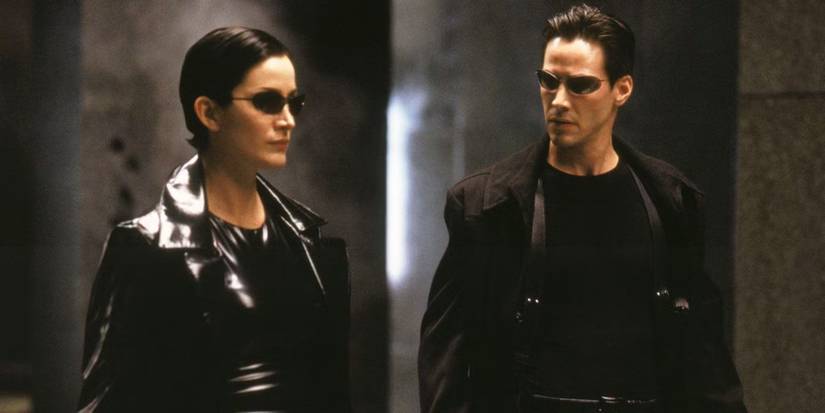
In The Matrix, Neo learns that his life and reality are false. He and many other humans are harvested by an empire of sentient machines, who farm humans for their life-sustaining energy. Humans are plugged into a digital simulation called "the Matrix," which keeps their minds active so they can continue generating energy. Morpheus (Laurence Fishburne) and his squad of freedom fighters, who are part of a larger military working to liberate humanity from the machines, free Neo from imprisonment. Morpheus also believes that Neo is a special, unique human called "The One," who can rewrite the Matrix as he sees fit and is prophesied to end the war and save humanity.
Despite Neo doubting his divinity, he grows more confident in his abilities to fight back against the machines and their nefarious super-programs, the Agents, led by the cruel and diabolical Agent Smith (Hugo Weaving). At the end of the movie, Neo awakens to his true powers, becoming "The One," granting him nearly unlimited "superpowers" within the Matrix simulation, essentially a type of computer "God Mode." Neo's new abilities allow him to destroy the Agent programs and see the entire code of the simulation.
'The Matrix' Ends on an Epic Note


With his newly awakened abilities, the Matrix is now Neo's playground, where he can make the rules. During the ending, Neo makes a phone call, contacting the machine empire, mirroring Trinity's (Carrie-Anne Moss) phone call being traced by the machines in the prologue. However, this time, Neo disables the tracer program, proving the machines no longer have the advantage. Neo delivers a warning to the machines that have enslaved humanity. He says, "I'm going to show them a world without you. A world without rules and controls, without borders or boundaries. A world where anything is possible. Where we go from there is a choice I leave to you."
Next, Neo dons some radical sunglasses in full view of all the other unsuspecting humans, who are also imprisoned in the digital simulation. Then, Neo blasts off into the air, as his powers now grant him the ability to fly. Neo no longer needs to make an impossible super jump since he can now take to the skies at will. The score transitions to the aptly titled song, "Wake Up," by Rage Against the Machine, leaving the movie on a rousing, exciting burst of energy. Neo's final line and warning to the machines depict that the character has finally discovered his true identity and knows his true purpose, as he seeks to free the minds of the rest of humanity, much as Morpheus did for him.
Neo's Awakening Is Also Humanity's
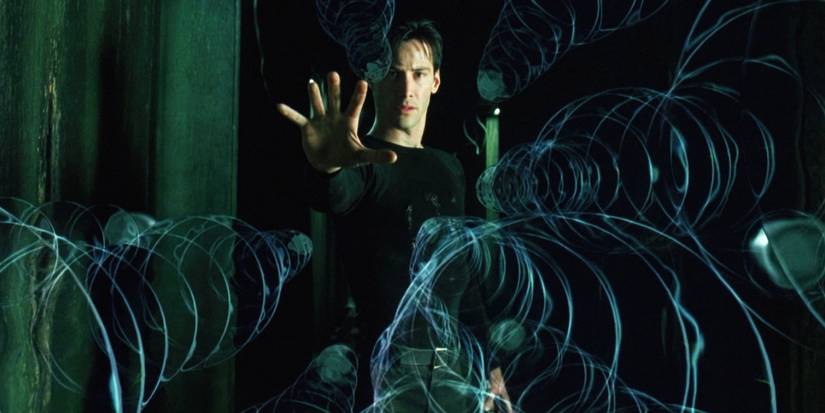
The Matrix's epic ending offers the perfect plot resolution. The movie utilizes the Matrix, a digitally created simulation, as a metaphor for individuals trapped in the doldrums of everyday life. Directors Lana and Lilly Wachowski craft an empowering story, showing how people can break free from the rut of their lives and awaken to their true selves, much like Neo and his allies. Most humans who broke free from the Matrix already felt like something was off—a truth about the world they couldn't detect or truly see, but deep down, they knew something was wrong. Morpheus offers individuals the "red pill," a chance to learn the harsh truth of the world and an opportunity to liberate enslaved humans from imprisonment at the hands of the machine empire.
Neo's speech at the end presents a microcosm of the entire movie. It represents that humanity yearns to be freed from the shackles, boundaries, and restrictions that machines placed on their lives. Neo, with his newly discovered powers, will similarly empower and free more minds, revealing that the possibilities of reality are only limited by their imagination. The ending also highlights that the machine empire's philosophy is restricted by their binary coding and rudimentary thinking, while Neo and humanity's potential are limitless once their minds are liberated. The Matrix and Neo's journey represent an awakening to your true self, and realizing that an individual's singular potential is endless when you believe in the power of One. The movie's final line and moments cement it as one of the greatest sci-fi action flicks of its era, marking a major moment for cinema. The Matrix presented moviegoers with the movie of the future for the future of the medium.
KioskNews shows a cleaned-up reading view extracted from the publisher’s page — the original always lives on their site, not ours.