Dolphins with active social lives and big friendship groups live longer, Australian researchers discover

Dolphins who spend time socialising in large and consistently sized social groups tend to live longer, new research has found.
Indo-Pacific bottlenose dolphins are marine mammals that can live for more than 50 years and have complex social lives. They spend time socialising in groups – which increase in size during their youth and early adulthood, before declining towards the end of their life, according to a study in PLOS Biology.
The study found that dolphins who maintained the strongest and most stable social groups also ended up living the longest.
The insights draw on nearly 40 years of data collected at Shark Bay, in Western Australia, including tens of thousands of observations of dolphins. The dataset traces each individual – recognisable by colour, location and unique marks and notches on its back and dorsal fin – on their own and in groups over time.
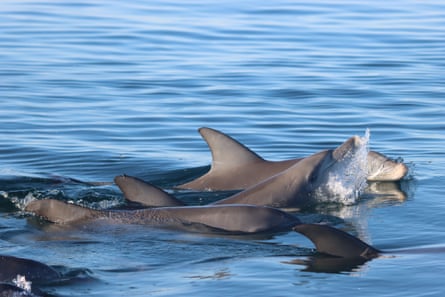
Lead author, Kelley Meehan, from the University of Queensland, said analysis of those records revealed group sizes could vary, but as dolphins aged they tended to become more “set in their ways”.
“They become more selective about the groups that they will join, and what size [of group] they’ll be involved in,” Meehan said.
But there were pros and cons to being in a group, she said. Socialising can enable dolphins to find and form bonds, share information and find mates. But it can also come with downsides, like increased disease transmission or added stress.
Given that the Shark Bay dolphins formed long-term, stable bonds, their preference for smaller group sizes as an animal aged was likely to reflect the loss of key, closely bonded individuals.
At every stage of life, males generally spent time in larger groups than females, the researchers found.
“Being social is the backbone of their reproductive strategy, because it takes a team of males to consort [with] a single available female. And so those bonds that males have in their alliances are extremely important to their overall success in reproduction,” Meehan said.
“So being social really matters to them.”
Females spent more time with their kin, along with others using similar foraging strategies or occupying similar habitats. Their group size was less predictable – they could go from foraging solo, or in small groups to very large pods.
Associate professor Celine Frere, an evolutionary ecologist at the University of Queensland and co-author of the paper, said the deep and continuous dataset was crucial in understanding the dolphins’ social lives, including how each animal was unique, and how their preferences changed over time.
“To be able to follow individuals throughout their life at very different points in time – the day, the season, or the years throughout their age and sex differences – really start telling us a story about how individuals differ,” Frere said.
“Are you a social butterfly? Or are you someone who doesn’t like to socialise as much? Do you enjoy hanging out with certain members of your community versus others?”
Cetacean researcher Dr Mike Bossley, who has studied the lives of individual dolphins in the Adelaide dolphin sanctuary, said in many ways this mirrored patterns of social behaviour in humans – “every individual has their own way of socialising, and our pattern of socialising changes over time”.
Bossley, who was not involved with this study, said it was “another demonstration of the complexity of dolphin social behaviour”.
“It reinforces the notion that the difference between humans and other species is diminishing almost by the year,” he said.
“Once upon a time, we thought we humans were special and unique. Increasingly that appears not to be the case, and I think that’s got enormous ramifications for the way we treat other species.”
KioskNews shows a cleaned-up reading view extracted from the publisher’s page — the original always lives on their site, not ours.