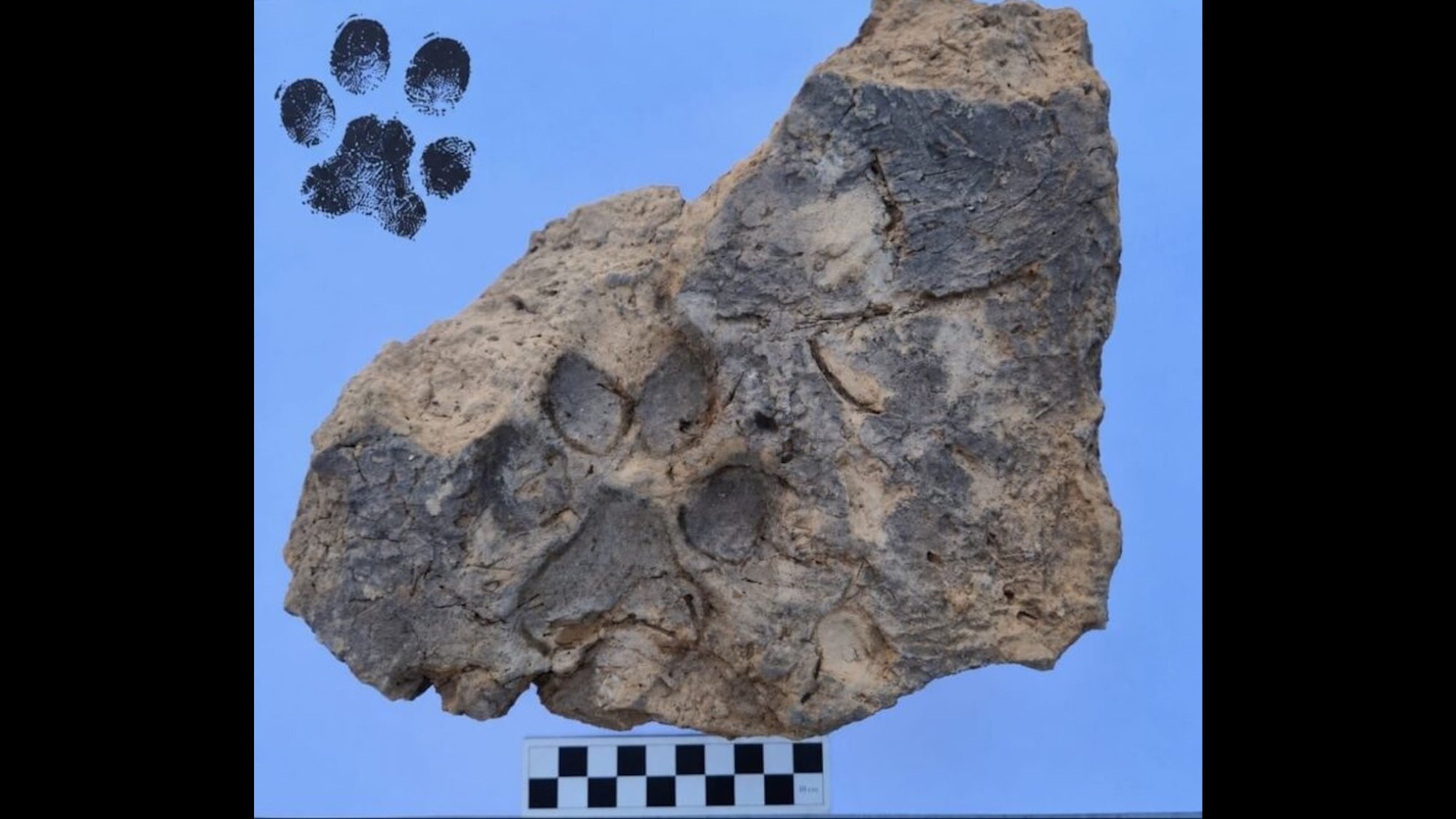
Dog’s paw print found in a 3,700-year-old brick
Archaeological relics often leave a lot to the imagination. Corroded jewelry and the tattered remnants of ancient clothing only tell part of a much larger story, but sometimes an object offers up a bit more detail. Occasionally, an artifact such as a piece of pottery is so well-preserved that even its creator’s signature is still legible thousands of years later.
In Turkey, archaeologists recently excavated an unexpectedly pristine example of one Bronze Age artist’s proof-of-authenticity. However, this wasn’t the work of a revered local craftsman. The marking appears to be the pawprint of a dog waltzing through a local construction site.
Turkey’s Ministry of Culture and Tourism Mehmet Nuri Ersoy highlighted the discovery earlier this month on social media. Archaeologists led by Erkan Fidan of Bilecik Şeyh Edebali University discovered the memento about 100 miles south of Istanbul at a site known as Tavşanlı Höyük. Spanning nearly 100 acres, Tavşanlı Höyük is one of the region’s most extensive Bronze Age mounds, and contains remnants of local Anatolian communities dating as far back as 8,000 years.
Fidan’s team has spent over five years excavating sections of the mound. In 2021, the archaeologists began investigating architectural debris that is roughly 3,700 years old. The debris included sections of mudbrick wall that were common at the time, which were made from combining water, soil, and straw into sections and then drying in the sun. But as one batch of mudbrick lay in the heat, a rogue dog apparently traipsed across a brick and left behind a near perfect, four-toed indentation.
“In Tavşanlı Höyük…we reveal not only structures and artifacts, but also such small and unexpected traces of life,” Esroy said in his post translated from Turkish.
After nearly 4,000 years, it’s impossible to know if a dog made its way across the bricks while workers weren’t looking, or if a human assisted his furry friend in making his mark. Either way, laborers still included it in the structure’s wall rather than discard the decorated mudbrick.
Tragically, archaeologists have since determined that the building eventually burned down with two people still inside. That said, a lack of canine remains suggests the paw’s owner was long gone before the blaze.
KioskNews shows a cleaned-up reading view extracted from the publisher’s page — the original always lives on their site, not ours.