6 months into war, Iran and UAE find consensus in BRICS declaration
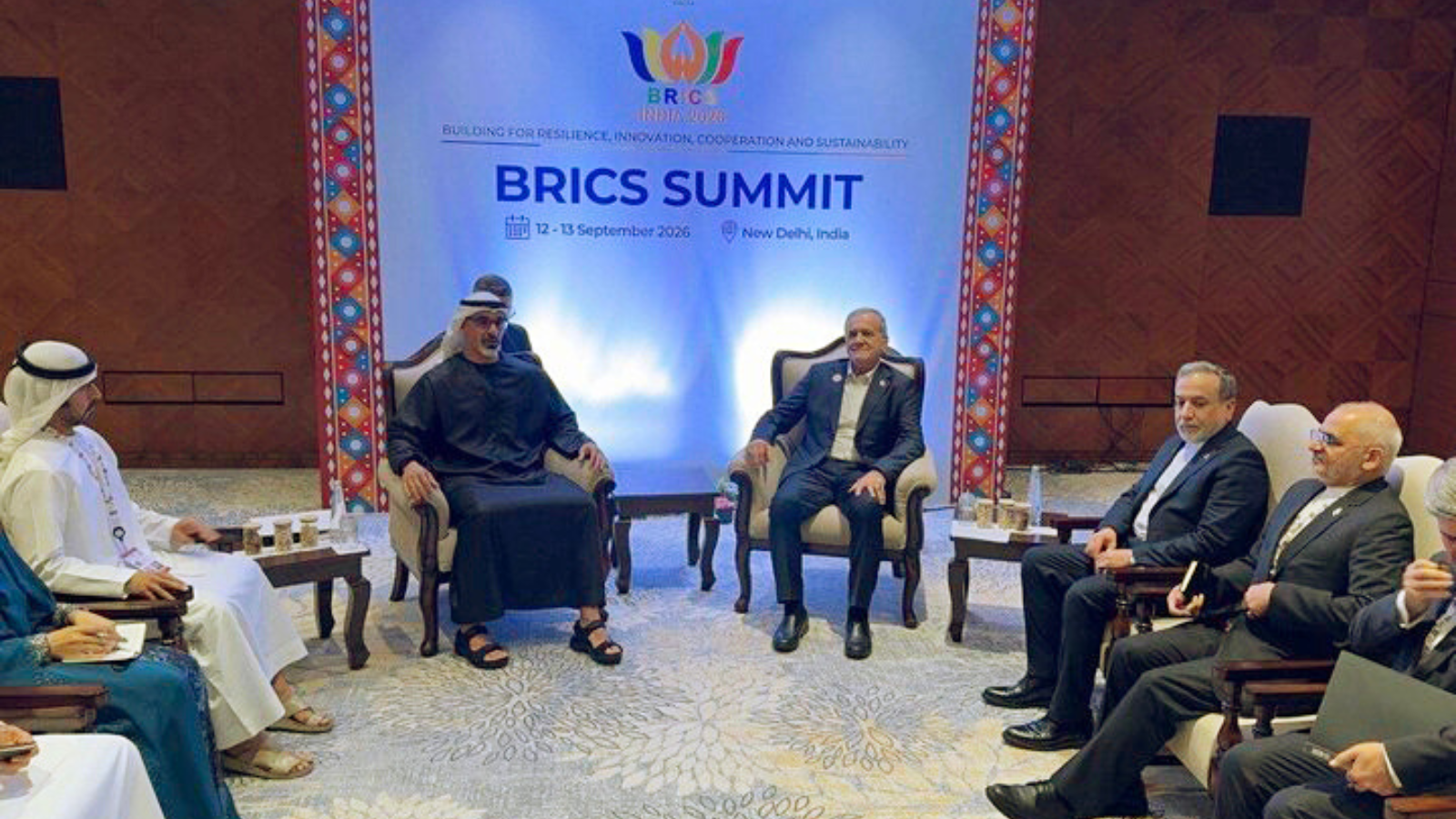
Iran President Masoud Pezeshkian meets UAE Crown Prince Khaled bin Mohamed bin Zayed Al Nahyan on the sidelines of the BRICS Summit in New Delhi on Saturday (X@Iran_In_India).
As the six-month-long West Asia war flares up with US and Iran exchanging strikes, India achieved the much-anticipated – and the much-fraught — consensus at the BRICS summit between UAE and Iran after hectic negotiations paving the way for the joint declaration adopted Saturday.
Against this backdrop, UAE’s crown prince Sheikh Khaled bin Mohamed bin Zayed Al Nahyan, who is the Crown Prince of Abu Dhabi, met Iranian President Masoud Pezeshkian on the margins of the BRICS summit.
In paragraph 28 of the joint declaration, the BRICS leaders said, “We express deep concern over the continued escalation of tensions in Middle East/West Asia and, recalling our respective national positions, call for exercising maximum restraint, as well as avoiding actions that could further aggravate the situation.”
The declaration acknowledged the sensibilities of both sides by flagging territorial sovereignty and the need to secure civilians and infrastructure. UAE has been at the receiving end of a series of Iranian strikes on its cities with Tehran calling it a proxy of the United States. In addition, the declaration underscored dialogue and diplomacy and smooth flow of energy — all important issues and challenges faced by all the countries from the developing countries.
“We urge to ensure the protection of civilians and civilian infrastructure in accordance with the purposes and principles of the Charter of the United Nations in their entirety and interconnectedness, including respect for the sovereignty and territorial integrity of the States,” the declaration said. “We encourage increasing efforts, through dialogue and diplomacy, towards a long-term understanding that will contribute to lasting peace, security and stability in the region. We stress the need to work together to maintain smooth flow of global trade, supply chains and energy, in accordance with applicable international law.”
The phrasing of the war in West Asia had divided Iran and UAE in the last six months. Incidentally, barely three months ago, in May, there was no consensus on the paragraph at the BRICS Foreign ministers meeting.
At that time, Delhi had issued a chair statement and an outcome document, trying to reflect the divergences between Iran and the UAE over the war. The statement had underlined “differing views among some members” over the West Asia situation, and that BRICS members had expressed their “respective national positions”. In contrast, there was a much more expansive paragraph in the BRICS declaration.
Story continues below this ad
Said Secretary (economic relations) in the Ministry of External Affairs Sudhakar Dalela, who is also the BRICS Sherpa: “The adoption of New Delhi Declaration was among the defining outcomes of India’s chairship, demonstrating that BRICS members can forge consensus on matters of global importance.”
The negotiators were able to achieve this in the last few days of hectic negotiations. With the war in West Asia flaring up following the exchange of strikes between the US and Iran, the BRICS Sherpas, the most senior negotiators from the 11 member countries of the grouping, have been burning the midnight oil to hammer out the joint declaration. With UAE and Iran, new members of the BRICS since 2024, part of the negotiations, Indian officials worked to bridge the gap between the two sides.
This is a repeat of what happened at the G20 summit in September 2023, when the paragraph on the Russia-Ukraine war was agreed upon through consensus after a protracted back-and-forth.
Since the war started on February 28 when the US and Israel attacked Iran, Tehran has targeted US bases in the Gulf region including in the UAE. This has had the Emiratis and the Iranians at loggerheads over the last six months.
Story continues below this ad
In May this year, when Foreign Ministers of the BRICS met in New Delhi, Russia’s Sergey Lavrov told the UAE and Iranian ministers to hold direct talks. At that time, India was unable to bridge the diplomatic gap within the BRICS and could not come up with a joint statement after the two-day meeting of the Foreign Ministers.

Shubhajit Roy, Diplomatic Editor at The Indian Express, has been a journalist for more than 27 years now. Roy joined The Indian Express in October 2003 and has been reporting and writing explainers and analysis on foreign affairs for about 19 years now. Based in Delhi, he has also led the National government and political bureau at The Indian Express in Delhi — a team of reporters who cover the national government and politics for the newspaper. He has got the Ramnath Goenka Journalism award for Excellence in Journalism ‘2016. He got this award for his coverage of the Holey Bakery attack in Dhaka and its aftermath. He won the Ramnath Goenka Journalism award, 2023, for the second time for his reporting of the Oct 7 attacks on Israel and the war in Gaza. He also got the IIMCAA Award for the Journalist of the Year, 2022, (Jury’s special mention) for his coverage of the fall of Kabul in August 2021 — he was one of the few Indian journalists in Kabul and the only mainstream newspaper to have covered the Taliban’s capture of power in mid-August, 2021. ... Read More
KioskNews shows a cleaned-up reading view extracted from the publisher’s page — the original always lives on their site, not ours.