Israel’s laser defense made history. Its future now lies with 11th graders. - Sponsored Content
In December 2025 the IDF took delivery of Iron Beam, the first high-power laser interception system declared operational anywhere in the world. It exists because Israeli physicists and electronics engineers worked tirelessly to pair a high-power laser with electro-optical tracking and adaptive optics. Fifteen years from now, our protection may look nothing like a laser, but it will need the same kind of minds.
Some of those minds are in Dimona, in southern Israel
Danielle is 16, grew up in Dimona and last month spent two afternoons on a circuit that refused to work. The sensor read correctly in simulation but produced nonsense on the bench. Her instructor did not give her the answer. He handed her an oscilloscope probe instead.
On the screen, Danielle found a spike of electrical noise every time a motor on the same board switched on. She rerouted one ground line, and the reading went clean.
“In the simulation everything is perfect,” she told me. “On the table you find out what you actually built.”
I have not heard a better description of where technology education in Israel needs to go.

Coding is no longer the whole ticket
For twenty years we told teenagers that learning to code was their way into Israel’s technology economy. That advice is aging fast. AI tools now write software from a simple paragraph of instructions. What AI cannot do though is find the noise on Danielle’s board, or make these software, electronic and mechanical components behave as one system.
That is the skill Israel’s next generation of technology will demand, in robotics, autonomous systems, defense, communications and medical devices.
A lab where the talent lives
Danielle is in 11th grade in Nitzanim Pro, the advanced track of Nitzanim, the technology program that BU runs in some 60 towns across the Negev in Southern Israel, and the Galilee in Northern Israel. BU, known in Hebrew as Be’Netivei Udi (“On Udi’s Paths”), was founded in memory of Lt. Udi Elgrabli and has worked with young people in Israel’s periphery for decades.
Danielle and about 2,000 other students got there the same way: a short exposure unit in ninth grade, a placement test, then three years of four to five weekly hours with an instructor. Every student in the track gets a personal computer, and families pay almost nothing.
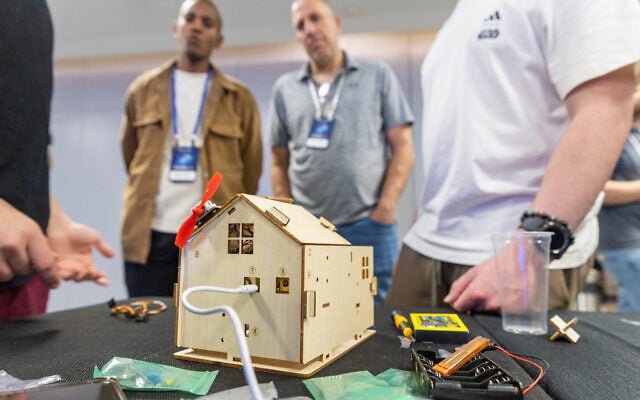
The students located in the Southern periphery of Israel study in our engineering lab in Be’er Sheva, in a rented building, with hopes of a permanant one in the near future. Electronics, physics, software and AI are taught in one room, on professional equipment: oscilloscopes, circuit board tools, 3D fabrication and robotic platforms. The method is simple to describe and hard to do. Measure, fail, find out why, try again.
The talent is there. The labs are not.
A gifted 14-year-old in Dimona or Kiryat Shmona has the same ability as one in Ra’anana or Herzliya. What they often lack is access to a lab, a specialist teacher and a mentor. Israel’s economy rests on a small pool of people who can solve hard technical problems, and every capable teenager who never sees a lab makes that pool smaller.
At 18, these teenagers go into the army, and what counts is what they know when they arrive. Nitzanim has grown from about 270 students in 2019 to roughly 5,170 in 2026, including the ninth-grade exposure layer. In 2025, according to IDF data, 62% of recruits from the periphery who entered the IDF’s computing cluster came through Nitzanim. Over five years, the periphery’s share of that cluster rose from 12% to 19%. Many things move a figure like that, and we do not claim all of it. The 62% is the part we can trace.
Where you come in
In July we laid the cornerstone of Beit Udi, a permanent technology and innovation hub in Be’er Sheva, planned with seven labs, near Ben-Gurion University and the Gav-Yam technology park. We are working on similar labs in the north, and both depend on funding we are still raising.
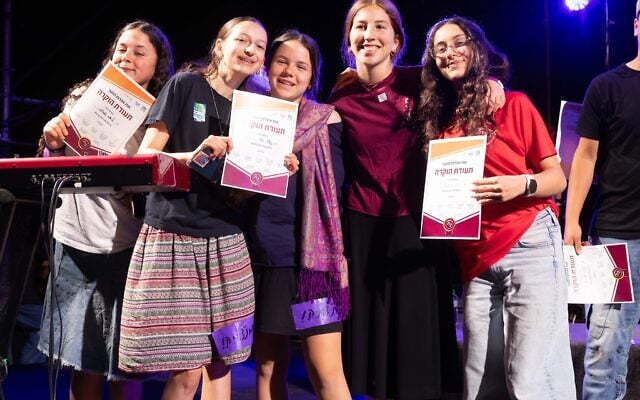
Young women are about 35% of the advanced track, so Danielle is still in a minority there. Our goal is at least 50% by 2030. The state funds every student equally, however bringing girls into these tracks and keeping them there takes more outreach and support per student than that funding covers.
These are two of the main gaps we are asking you to help close.
Danielle needed two afternoons to find one ground line. Whether the next Danielle gets those afternoons should not depend on how far her town is from a lab.
Help build the next lab at bu-tech.org.
And if you work in Israeli industry, come to Be’er Sheva and bring a hard problem for our 11th graders to solve.
KioskNews shows a cleaned-up reading view extracted from the publisher’s page — the original always lives on their site, not ours.