Lingering scent of whale could draw sharks to City Beach for weeks: expert
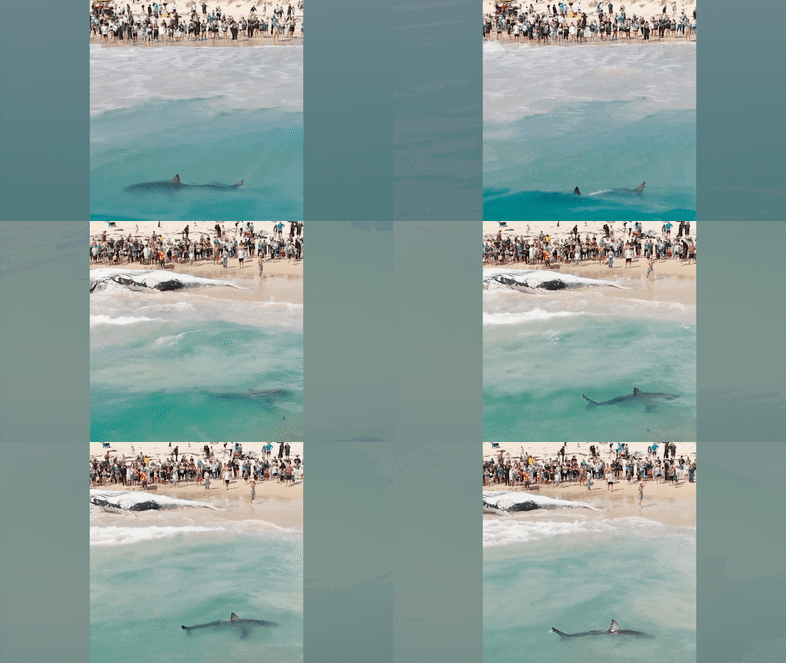
As another day goes by where a whale carcass remains on the shoreline south of City Beach, authorities are taking the opportunity to tag the sharks lured by the remains.
But shark experts aren’t convinced the predators will take the bait.
A 13-metre whale was spotted beached at 7.30am on Monday morning and quickly attracted a number of great white sharks into the shallows of the beach, some more than five metres long.
The carcass was reported by Surf Life Saving WA and the organisation’s helicopter reported a number of sharks had begun hanging around the coastline near Swanbourne, just south of City Beach, around 10.30am.
The helicopter reported seeing three, four-metre long great white sharks circling about 15 metres from the shore, about 2.45pm.
A small hammerhead was also spotted heading south from Trigg Beach, towards the carcass, and two tiger sharks were reported further south at Cottesloe Beach.
The carcass was originally planned to be removed on Tuesday, but the Town of Cambridge has had to push that back by a day as the equipment needed to lift and transport the whale isn’t available until Wednesday.
With the beach closed to the public, the Department of Primary Industries and Regional Development has taken the opportunity to drop three drum lines into the ocean in a bid to tag curious sharks.
Macquarie University Fish Lab spokesman Culum Brown said this behaviour is common for sharks “looking for a free meal”.
“Sharks just do what sharks do, right? I mean, if there’s a free meal, they’ll certainly be attracted to it, and it’s very well known that they’re attracted to whale carcasses,” he said.
“The sharks will be in feeding mode, and I mean most people probably think of sharks and particularly white sharks as being sort of attack, kill, ambush type predators and that sort of thing.
“But actually, they’re quite happy to have a free meal, and a massive whale carcass like that will keep them going for a very long time.”
Throughout Monday and again Tuesday morning great white sharks between three and five metres in size were reported swimming 10 and 15 metres from the shore near the carcass.
Brown said sharks will go to great lengths to get to their meal, even if it means beaching themselves.
“I’ve seen sharks virtually beach themselves in order to get access to easy food. When there’s a big school of salmon or whatever in the shallows, the sharks will come right in, no problem at all,” he said.
“Once they’re in that feeding mode, they do a sort of a risk reward calculation in their heads, and if there’s a good meal within reach, they’ll do their best to get to it.
“So the depth is not really an issue for them, and it’s unusual because we normally wouldn’t see sharks coming in that shallow because they’re deterred by human activity and that sort of thing.
“If there’s a free meal like a whale just sitting there tantalising, you can imagine the smell. It must be driving them crazy.”
It is for this reason he believes the shark tagging efforts might produce little reward.
“It’s an odd decision because quite frankly I think that the attraction to the whale will certainly be way more powerful than any bait they can put on a hook.” he said.
“So I don’t think that’ll be very successful, but given that the sharks can’t actually access the carcass at the moment, it may be that they’d happily go off and find something in the nearby vicinity as an alternative.
“But honestly, I think they’ll be pretty determined to get that carcass.”
Fisheries minister Jackie Jarvis said fisheries officers were out on the water to drop the drum lines into the ocean.
“We make use of opportunistic tagging opportunities, and when there are whale carcasses, we make sure that we use them as an opportunity to tag sharks,” she said.
“We’ll tag as many sharks as we can. It’s important to remember when we tag sharks, this isn’t just a tag on the dorsal fin. The shark is caught. It is actually pulled up alongside the boat. It is actually turned over, and an internal tag is actually surgically inserted, so each shark actually has sort of minor surgery on it. It is a mammoth task.”
As for why the carcass will be removed and taken to a tip as opposed to being dragged back into the ocean, Jarvis said it was based on the weather conditions.
“With regard to the removal of the carcass, I’m not an expert. My understanding is, however, if the whale carcass is dragged out further in this type of weather conditions, it increases the chance of the carcass breaking up and washing back onto shore, and therefore causing more shark activity,” she said.
Brown said that removal to a tip would be the most logical decision, but that it should be done sooner rather than later as the smell of the carcass could linger for weeks.
“The longer it stays there, the more sharks will come in,” he said.
“The smell could last for weeks depending on how long it sits there for. Usually, what happens is that the oil and the smell infiltrates into the sand, down into the water table, and as the tides come and go, it spreads out into a broader radius.
“So it could be weeks before that smell is, you know, sufficiently dissipated. So even if you remove the carcass, somebody is going to have to maintain some sort of watch over that beach for quite some time yet I would imagine.”
Jarvis said as long as there is shark activity, the beach will remain closed out of caution.
It comes just 11 days after 63-year-old Greg O’Neill was killed in a suspected great white shark attack while swimming close to shore at Sorrento beach, just 12 kilometres north of City Beach.
O’Neill’s death prompted Surf Life Saving WA helicopter patrols to start the season a week earlier than scheduled, to boost safety.
But Brown said it was encouraging to see so many people and children down by the beach who were curious to see the whale remains and sharks.
“Seeing a whale on the beach is incredible, but people are excited about seeing the sharks too,” he said.
“So that to me is heartening that there’s not an angry mob going down there to take out the sharks.”
KioskNews shows a cleaned-up reading view extracted from the publisher’s page — the original always lives on their site, not ours.