CNA Explains: What are the grievances driving the expanding school protests in France?
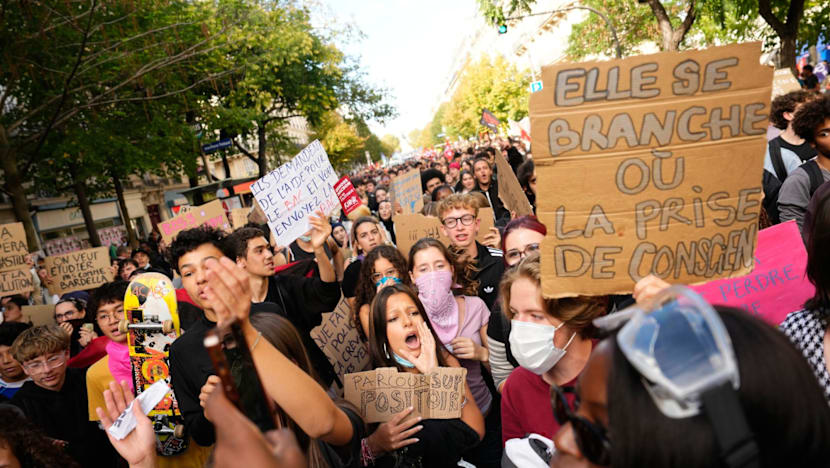
A strike over working conditions and staff shortages at a high school in a Parisian suburb has morphed into nationwide demonstrations protesting the state of France’s education system.
New: You can now listen to articles.

This audio is generated by an AI tool.

07 Oct 2026 07:34PM
Mass protests over conditions at France's high schools have descended into sporadic violence, resulting in nearly 500 arrests and leading French President Emmanuel Macron to call an emergency meeting.
France’s interior ministry said at least 256,000 people protested nationwide on Tuesday (Oct 6), adding that hundreds were arrested after some of the protests turned violent.
What started as a protest over teacher and staff shortages at a high school outside Paris last month has morphed into nationwide demonstrations, with parents, teachers and union workers joining with student movements to protest the state of France’s education system.
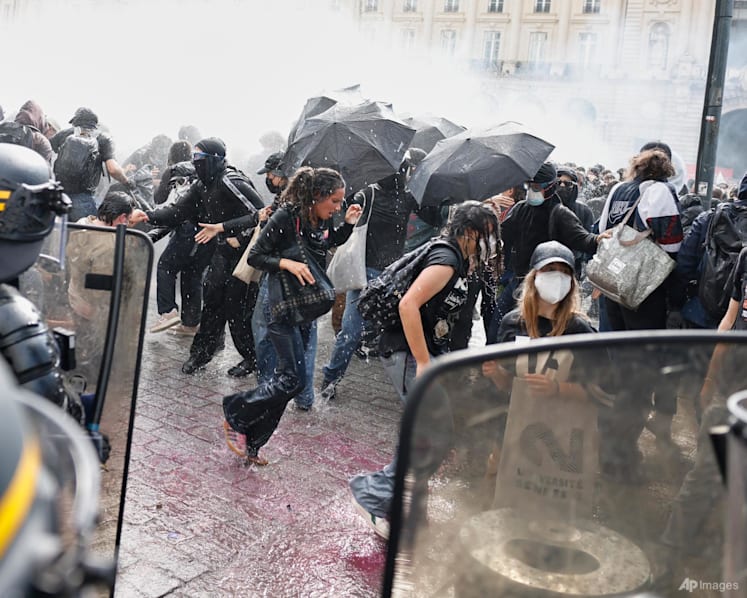
Rights groups, unions and the students have accused authorities of using disproportionate force, with French police suspending the use of stun grenades after a teenage protester lost a hand on Monday.
CNA takes a look at what sparked the protests, what the students want, and if the movement could turn into something bigger.
What started the protests?
Rather than a single government policy, the movement was sparked by events at the Saint-Exupery high school in the Paris suburb of Creteil.
Staff members went on strike on Sep 17 over vacant positions and a lack of resources. Students joined the teachers soon after.
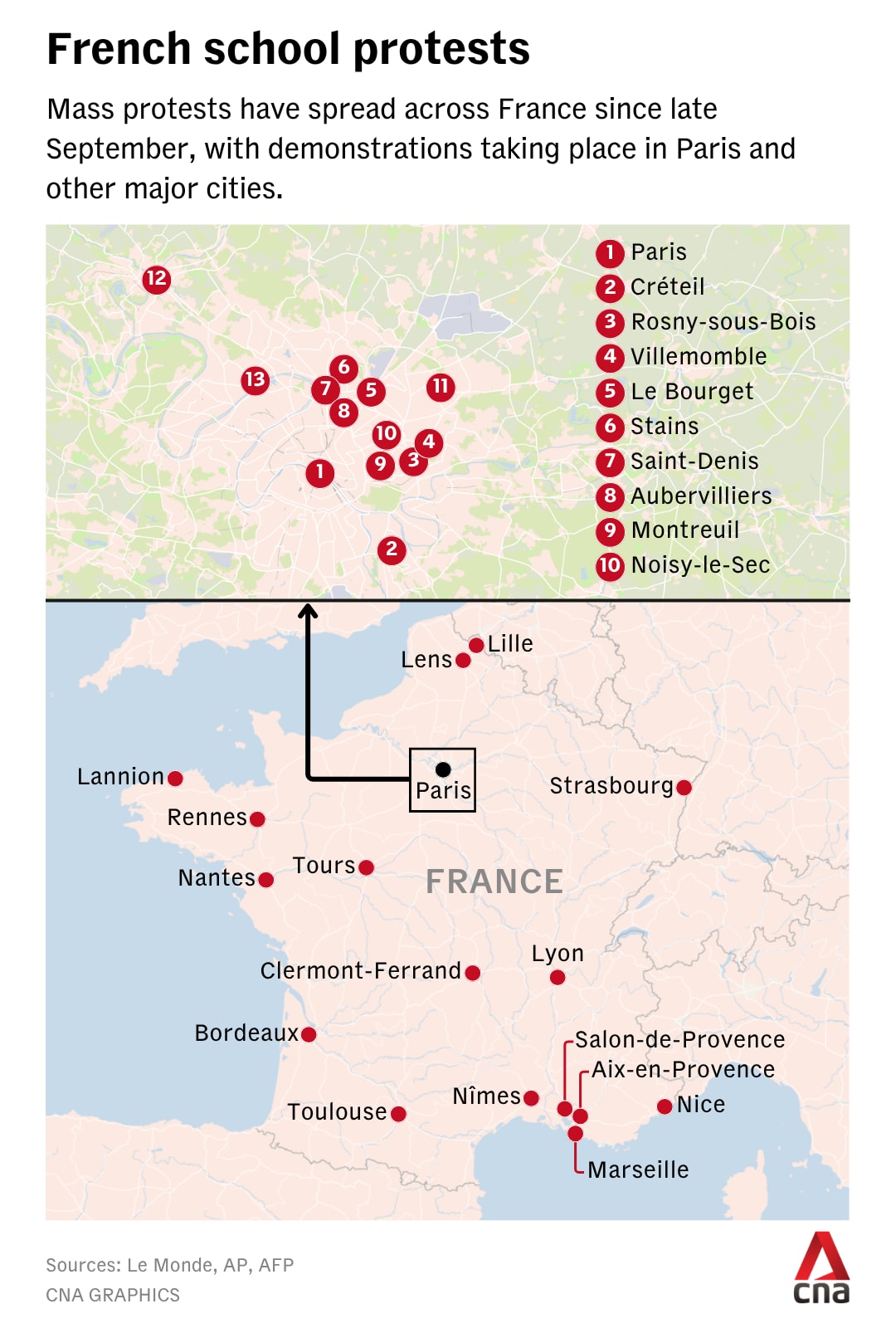
Within days, similar protests spread through the Parisian suburbs - where poverty levels are high - and then to other parts of France, where entrances to schools in areas like Marseille, Strasbourg, Tours and Lille remain blockaded.
The movement gained momentum through social media platforms such as Instagram and TikTok, which students used to organise protests and circulate their demands.
While protesters raised different concerns, common complaints included teacher shortages, overcrowded classes, deteriorating facilities, long school days, inequality between schools and proposed budget cuts.
According to statistics from France's education ministry, 9.8 per cent of teaching hours in public secondary schools went untaught during the 2024-2025 academic year, with the majority of the missed hours due to absent teachers not being replaced.
A 17-year-old protester at a school in Aubervilliers, a suburb north of Paris, told Reuters that she once took a high school French exam without a French teacher.
"The education authority is not investing enough in the suburbs. It's classist and racist," said another student.
What do the students want?
As there is no single organisation representing the protesters, there are no specific demands that would end the protest.
However, student movements such as the Union Etudiante - a federation of local student unions - have broadly called for more teachers and educational support staff, renovations for ageing infrastructure and overhauls of overloaded timetables.
Some have also taken issue with Parcoursup, the university admissions system introduced in 2018 that has been criticised by some students and teachers as opaque and discriminatory.
The French government has acknowledged that many of the underlying grievances are legitimate.
On Oct 4, Prime Minister Sebastien Lecornu ordered the government to work on five areas: Ensuring lessons take place, improving school buildings, reorganising school days, making Parcoursup more transparent and giving students a greater say in school life.
He added that the government's proposed 2027 budget provides an additional 1.2 billion euros (US$1.34 billion) for education.
The education ministry has also launched a nationwide online consultation, encouraging every high school to devote half a day to discussions between students and staff.
Initial decisions are expected before the end of October, Lecornu said.
Who is joining the students - and why?
Apart from high school students, their parents and teachers, university students, worker unions and political party officials have also joined the movement.
About 40 per cent of France's public higher education institutions were disrupted on Tuesday, according to the French higher education ministry. The figure includes institutions that were blocked, partly blocked, occupied or closed by administrators.
The concerns of university students overlap with those of high school pupils, but extend to the availability of places in university programmes, student living costs and access to postgraduate education.
Teachers and labour unions have joined the movement, as complaints about teacher shortages, large classes and stretched support services are also longstanding workplace issues for school staff.
Parents and other adults have appeared at demonstrations too.
Some were there in support of the students' education demands, while others said they joined because they were concerned about the way police were dealing with protesters, many of whom are minors.
The protests have also entered party politics, with the hard-left France Unbowed (LFI) party encouraging the movement and its veteran presidential candidate Jean-Luc Melenchon calling for a non-violent protest.
LFI has rejected the government’s accusation that the party is encouraging unrest, saying the movement is student-led.
Why have the protests become so confrontational?
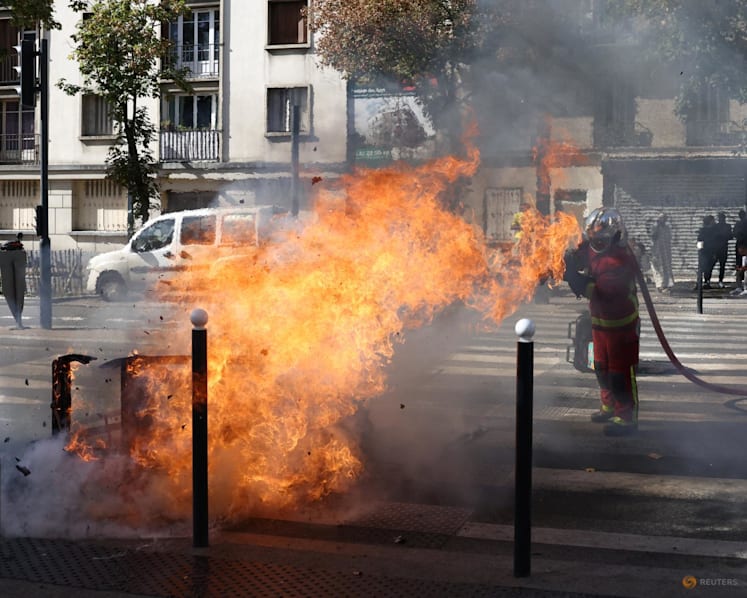
While many demonstrations have been peaceful, some have spiralled into vandalism, including the destruction of bus shelters, the burning of school entrances and clashes between protesters and security forces.
Since the start of the movement, at least 24 schools have been burned or ransacked, according to the education ministry.
Police have responded with batons, tear gas and riot-control rounds.
The government said on Monday that 215 students and 715 police officers have been injured since the start of the movement. At least 10 investigations have been opened by the police watchdog.
In one instance, a 15-year-old teenager lost his hand in the northern town of Lens when he picked up a stun grenade fired by riot police. This led the government to suspend the use of the devices at protests.
Another protester aged 16, who suffered serious head injuries at a protest in the central city of Tours, lost the use of one eye.
France's National Consultative Commission on Human Rights (CNCDH), an independent state-backed human rights body, said it was deeply concerned about what it described as disproportionate use of force in some cases.
Amnesty International on Monday said the French authorities should "put an end to the disproportionate police repression seen in recent days during student protests".
Interior Minister Laurent Nunez has labelled the protests a "climate of unacceptable violence" and called for order.
Police response has itself become one of the movement's main grievances. Union Etudiante has also called for the end of police violence against protesters.
Could this become a wider anti-government movement?
US President Donald Trump, pushing his global right-wing narrative ahead of tough midterm elections at home, has sought to blame the unrest on "mass migration" and Islam.
But while the movement is already broader than a school protest, it has not yet developed into broader opposition to the government.
However, there are signs that it could expand, with high school students increasingly joined by university students, teachers, trade unions, parents and other supporters.
While the interior ministry said that 256,000 people protested nationwide, union organisers put the figure at 450,000.
The unrest also comes months ahead of a 2027 election that would determine the successor to Macron, whose government announced last week a series of unpopular spending cuts for the next year's budget.
The education budget is set to increase by a below-inflation 1.7 per cent to 65.53 billion euros, excluding teacher pensions.
And while France ranks in the middle of OECD countries for spending on education, the average expenditure per secondary school student has barely changed over the last decade, education ministry data shows.
For now, education remains the issue holding the protests together, but grievances beyond schools are increasingly being embraced. The movement could very well evolve into a much broader outlet for government dissatisfaction.
Want an issue or topic explained? Email us at digitalnews [at] mediacorp.com.sg. Your question might become a story on our site.
KioskNews shows a cleaned-up reading view extracted from the publisher’s page — the original always lives on their site, not ours.