How to interpret North Korea’s response to explosions in the DMZ
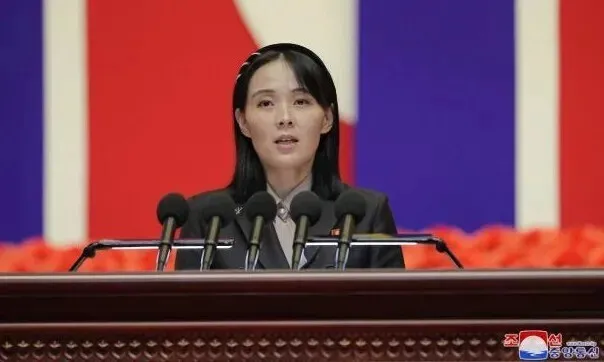
Kim Yo-jong, a high-ranking member of North Korea’s Workers’ Party of Korea and the sister of Kim Jong-un. (KCNA/Yonhap)
After Kim Yo-jong, the sister of North Korean leader Kim Jong-un, denied that a recent explosion on the western front of the Demilitarized Zone (DMZ) was due to a North Korean mine, analysts say she was likely trying to help Pyongyang dodge blame for the incident and continue its efforts to fortify the border with South Korea.
Kim, whose official rank is department director of the Central Committee of the Workers’ Party of Korea, made the remarks in a Tuesday statement titled “Ringleaders of provocation should be prepared for paying price for the farce of their own making.”
The statement was published by the state-run Korean Central News Agency on Wednesday, just days after South Korea’s Joint Chiefs of Staff said in an interim briefing about its ongoing investigation that the DMZ explosion had “very likely” been caused by a North Korean land mine.
When the South Korean Joint Chiefs announced the final results of a probe into a similar incident involving a wooden-box mine in August 2015, four days passed before the policy bureau of North Korea’s National Defense Commission got around to issuing a statement effectively denying the North’s responsibility for the blast. But this time, Pyongyang’s response has been much swifter, and the name behind the statement carries much more weight.
In 2015, North Korea responded to South Korean propaganda broadcasts with military measures, including shelling on the western front. But Kim’s move has been to issue an intimidating statement instead of taking military action.
South Korea’s National Intelligence Service told lawmakers during a plenary session of the National Assembly’s Intelligence Committee on Wednesday that Kim’s statement was primarily aimed at keeping the DMZ blast from being linked to the North.
A secondary objective, the intelligence agency said, is ensuring that the North’s ongoing fortification of the border can proceed unhindered. Since April 2024, North Korea has been hardening its border with the South as part of its policy of treating the two Koreas as separate states sharing a “hostile” relationship. That includes cutting road and rail connections, placing mines and installing barbed-wire fencing around the Military Demarcation Line, the land border between the two Koreas.
“The enemies’ provocative acts near the southern border area are [crossing the line] with each passing day,” Kim said in her statement, adding that North Korea’s “work of strengthening the border [. . .] is only a thorough exercise of sovereignty unrelated [to] any military purpose.”
Experts say that when Kim specifically accused South Korea’s 21st Infantry Division — which is stationed on the eastern front, near North Korea’s ongoing fortification efforts — of carrying out frequent provocations, she was attempting to preempt retaliation by the South Korean military, which could hamper the fortification drive.
“What this means is that North Korea, which is hastening to finalize its fortification project as part of its ‘two states’ policy, wants to dodge responsibility [for the DMZ blast] without instigating needless conflict with the South,” said Hong Min, a senior research fellow at the Korea Institute for National Unification.
There is evidence that North Korea is exercising restraint. It did not make a military response, as it did in 2015, and Kim included a proviso about retaliating only if South Korea actually fires on North Korean soldiers, rather than taking “warning shots.”
That was supported by the National Intelligence Service analysts’ description of Kim’s statement as “an extremely low-key response” in their Wednesday briefing of the Intelligence Committee.
KioskNews shows a cleaned-up reading view extracted from the publisher’s page — the original always lives on their site, not ours.