Delhi's Post-Diwali Toxic Haze Leads To 44% Delay In Flight Departures
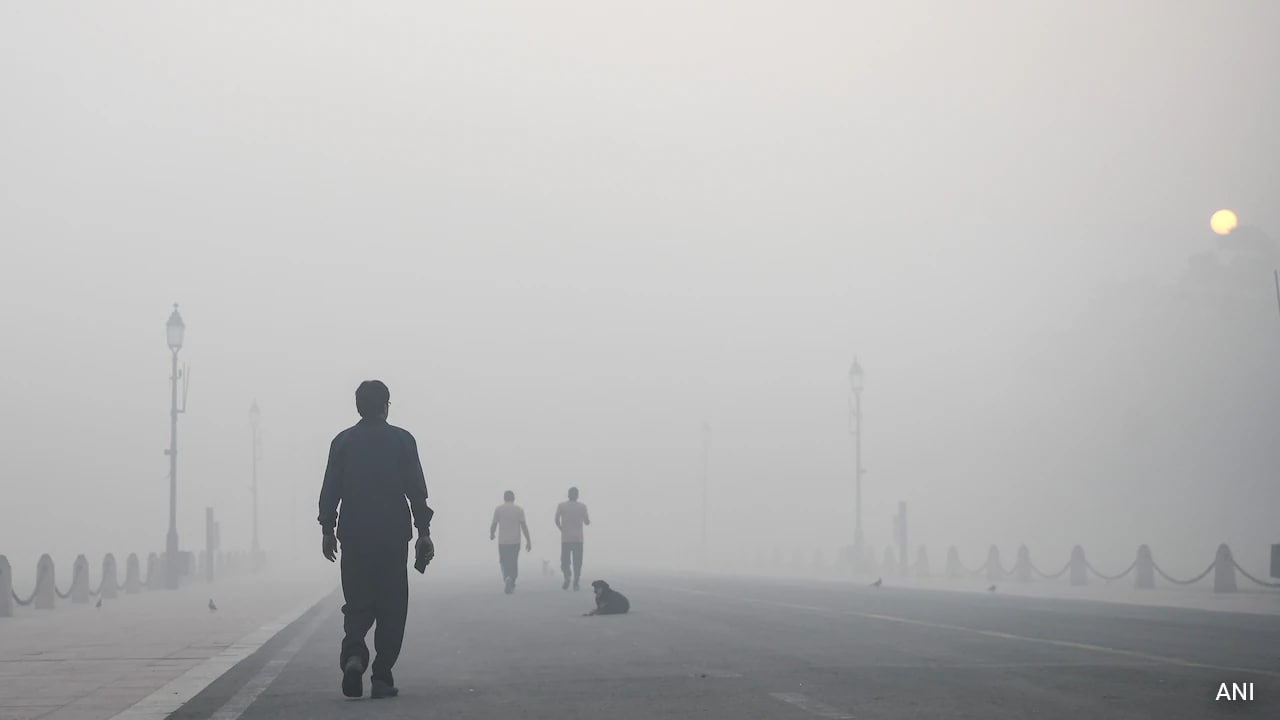
Delhi's post-Diwali pollution has brought the vulnerability of the capital's aviation operations into focus, with smog and shallow fog reducing visibility at Indira Gandhi International (IGI) Airport and prompting the activation of low-visibility operating procedures.
Although the airport has runways equipped for Category III (CAT-III) operations, the technology does not offer an unconditional guarantee against delays. The ability to land or take off in poor visibility depends on several factors, including runway visual range (RVR), aircraft equipment, airline authorisation and the qualifications of pilots operating the flight.
The impact was visible on Diwali night, when Delhi Airport activated its first Low Visibility Procedure (LVP) of the 2026-27 winter season. Around 44 per cent of departing flights between midnight on November 8 and 8 pm on November 9 were delayed, with the average delay standing at approximately 20 minutes. Arriving flights, however, operated with little or no delay during the same period.
READ | Experts Explain Why Delhi's Air Quality Monitors Went Blank On Diwali Night
The airport had issued a passenger advisory on the low-visibility procedures, while clarifying that flight operations were continuing. The distinction is important: activation of LVP is a precautionary safety measure and does not necessarily mean that the airport has suspended normal flight operations.
What does FlightRadar24 data show?
The disruption picture remained mixed on Tuesday.
An examination of Flightradar24's live airport operations tracker for Delhi, accessed at around 12.45 pm on November 10, showed an average delay of 13 minutes. The platform listed 197 delayed flights, accounting for approximately 14 per cent of its reported daily flight movements, and 32 cancellations, or around 2 per cent.
The tracker showed 719 departures and 704 arrivals scheduled or recorded for the day at the time of the snapshot. Its disruption index stood at 1.2 on a five-point scale, classified by the platform as indicating relatively good traffic flow.
READ | 'Couldn't Run 1 km': Delhi Residents Struggle As Air Quality Worsens
These figures represent the airport's reported operational position at the time of checking, rather than a final end-of-day count. They also do not establish that all the delays or cancellations were caused by poor visibility. Airline scheduling, aircraft rotations, air traffic congestion and other operational factors can contribute to the numbers.
Visibility at IGI: Shallow fog recorded on November 10
Weather observations at IGI indicate that visibility remained variable during the early hours of Tuesday.
Historical airport weather observations displayed by FlightAware recorded visibility of around 2,000 metres during the early morning hours, before it dropped to approximately 600 metres at 6.30 am and remained at that level at 7.30 am. The corresponding observations described the conditions as shallow fog.
By the afternoon, Flightradar24 was reporting clear conditions at the airport, with an average delay of 13 minutes. This suggests that the immediate visibility situation had improved, although the operational impact of earlier disruptions could continue through aircraft rotations and schedule adjustments.
The distinction between general visibility and runway visual range is crucial. The 600-metre reading is a meteorological visibility observation, not a runway-specific RVR measurement. The latter is the figure used by pilots and air traffic controllers to determine whether particular low-visibility operations can be conducted.
Delhi's AQI remains very poor
The aviation concerns come against the backdrop of a sharp deterioration in Delhi's air quality following Diwali celebrations on November 8.
According to Central Pollution Control Board (CPCB) data, Delhi recorded an average AQI of 376 on Diwali, its highest Diwali-day reading since 2021. The pollution level remained high the following morning, with the city's AQI reaching 370 at 9 am on November 9.
On Tuesday, November 10, there was some improvement. CPCB readings placed Delhi's overall AQI at around 304 at 7.15 am, keeping the city in the very poor category. Pusa and Chandni Chowk recorded readings of 395 each, while NSUT Jaffarpur registered 382.
READ | 135 Burn Injuries Recorded At Delhi's Safdarjung Hospital On Diwali
PM2.5 remained the dominant pollutant across most of Delhi's monitoring stations.
Fine particulate matter can contribute to atmospheric haze, but the relationship between AQI and RVR is not a direct or uniform one. An AQI reading of 400 does not automatically mean that an aircraft cannot land. Operational decisions are based on the actual visibility and RVR available at the airport, alongside the aircraft's and crew's approved operating minima.
Why CAT-III runways cannot eliminate flight disruptions
Delhi Airport's CAT-III infrastructure is designed to facilitate aircraft operations in extremely poor visibility. However, airport certification is only one part of the operational requirement.
According to the Airports Authority of India's Aeronautical Information Publication, several runways at IGI are equipped for CAT-II and CAT-III operations. The supporting infrastructure includes the Instrument Landing System (ILS), runway lighting, RVR measurement equipment and standby power systems.
Surface Movement Radar is also required to support CAT-II/CAT-III operations when RVR falls below 350 metres.
An ILS provides an aircraft with precise guidance during its approach towards the runway. It helps the aircraft maintain the correct alignment and descent path, reducing dependence on visual references during the final stages of landing.
However, the actual ability to complete a landing depends on the prevailing RVR and the minimum operating conditions approved for that particular aircraft and flight crew.
CAT-III operations are divided into different categories, with CAT-IIIA generally permitting operations at an RVR of around 200 metres and CAT-IIIB allowing suitably approved operations at much lower values, potentially down to 50 metres.
These are not blanket permissions applicable to every aircraft or airline. The approved minimum depends on the aircraft's certification, the operator's authorisation, the equipment available and the qualifications of the crew.
Aircraft equipment and pilot qualifications matter
Even when an airport has CAT-IIIB facilities, an aircraft without the necessary equipment cannot automatically benefit from them.
Low-visibility operations require appropriate aircraft systems, including certified autopilot and flight-guidance capabilities. Depending on the category of operation, additional requirements relating to automatic landing and rollout guidance may apply.
The pilot must also be trained, current and appropriately authorised to conduct the relevant category of approach.
The DGCA's operational requirements make low-visibility capability a combination of airport infrastructure, aircraft approval, airline authorisation and flight-crew qualification.
This explains why two aircraft approaching the same airport under identical weather conditions may not have the same operational options. One may be cleared to conduct a low-visibility approach, while another may have to hold, delay its approach or divert if the prevailing conditions fall below its approved minima.
Take-offs have separate low-visibility requirements. The fact that an aircraft can perform a CAT-III landing does not automatically mean it can take off in equally poor visibility.
What measures are being taken?
Delhi Airport's winter preparedness includes monitoring runway visibility and providing operational information to passengers.
Its official winter travel information page carries a live runway visibility section, along with weather and air-quality information. The airport has also advised passengers to check with their respective airlines for the latest flight updates.
At the national level, the Ministry of Civil Aviation reviewed winter fog preparedness on October 27. The meeting involved the DGCA, Airports Authority of India, airport operators, airlines and other aviation stakeholders.
Airlines were asked to ensure that aircraft and pilots are adequately prepared for low-visibility operations. The DGCA was tasked with monitoring regulatory compliance, while AAI and airport operators were asked to ensure that ILS and RVR systems remain operational.
The ministry also emphasised timely passenger communication through SMS, email and airline applications. Adequate ground staff, baggage-handling arrangements and passenger assistance facilities were among the other requirements discussed.
The India Meteorological Department was asked to provide timely forecasts and weather updates to support airport operations.
The IMD's identified winter fog period for 2026-27 runs from December 15 to February 15, suggesting that the present episode is occurring ahead of the main winter fog season.
Pollution and flight disruption: Is there a direct correlation?
The available data establishes that Delhi experienced severe post-Diwali pollution, low airport visibility and flight delays during overlapping periods. It does not, by itself, prove that pollution was responsible for every delayed or cancelled flight.
The impact of fog and haze extends beyond the final approach to a runway.
When LVP is activated, aircraft movement on the ground is subject to additional safeguards. Air traffic control may have to increase separation between aircraft, regulate runway crossings and restrict certain ground movements.
Taxiing also becomes more challenging because pilots and ground personnel have fewer visual references. Aircraft may have to move more slowly, while air traffic controllers must ensure that runway and taxiway movements remain safely coordinated.
These precautions can reduce the number of aircraft movements an airport can handle within a given period.
Even if CAT-III systems allow aircraft to land in very low visibility, the overall movement rate can fall because of ground-handling and separation requirements.
This is one reason why flight delays may continue even after visibility begins to improve. Aircraft and crew rotations are interconnected, and a delayed departure at one airport can affect subsequent services elsewhere.
KioskNews shows a cleaned-up reading view extracted from the publisher’s page — the original always lives on their site, not ours.