Thailand eyes status as AI medical hub
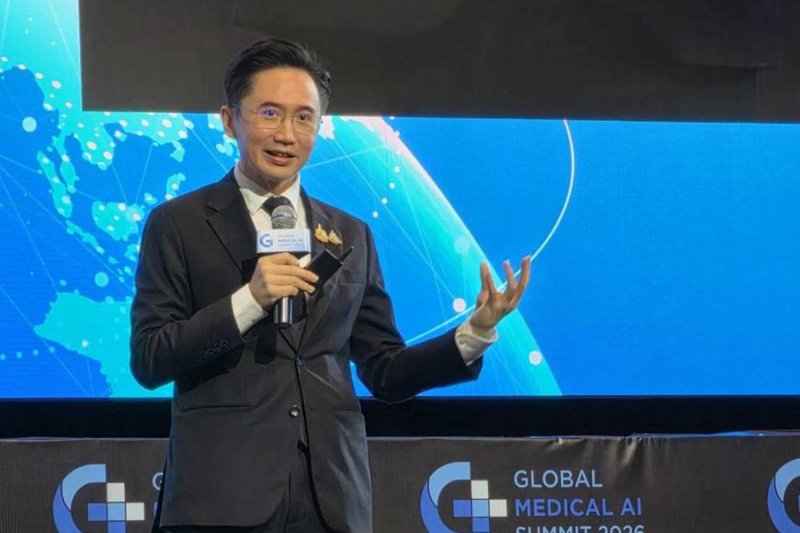
Thailand wants to become a regional artificial intelligence (AI) medical hub by developing AI models tailored to Southeast Asian populations and turning decades of clinical research into advances in precision medicine, drug discovery and cancer treatment.
The strategy seeks to combine the country's clinical expertise, diverse patient data and research archives with private investment to bring innovations to commercial usage, said Deputy Prime Minister Yodchanan Wongsawat at the Global Medical AI Summit 2026 yesterday, co-hosted by the AI Entrepreneur Association of Thailand (AIEAT) and the Technology and Innovation in Life Sciences National Agency.
Thailand's priorities span from building regional medical foundation models, AI-driven genomics, generative biology, autonomous discovery, longitudinal AI, human digital twins and precision oncology, he noted.
The regional medical foundation models rely on AI systems trained on extensive datasets to support multiple applications that address Southeast Asian populations.
Mr Yodchanan said existing models are insufficiently tailored to the region's demographics and clinical conditions.
"Thailand's multicultural patient base could help develop systems better suited to these populations," he said.
The proposed models will move beyond 2D imaging to 3D structures and 4D data capturing changes over time, enabling analysis of complex spatial and time-series clinical information, noted Mr Yodchanan.
AI-driven genomics can connect clinical and biological data to support personalised care. University hospitals' tissue-imaging archives, spanning 50 years, could provide a foundation for cancer research.
Linking these records with molecular biology and spatial transcriptomics, which maps gene activity within tissues, could deepen understanding of cancer and guide more targeted treatments, he said.
Generative biology and autonomous discovery would involve laboratories where AI systems connect to equipment, initiate experiments, analyse results and guide subsequent tests. Automating repeated experimental work can accelerate parts of drug discovery.
Longitudinal AI and human digital twins develop disease-specific twins for heart disease, diabetes, and kidney disease risk prediction.
Mr Yodchanan said medical AI should support preventive care and drug discovery using local natural ingredients, linking healthcare research with Thailand's agricultural resources.
Under a "one health" approach, human health information would be combined with environmental, animal and agricultural data to improve understanding of disease and prevention, he noted.
Thailand's demographic and behavioural diversity could strengthen its appeal to international researchers, alongside its position as a medical destination connecting India, southern China, Vietnam and southern Indonesia.
Mr Yodchanan also proposed adapting space and defence technologies to locally produce medical imaging equipment and vaccine machinery.
FROM RESEARCH TO MARKET
University hospitals account for 80-90% of Thailand's medical innovations, making them central to these ambitions, he noted.
A nationwide consortium of university holding companies was established to facilitate collaboration in related areas. Technology licensing offices would help startups and overseas partners access intellectual property and turn research into products.
Mr Yodchanan urged researchers to pursue original scientific contributions capable of competing in the international market. Government funding alone might be insufficient to scale pharmaceutical and medical AI ventures, requiring international venture capital and private investment.
"Supporting infrastructure would include high-performance data centres, reliable energy supplies and shared laboratories," he said.
Supachai Parchariyanon, managing partner of SeaX Ventures, said the company's non-profit Southeast Asia Health Tech Innovation Hub aims to accelerate clinical validation, hospital adoption and market expansion. The network spans 50 partner health systems and has reached 30 million patients, targeting 100 million by the end of 2028. The hub is working with Skribe Medical USA on AI-discovered cancer drugs, he said.
Chanwit Boonchuay, the AIEAT president, identified three opportunities for medical AI solutions: earlier disease detection, personalised care, and AI-driven drug discovery.
KioskNews shows a cleaned-up reading view extracted from the publisher’s page — the original always lives on their site, not ours.