The Weight of Angels by John Boyne review – what if Oscar Wilde had lived?
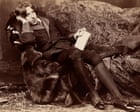
In 1895, four days after the opening of The Importance of Being Earnest, the Marquess of Queensberry left a card at Oscar Wilde’s club that publicly accused him of “posing as a somdomite”. Instead of instigating the libel case that led to his imprisonment and early death in a Paris hotel just five years later, what would have happened if Wilde had simply torn that card up? John Boyne’s new novel sets out to answer that intriguing question.
For starters, Boyne contrives a fate for Wilde’s beloved Lord Alfred Douglas which entertainingly redistributes the details of the real Wilde’s life before, during and after his time in Reading jail. This sets up the novel’s cat-and-mouse game with the history it is reimagining. Wilde himself, conveniently released from marriage by the early death of his wife, is then free to live not as a tortured, scandal-haunted genius, but as a randy, wisecracking, party-going queen. The upside of this is that Oscar gets to swap bons mots with a crowded cast list of celebrities; the downside is that he shows little sign of the troubled and radical mind that produced the real Wilde’s late journalism and fiction, never mind the subversive linguistic pyrotechnics of The Importance.
The storyline leaps elegantly across the years, and often drops the high-society comedy to show this alternative Wilde becoming embroiled in more than his fair share of melodrama. This allows for some highly effective tear-jerking, notably in the scene that re-imagines the departure of his beloved elder son for the Somme. Time jumps are delivered in the form of letters, newspaper articles and even scripts of hypothetical plays and films about Wilde; this genre-hopping keeps things lively, and allows Boyne some very effective shifts of tone, time and place.
The real Wilde wrote no more plays after The Importance of Being Earnest; Boyne’s version lives to write nine more, plus a Hollywood screenplay. Sadly, of these we get to read not a single quotation. Curiously, Boyne goes out of his way to make these plays sound dull; he has his fictional alternative turn into a staunch aesthetic conservative, concerned only with success. We see his writing’s rewards (endless money, a knighthood) but are never made privy to its process or motives. In fact, we never see him functioning as a writer at all.
With regard to Wilde’s queerness – the treatment of which Boyne clearly intends to be his novel’s main claim to seriousness – the narrative makes a point of having him collide with several of the most important early European theorists of what we now call gay liberation: George Cecil Ives, Magnus Hirschfeld, André Gide. However, it leaves Wilde untouched by their ideas, and keeps him well away from any experience of their respective gay subcultures in London, Berlin and Paris. Instead, Wilde stays in the closet and settles down in a Mayfair mansion with a conveniently doting schoolteacher. After a decade of monogamy, Oscar wrecks this happy home with the help of a hard-bodied student football player. As a direct outcome of this error, the deadly outcomes of gay shame and self-loathing invade the novel for the first time; Wilde promptly acquires a conscience, deciding that he really ought to use his status as a literary national treasure to do something to make the world a better place for homosexuals.
From then on – around 1930 – Boyne doesn’t so much show his imaginary Wilde interacting with queer history as magically abolishing it. At yet another party, Winston Churchill is enlisted to promote gay rights in parliament; characters become helpfully psychic, imagining 1970s-style gay liberation marches, gay marriage and even some very specific post-Stonewall arguments about the respective merits of radical and assimilationist theories of gay freedom. Boyne’s Wilde clearly sides with the latter. Speaking in a voice that sometimes sounds suspiciously like Boyne’s own, Wilde gives a speech that not only allows him to publicly champion feminism and Irish independence, but also to single-handedly persuade an audience of MPs to vote for the complete and overnight decriminalisation of homosexuality. Luckily, all of this emotive nonsense happens just in time for the coronation of 1952, meaning that both Prince Philip and Elizabeth II get to congratulate Wilde on his efforts during their after party. Unsurprisingly, Wilde dies of happiness, and goes straight to heaven.
Any historical fantasia worth its salt must play with its reader, continually asking them to assess whether the alternatives being imagined are credible or desirable. In this case, in a year that has seen attacks on queer and trans lives proliferate, Boyne’s decision to replace the real history of that community’s collective struggle with such a contrived and top-down miracle feels like a very odd fictional manoeuvre indeed. He has clearly done lots of research, but has chosen to put it at the service of creating a Wilde who is fatally less interesting and moving than the original. In this version of history, Ireland’s greatest lord of language is reduced to a sentimental, royalty-loving, champagne-quaffing showman. What a waste of a great idea.
KioskNews shows a cleaned-up reading view extracted from the publisher’s page — the original always lives on their site, not ours.