Have we been thinking about franchise QBs all wrong? CJ Carr, Darian Mensah and the Brock Purdy predicament
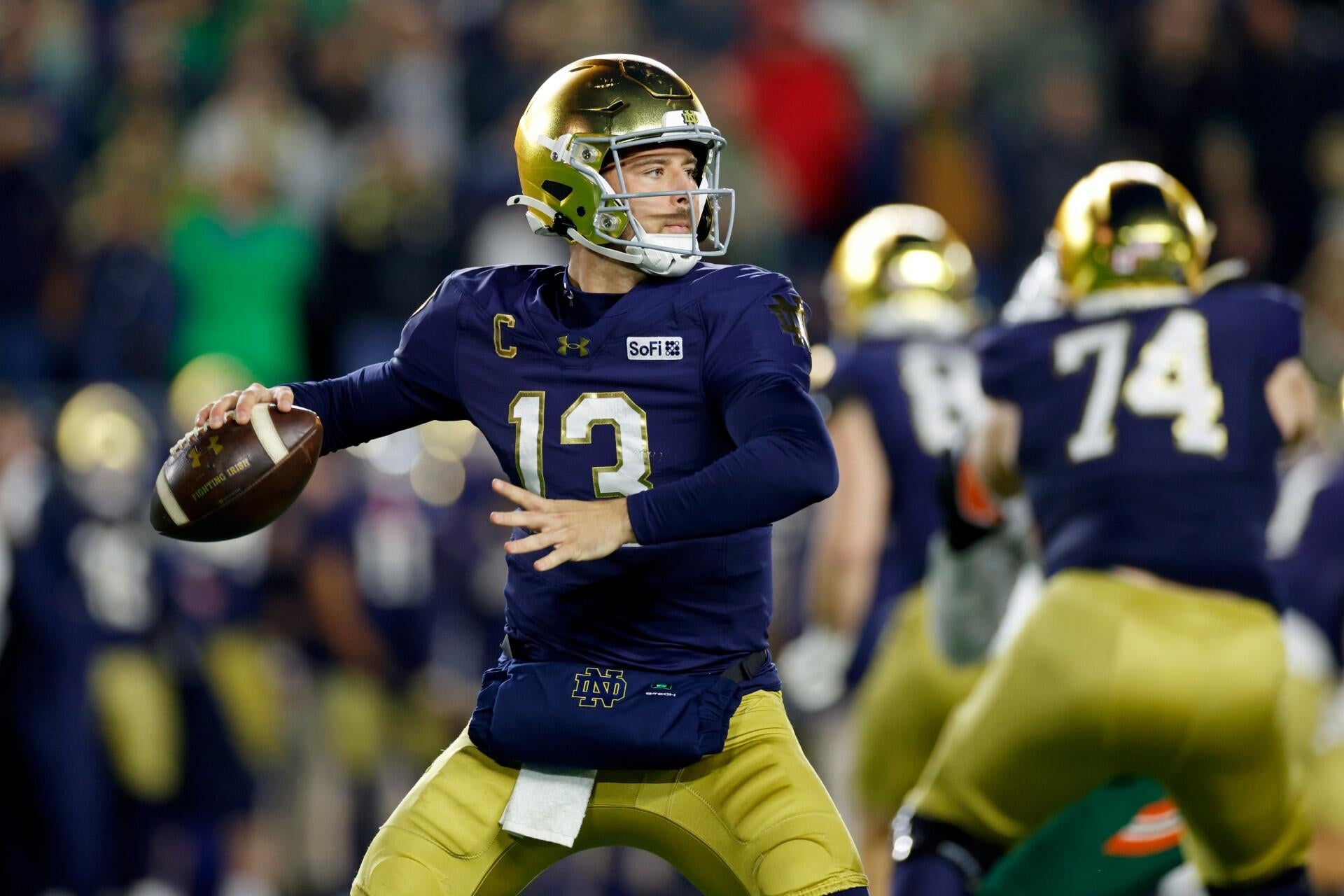
CJ Carr running Notre Dame's two-minute offense against Miami to end the first half is all you need to know about who he is.
It's as surgical a series of plays as you'll see this season; he's calm before the snap, unpanicked after, even when he's avoiding the rush, always has his eyes downfield, and throws with the accuracy and precision that will make you a first-rounder, even if you lack the "prototypical physical tools" NFL teams covet in their franchise QBs. When you look like you've been doing this for a decade, no one cares if you can throw the ball 80 yards or run a 4.3 forty.
That drive ended with an 18-yard laser to Micah Gilbert to give the Fighting Irish a 17-3 halftime lead. And while they didn't cruise to a blowout win – credit to Darian Mensah and the Canes for battling back – it did reinforce a question I've been thinking about as we work our way through another "can't-miss" quarterback class that has, once again, missed:
Have we been evaluating the position backward?
Every fall, NFL teams (and folks in the media too) fall in love with the big, athletic, strong-armed quarterbacks who, if you squint enough, start to look like Justin Herbert or Josh Allen. And there's a reason for that. When it all comes together, it can be special. When it doesn't … well, it can be the 2026 Los Angeles Chargers.
It's why we annually watch evaluators excuse bad decision-making, chronic inaccuracy and poor processing because a QB gets off the bus looking like Will Levis or Drew Allar or if we're talking the '27 class, names like Arch Manning and LaNorris Sellers. Meanwhile, Brock Purdy, Mr. Irrelevant in 2022, and Kirk Cousins, a fourth-rounder a decade earlier, lacked those eye-popping physical traits but proved they could play quarterback at a high level in the NFL.
I'd even throw Mac Jones into the group. He put up huge numbers at Alabama and made the Pro Bowl as a rookie in New England, but his career went sideways after the Patriots decided Matt Patricia and Joe Judge should lead the offense. Jones had a pit stop in Jacksonville before finding his way to Kyle Shanahan and San Francisco, and all he did was play so well in Purdy's absence early last season that there were questions about whether he should keep the job. The point, in part, is what a smart, accurate quarterback with average physical tools can accomplish when the system plays to his strengths.
To be clear, this is less about arm strength or athleticism than how much inconsistency evaluators are willing to put up with for the upside, no matter how unlikely that realized upside might be. Put another way: are we undervaluing quarterbacks who win with anticipation, accuracy, processing and average NFL arms?
Which brings us to CJ Carr and Darian Mensah. Both should come in 6-foot-2 or 6-foot-3, so we're not talking about Bryce Young or Kyler Murray. But neither has a Patrick Mahomes fastball in their locker, either. They see the field, throw on time and with anticipation, and consistently understand where the football needs to go. Saturday gave us two very different looks at those skills.
Carr was clinical from the start. He set protections, got the ball out quickly and accurately, and once he started feeling it, was damn-near unstoppable in the way Purdy can be when he's in his bag. Again, I'd refer you to Carr running that two-minute offense as all the evidence you need.
Mensah spent much of the first half running for his life before settling down in the third quarter and drawing the Hurricanes to within seven points after one of his bread-and-butter back-shoulder throws:
Notre Dame gave Miami's offensive line fits for much of the night, and on the Hurricanes' very next drive, Mensah threw just his second interception of the season.
It's undoubtedly a bad pick, but this is what NFL evaluators will note – and what shows up all over Mensah's tape: he's one of the best anticipation passers in the class. And sometimes, when you throw with anticipation on a speed out and miss inside, you're playing with fire. On this play, Mensah got burned.
It also didn't help that Malachi Toney, the best player on the planet not named Jeremiah Smith, was out with an ankle injury and exactly zero of the remaining Miami receiving options scared the Fighting Irish secondary.
But excuses, as they say, are for losers.
And don't get it confused: this wasn't Caleb Williams going into South Bend in 2023 and throwing three first-half interceptions, repeatedly making bad decisions under pressure as Notre Dame dismantled USC. Mensah was under siege often, and despite that pick, he kept competing, made big-time throws down the stretch and gave Miami a chance to tie the game in the closing minutes.
But he can't catch it for them:
He didn't win, and he wasn't perfect, but he bounced back from a slow start and an early second-half interception to give Miami a chance to tie it late, on the road against one of the best defenses he'll face all season. And he did it without abandoning the traits that made him my QB1 in the first place (and Malachi Toney).
It's worth remembering that neither Mensah nor Carr entered the season as sure-fire first-round picks. Back in August, I had both with second-round grades and a lot to prove. And while there was a lot to like, there were also some legitimate concerns.
During his 2025 season at Duke, Mensah appeared to have the bigger arm, but his footwork was all over the place, and his decision-making was at times spotty. Carr threw with anticipation, consistently knew where to go with the football and showed impressive touch on second-level throws. But he could also let pressure affect him, and an average arm raised questions about how his game would translate to the NFL.
The numbers told a different story. In August, we introduced FRED, a model that compares college quarterbacks with previous first-round picks based on their production and experience. Mensah scored a 39.4, putting him within striking distance of 50, a mark every eligible quarterback in our historical sample had reached before eventually becoming a first-round pick. Carr scored just 10.6, although he had considerably less starting experience. I liked Carr more than the model did, but Mensah's numbers suggested he might be closer to first-round territory than his 2025 tape suggested.
Fast-forward to present day, and Mensah is my QB1, Oklahoma State's Drew Mestemaker is QB1a, and Carr is QB3. Both Mensah and Carr have made impressive strides, and both have looked the part of future first-round picks.
Both had dominated stretches of the season, but neither had faced many opponents capable of truly testing them. The Miami-Notre Dame matchup offered a chance to change that.
For Mensah, the biggest improvement this season has been his consistency. Coming into Saturday's game, he had completed 77.4% of his passes, averaged 10.3 yards per attempt and thrown 25 touchdowns and just one interception (which is now two). But here's what really stands out: When he throws in rhythm, he's completing 83.1% of his passes and averaging 11.4 yards per attempt, both among the best marks in college football. It's a reflection of what shows up every week on tape: He sees the field, throws with anticipation and rarely passes up an easy completion to force something downfield.
Carr has made significant strides too, in part because he has addressed one of my biggest preseason concerns. A year ago, he took sacks on nearly 21% of the plays in which he was pressured. This season, that number is now 6.7%, and he's been sacked just twice. His completion percentage under pressure has also improved from 26.1% to 51.9%. Notre Dame's outstanding offensive line deserves some credit, certainly, but Carr looks like a different quarterback when things break down; he's more decisive, better identifies pressure and seldom looks rattled.
The ability to avoid costly mistakes separates both quarterbacks from some of their peers. Mestemaker has put the ball in harm's way seven times in 54 opportunities under pressure, compared with one apiece for Mensah and Carr. Neither has been immune to bad decisions, but both have generally understood when to test a defense and when to take what it's giving them. And as we've seen with many highly drafted quarterbacks, that matters.
How top 2027 quarterback prospects handled pressure entering Week 10
Quarterback | Times pressured | Yards per attempt | Turnover-worthy plays |
Darian Mensah | 44 | 9.0 | 1 (2.3%) |
CJ Carr | 30 | 4.9 | 1 (3.3%) |
Drew Mestemaker | 54 | 4.5 | 7 (13.0%) |
Arch Manning | 74 | 10.8 | 4 (5.4%) |
Julian Sayin | 40 | 8.3 | 3 (7.5%) |
Source: PFF, through Week 9
There's also this idea that Carr's average arm means he's Captain Checkdown. Fun fact: Nearly a quarter of his passes this season have traveled at least 20 yards, almost twice Mensah's rate. Heading into Week 10, Carr had eight touchdowns on those attempts and only one turnover-worthy play. Mensah was far more accurate on deep throws, completing 58.1% compared with Carr's 37%, but Carr had 23 more attempts. He wins with timing and touch, even if his accuracy can suffer when he's late on an intermediate route or forced off his spot.
There's also some context to Mensah's remarkable efficiency. A quarter of his attempts have come behind the line of scrimmage, generating 553 yards, compared with just 12.6% of Carr's throws. Miami does a terrific job creating easy completions, and Mensah takes advantage of them. But he's also shown he can make the difficult throws, and his ability to generate offense without regularly risking turnovers puts him in rarefied company, even when compared to previous first-rounders.
None of this means the next Brock Purdy should be auto-drafted ahead of the next Josh Allen. Allen is proof that betting on rare talent can pay off (even if those bets rarely work out, the allure is often too irresistible), and Bryce Young shows NFL teams will invest the No. 1 pick in a quarterback with more modest physical tools if the college tape is exceptional. And Carr and Mensah are making strong cases that they belong in that category.
Processing and anticipation don't replace physical talent. They are talents themselves, and Carr's and Mensah's performances were a reminder of how much they matter.
The question for NFL teams isn't whether either can make NFL throws. They've done that repeatedly. It's whether we've been too quick to forgive the quarterbacks who look the part, and too slow to appreciate the ones who consistently play the part.
KioskNews shows a cleaned-up reading view extracted from the publisher’s page — the original always lives on their site, not ours.