Seoul to expand anti-piracy naval unit’s area of operation closer to Hormuz
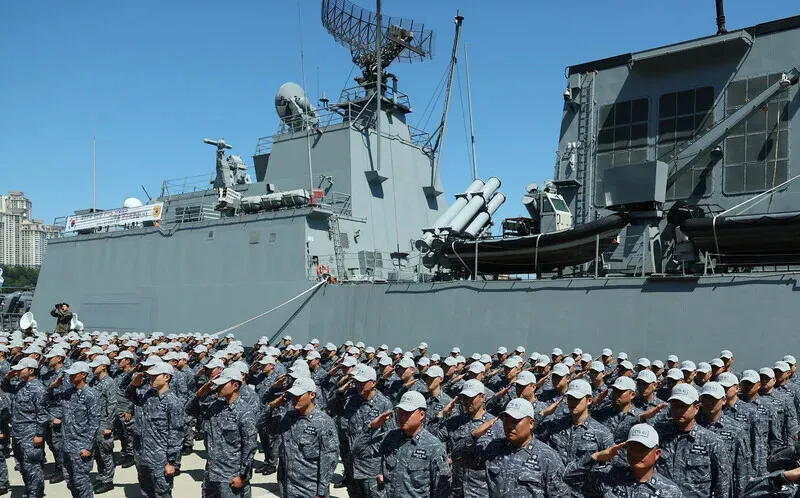
Members of the Cheonghae Unit’s 48th contingent attend a send-off ceremony before the ROKS Wang Geon departs Busan Naval Base in May 2026. (Yonhap)
South Korea will extend the operating area of the Cheonghae Unit, the naval contingent that protects merchant ships from pirates in the Gulf of Aden off Somalia, to waters south of Oman near the Strait of Hormuz, and will send a maritime patrol aircraft and mine-clearing assets to join it.
The explosive ordnance disposal team and unmanned minesweeping equipment are being sent with an eye toward possible Korean participation in an international effort to clear mines from the Strait of Hormuz, which could begin once the war between the US and Iran ends.
Seoul’s Ministry of National Defense said Thursday that it plans to submit to the National Assembly a revised motion extending the unit’s deployment, which would widen its mission area and add new assets. The motion cleared a vice-ministerial meeting the same day. After passing a Cabinet meeting next week and receiving presidential approval, it will be sent to the National Assembly for consent.
The Cheonghae Unit has been deployed to the Gulf of Aden since 2009 to escort ships. It currently consists of up to 320 personnel and a 4,400-ton destroyer (DDH-II) carrying one maritime operations helicopter and up to three high-speed boats.
The core of the revised motion is a change to the unit’s area of deployment. The current mandate covers “waters in and around the Gulf of Aden and waters designated during activities to protect South Korean nationals in an emergency.” The new motion extends that to “the open sea south of Oman.”
The mission area will reach the southern end of Oman’s Port of Duqm, which lies 350 nautical miles (about 650 kilometers) from the Strait of Hormuz in a straight line. The Gulf of Oman, which directly adjoins the strait, will not be part of the expanded area.
As a result, the unit’s operating range is expected to roughly double from the current 600 nautical miles (about 1,100 kilometers).
The ministry will also send a P-8A Poseidon maritime patrol aircraft, along with unmanned minesweeping assets, including unmanned underwater vehicles, unmanned surface vessels and remotely operated vehicles, and an explosive ordnance disposal team to operate them. The unit’s personnel will grow by 75 to a total of 395.
The ministry said the main reason for expanding the unit’s mission and assets was a gap in international naval presence caused by clashes in the Red Sea between Saudi Arabia and Yemen’s Iran-backed Houthi rebels, and a resulting rise in piracy.
“Pirate activity in the Gulf of Aden has more than tripled from last year,” a ministry official said. “Pirates are taking advantage of naval forces being concentrated in the Red Sea and Hormuz areas, and their activity is increasing and spreading to the area south of Oman.”
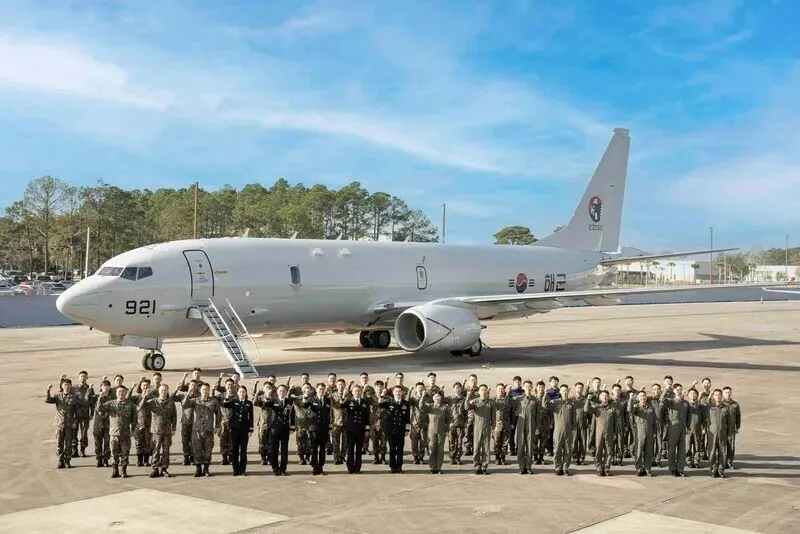
Then-Chief of Naval Operations Adm. Yang Yong-mo poses for a photo with South Korean Navy personnel training to take delivery of and operate the P-8A maritime patrol aircraft, in front of a South Korean Navy P-8A at Naval Air Station Jacksonville in the US on Feb. 2, 2024. (courtesy of the Republic of Korea Navy)
Asked about criticism that the move amounts to a backdoor deployment to the Strait of Hormuz, the official stressed that the unit would adhere to four principles: it will never engage or intervene in the war; its purpose is to protect South Korean nationals and vessels; the patrol aircraft will not conduct surveillance of Iranian territory or territorial waters or the inner part of the Strait of Hormuz; and the unit will operate under Korea’s own independent chain of command.
“The explosive ordnance disposal team is meant to be dispatched when there is a permissive environment and a request from the international community, but we have very little accumulated knowledge or hands-on experience with the unmanned minesweeping assets we currently have,” a ministry official said. “We assessed that they need to be deployed, if only as advance preparation.”
The official explained that a “permissive environment” would mean “conditions in which a freedom of navigation operation could begin in the region, either because the war between Iran and the US has ended or because Iran and the US have signed a memorandum of understanding.”
“When the time comes [to take part in freedom of navigation operations], we will submit a new motion for deployment,” the official added.
KioskNews shows a cleaned-up reading view extracted from the publisher’s page — the original always lives on their site, not ours.